Jaclyn Mednicov
Working from her Chicago studio, Jaclyn Mednicov is an American multi-disciplinary artist whose practice moves across painting, printmaking, sculpture and installation, guided by a sustained interest in materiality, memory and the fleeting beauty of the natural world. She has a BFA from the University of Kansas, an MA in Studio Arts from Eastern Illinois University, and an MFA in Painting and Drawing from the School of the Art Institute of Chicago. Time spent at the Vermont Studio Center, Ragdale Foundation, SEA Foundation, the European Ceramic Work Center and the Awagami Factory in Japan has all fed into her approach which is reflective and deeply responsive to place. In Imprints, Fragments, Reliefs, now on view at The Wolf Collective in London, those concerns come together in a solo exhibition that considers impermanence, preservation and the emotional weight of paying close attention.
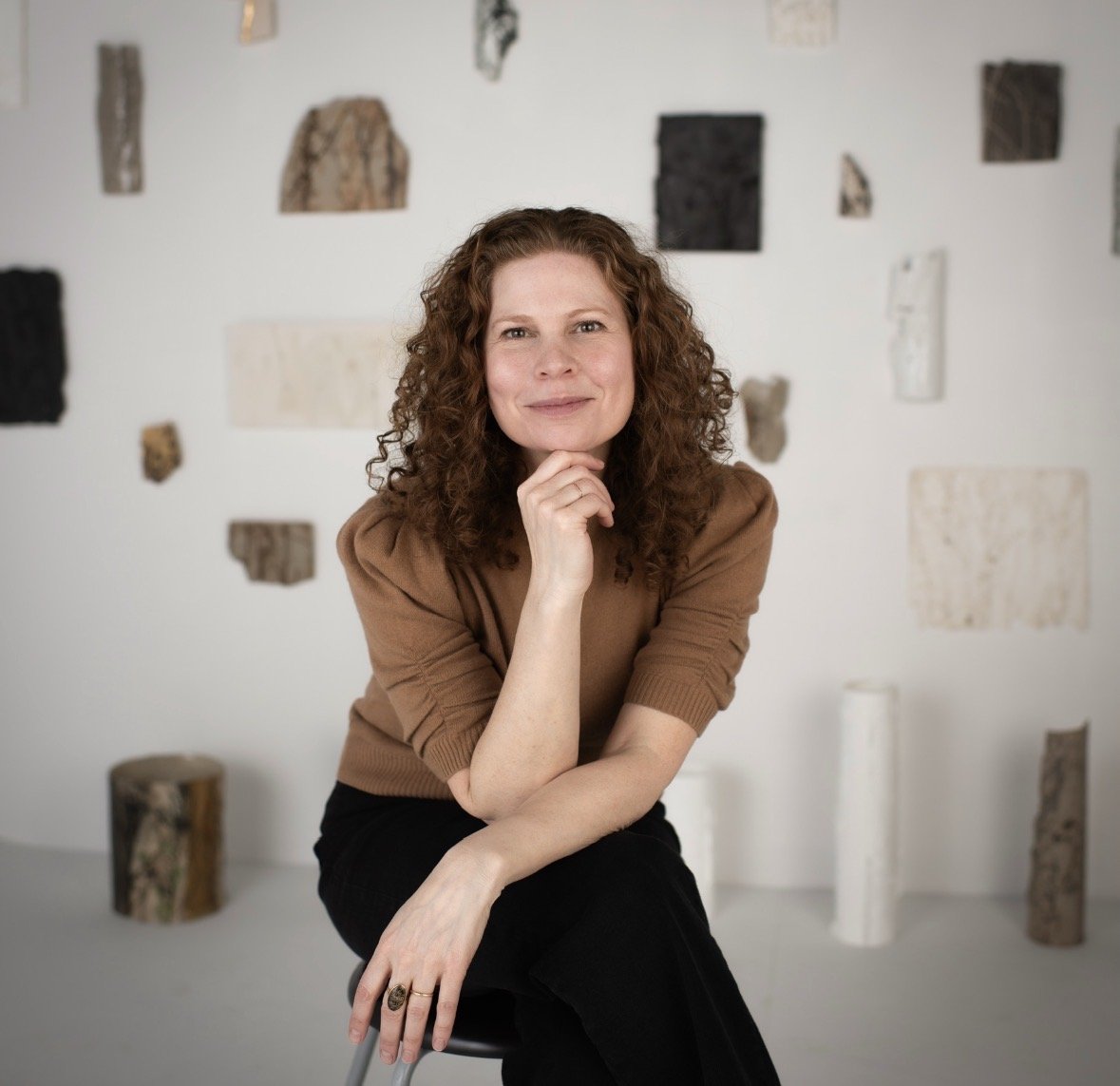
Portrait of Jaclyn Mednicov. Courtesy of the Artist and The Wolf Collective.
Imprints, Fragments, Reliefs is The Wolf Collective’s fourth exhibition, bringing together a body of recent work spanning ceramics, relief paintings, works on paper and collaborative textile pieces. Installed within the platform’s intimate home-gallery space in London, the exhibition feels especially sympathetic to Mednicov’s work, which is less about spectacle than about atmosphere. Rather than confronting viewers, the works draw them in gradually through delicate surfaces, botanical traces and subtle shifts in light and texture.
Much of the work stems from Mednicov’s time in Japan, particularly from her stay in Saga Prefecture, where she lived in a rural town for ten months in 2024–25 while her partner, Brian Anderson, carried out research on a Fulbright Award. It is a period which appears to have been deeply formative. Without a studio or a set plan at first, she describes spending ‘hours walking and observing’, particularly noticing how different the plant life was from home, and reflects that she found herself thinking about ‘memory and how to hold onto a specific place and moment in time’. That impulse runs through the entire exhibition: a desire not to freeze experience completely, but to hold onto its trace.
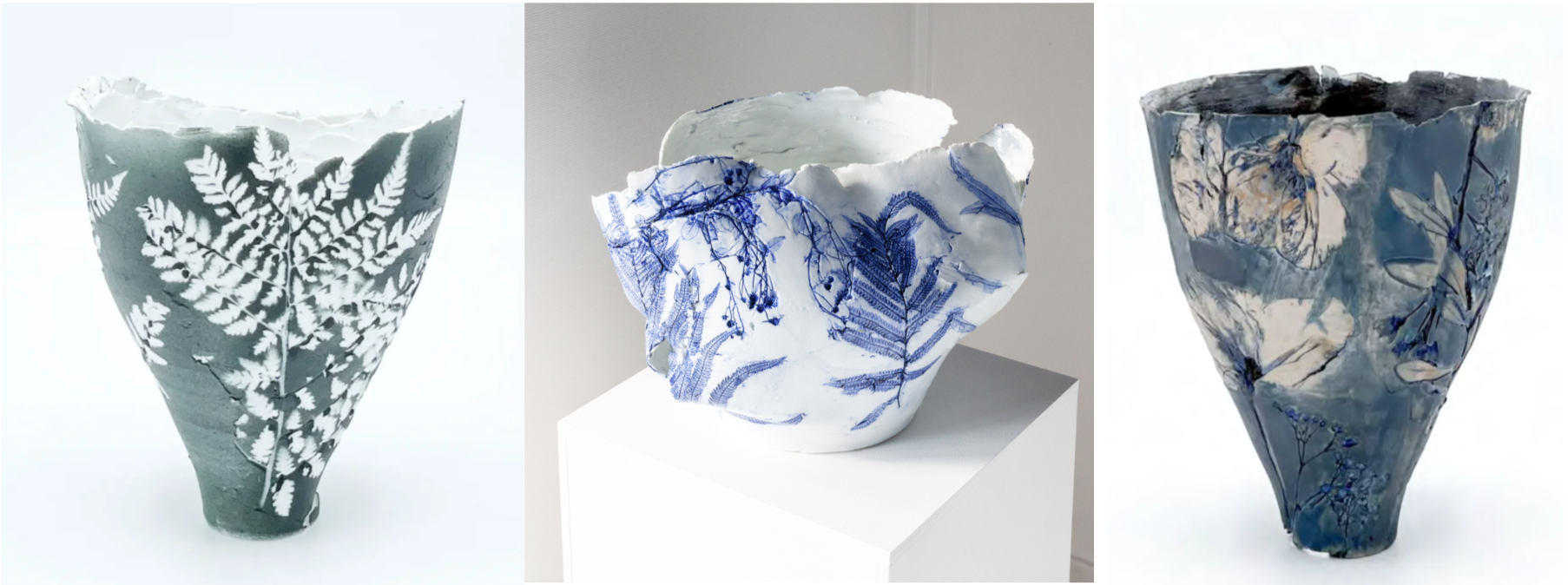
Jaclyn Mednicov, Fern Vessels, 2023, Courtesy of the Artist and The Wolf Collective.
Her ceramic works are among the strongest expressions of this idea. Developed during her time in Saga, which is widely regarded as the birthplace of porcelain in Japan, they preserve impressions of the landscape through repurposed plaster moulds and locally gathered plants pressed directly into porcelain. These vessels and fragments feel delicate yet grounded, as though they carry the memory of touch within their surfaces. There is something almost archaeological about them, but they resist feeling fixed or historical; instead, they remain intimate and immediate, like small acts of preservation. The works suggest a desire to keep hold of transient beauty while accepting its fragility.
That fragility is especially present in Wildflowers (winter light), a work Mednicov repeatedly returns to. Rather than naming it as a definitive favourite, she speaks about it in terms that reflect the shifting emotional register of the whole exhibition, noting that her relationship to the work changes with ‘the light, the time of day, and [her] mood’. Yet she keeps returning to it because ‘there’s a fragility to it, and the way it feels preserved within the frame resonates with the uncertainty and vulnerability of life.’ This captures something essential about the show: these works do not simply celebrate nature’s beauty, but also reflect on how vulnerable all acts of preservation are, and how even the most delicate impressions can carry profound emotional weight.
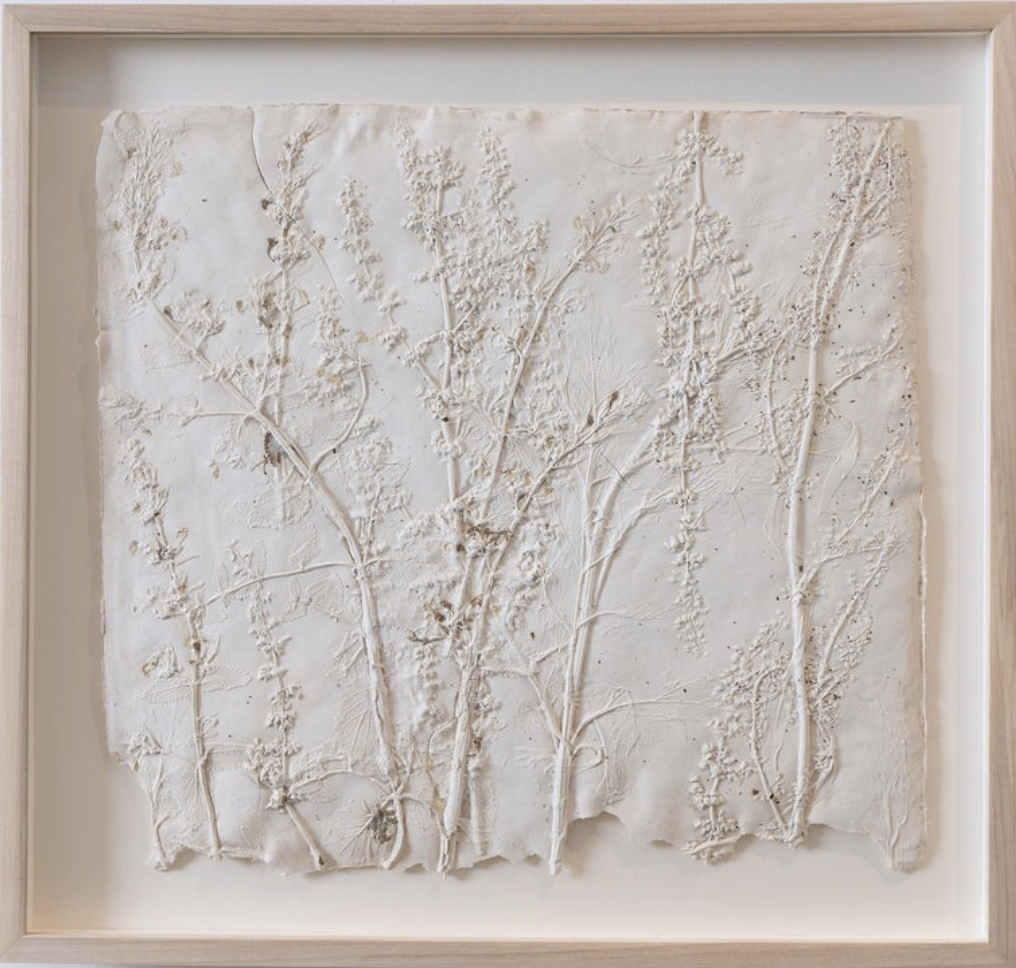
Jaclyn Mednicov, Wildflowers (winter light). Courtesy of the Artist and The Wolf Collective.
Although ceramics form an important thread, Imprints, Fragments, Reliefs is very much a cross-disciplinary exhibition. Relief paintings, prints, objects and textile collaborations sit together in a way that feels coherent rather than divided, each medium extending the concerns of the others. This is one of the show’s strengths. Mednicov’s different practices are not separated into neat categories; instead, they operate as interconnected ways of recording and responding to the world. She reflects that it has been especially meaningful to see all of the work together in one space, noting that Lupe Sanchez’s curatorial vision created an atmosphere in which the works ‘respond to one another’. She adds that each medium supports the others, and that the range of surfaces and textures reflects her broader interests while encouraging a fuller experience of the work.
That curatorial vision comes from Lupe Sanchez, founder of The Wolf Collective, whose domestic exhibition model gives the show much of its intimacy. Presented in a home setting rather than a conventional gallery, the works feel less like isolated statements and more like presences within a lived environment. This context seems especially well suited to Mednicov’s practice, which often sits, as she puts it, ‘at the edge of beauty’. She notes that the setting did not necessarily change how she approached displaying the work, since she trusted Iain and Lupe to lead the installation in a space so familiar to them, but she also says it has been especially gratifying to see the work in a home that feels ‘warm and inviting’. That warmth softens the encounter and allows the quieter emotional frequencies of the work to emerge more fully.
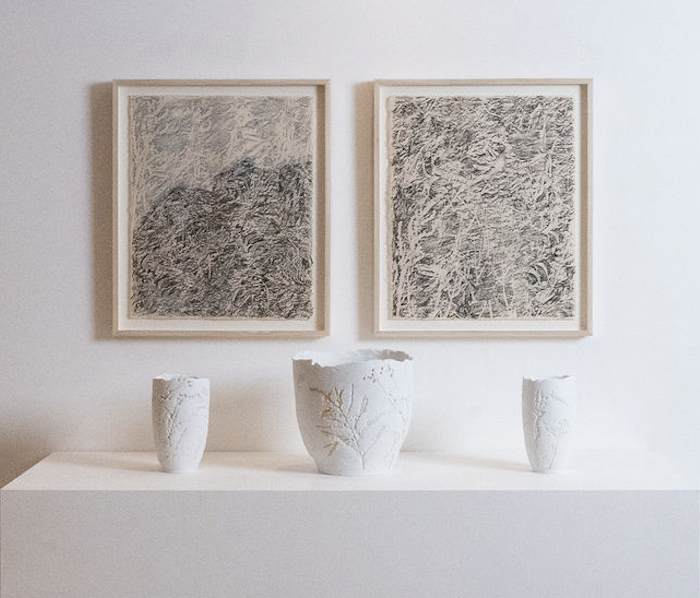
Installation view of Imprints, Fragments, Reliefs at The Wolf Collective, London. Courtesy of The Wolf Collective.
Sanchez describes Mednicov’s exhibition as taking the viewer ‘on a journey across time and continents’, a phrase that feels especially apt given the way the works move between Chicago, rural Japan and London while remaining rooted in questions of memory and impermanence. She writes that time is explored through ‘seasonality and shifting light’, so that one moment the viewer finds themselves in ‘the quietude and stillness of winter light’, while only a few steps later they encounter ‘glistening leaves, radiant with spring’s morning dew’. Her description captures the exhibition’s subtle movement between stillness and renewal, between preservation and change. The works never feel static; they seem to breathe through changes of season, mood and light.
This sensitivity to atmosphere is one of the exhibition’s most compelling qualities. Mednicov’s work feels hushed but never empty, delicate but never passive. It creates space for contemplation without prescribing a single emotional response. She says it is very important’to her that the work creates that space, and that ‘in a world where life moves so quickly’, she hopes to invite the viewer to slow down and reflect.
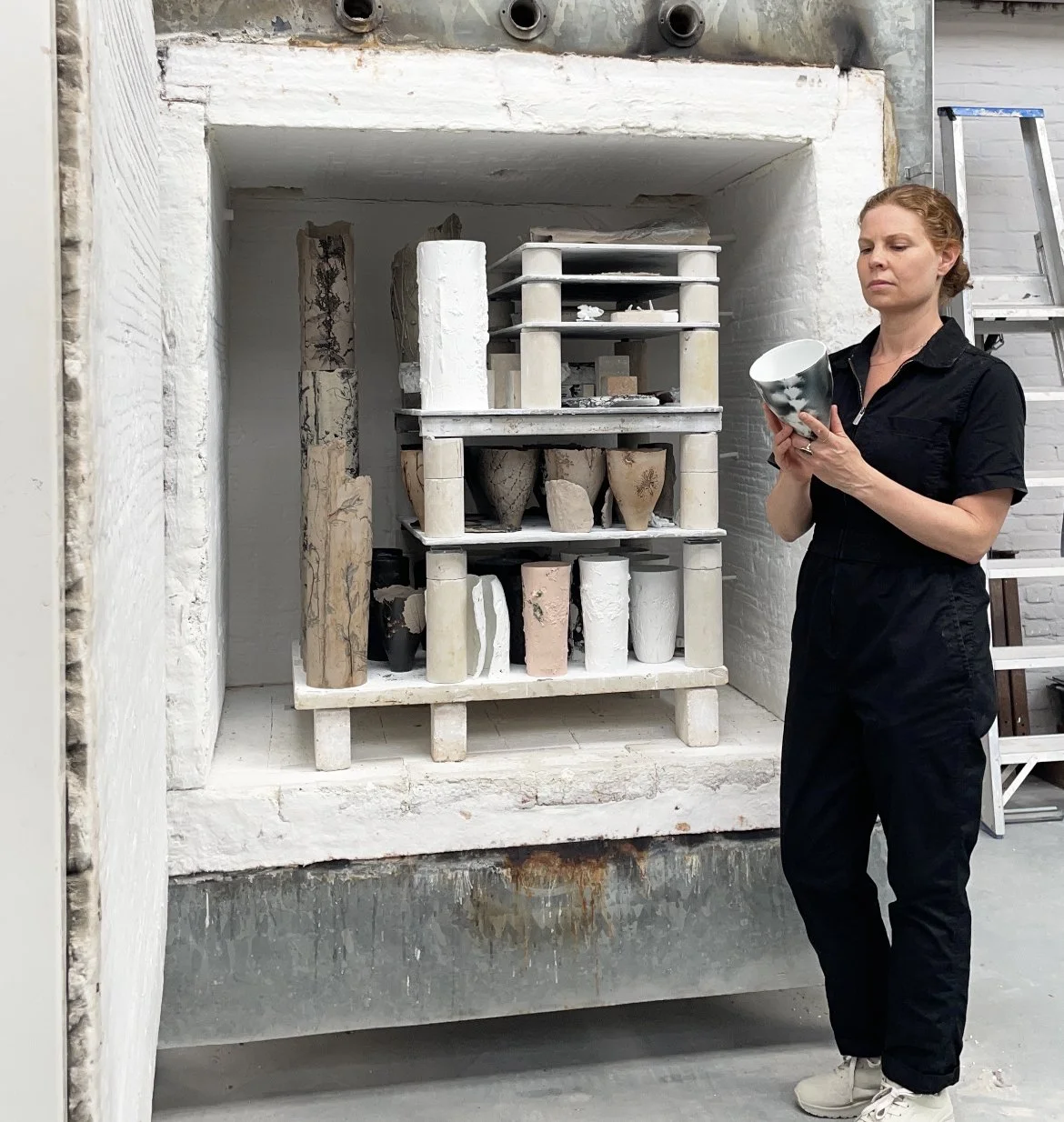
Portrait of Jaclyn Mednicov, Courtesy of the Artist and The Wolf Collective.
The exhibition also expands beyond Mednicov’s solo practice through collaborations that emerged from her time in Japan. During her stay, she was invited as a visiting artist to the Awagami Factory in Tokushima, where she worked alongside traditional washi artisans. That encounter with Japanese craft traditions clearly deepened her sensitivity to process and material translation. Also on view are two collaborative works with Harigane, a Kyoto-based textile artisan represented by CIPANGO. Mednicov created monoprints using plants from Harigane’s dye garden, which were then transformed into two distinct pieces: one woven with metal and suspended from the ceiling, and another realised as a wall tapestry in hand indigo-dyed and hand-tufted Kibiso silk. These works extend the exhibition’s broader meditation on trace and transformation, showing how a botanical impression can move between materials while retaining its intimacy.
A bespoke patterned wallcovering designed by Mednicov for the dining room wall further blurs the line between exhibition and domestic environment. This gesture feels entirely in keeping with The Wolf Collective’s ethos, but it also underlines how naturally Mednicov’s work inhabits a lived space. Her interest in the natural world is never detached or monumental. It remains personal, tactile and rooted in the poetics of everyday looking.
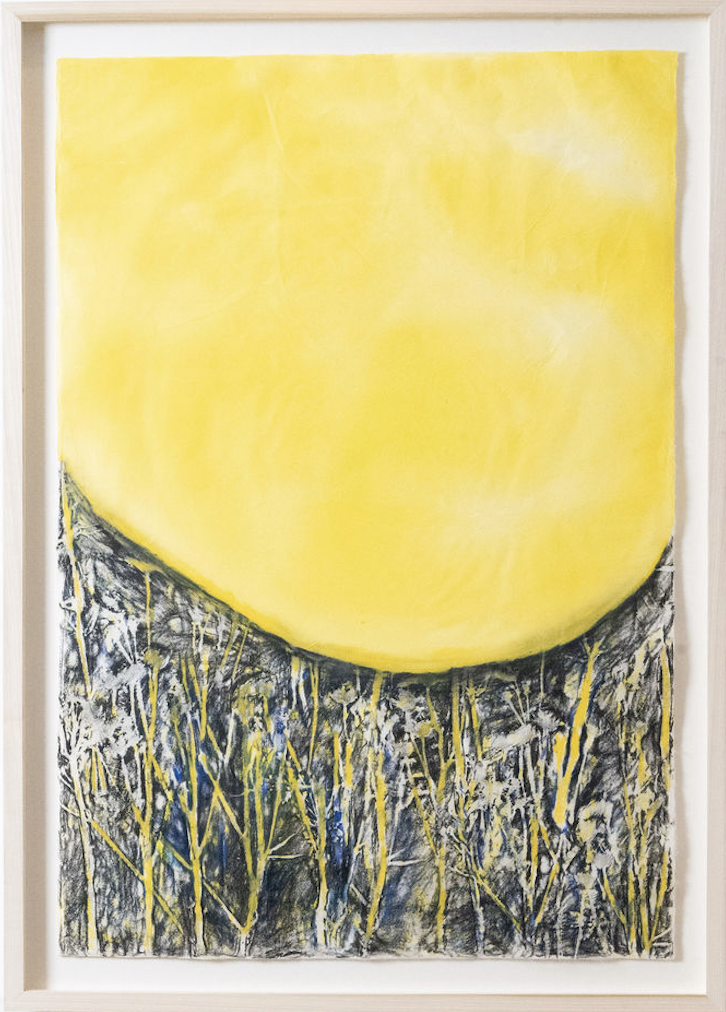
Jaclyn Mednicov, Yellow Light, 2023. Courtesy of the Artist and The Wolf Collective.
What lingers most after moving through Imprints, Fragments, Reliefs is its insistence on attention. In an age of speed, distraction and visual overload, Mednicov offers something quieter and more exacting: an invitation to notice. To see how a leaf pressed into porcelain can become a form of memory. To feel how a soft shift of light across a relief painting can hold an emotional charge. To understand beauty not as surface polish, but as something inseparable from vulnerability and loss.
When considering what she hopes visitors take away from the exhibition, Mednicov invites visitors: ‘To look. To feel. To contemplate.’
Find out more about Jaclyn on her website. Visit Imprints, Fragments, Reliefs at The Wolf Collective in Primrose Hill, London, till August 31st.
Amelia Holdsworth
Reviews Co-Editor, MADE IN BED