Nadia da Silva
Nadia da Silva is a Portuguese-born artist raised in Canada whose practice explores shifting terrains of identity, culture, and faith, approaching them as unstable forces that continually reshape the self. They investigate what it means to inhabit the feminine body within structures that seek to define it. For Nadia, the body is both an intimate archive and a contested site. Their work embraces beauty, tension, and otherness; they explore conflict, displacement, and memory. Throughout the work, Nadia seeks not to offer solutions but rather to create a suspended field of tension within a world just beyond reach.
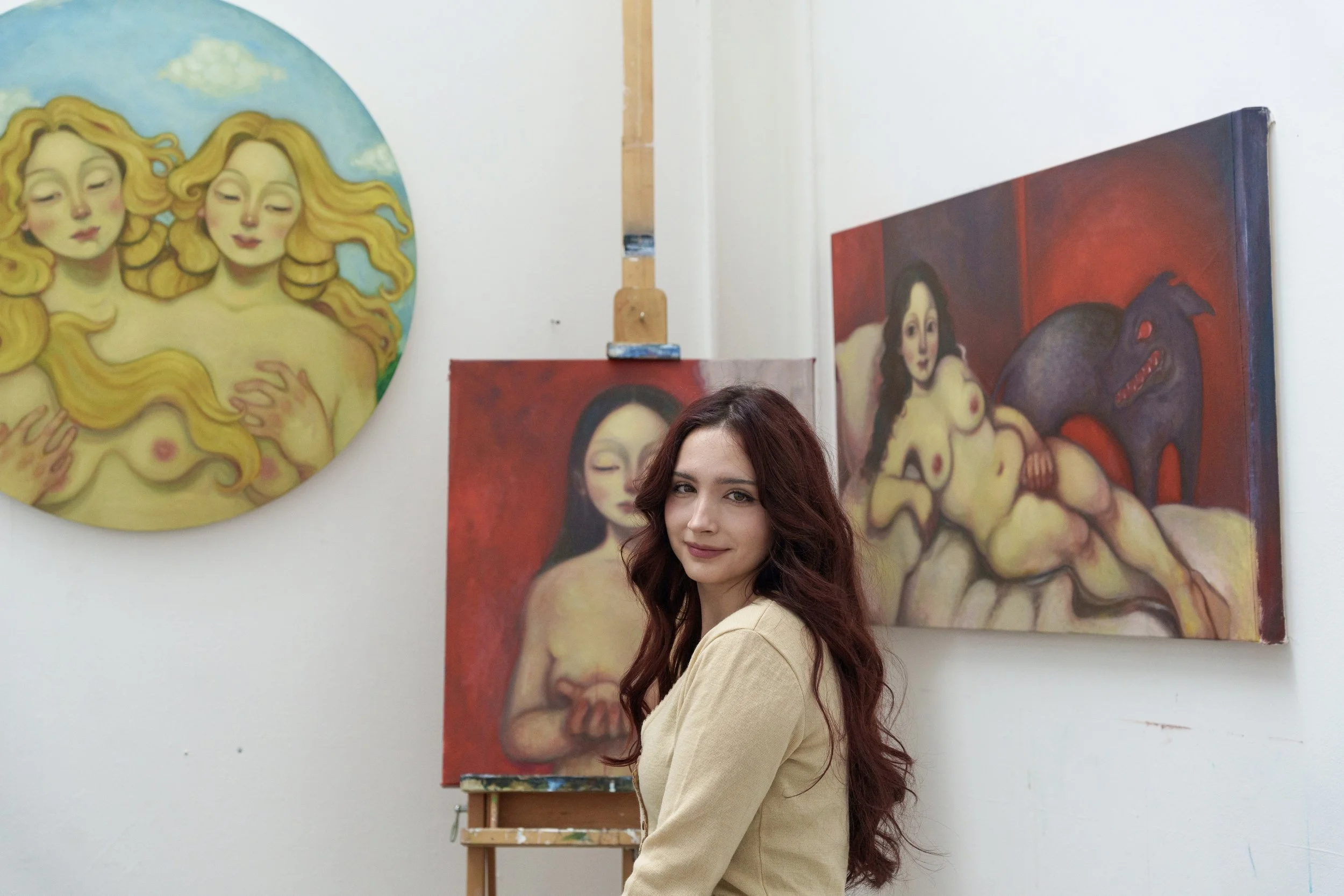
Portrait of Nadia in their studio. Courtesy of the Artist.
Nadia’s early relationship with drawing emerged as a way of navigating language barriers while growing up in Canada. They found themselves sitting at the back of classrooms, drawing dolls and caricatured figures, exploring the feminine body at a distance, and building a private vocabulary of form. The doll-like figures, for Nadia, were never passive, but rather a site through which they could begin to understand their own becoming. It was here that Nadia’s now-distinct visual language began to take shape. In their hands, the body becomes something mutable, stretched between reverence and rupture. During the process, this instability is mirrored.
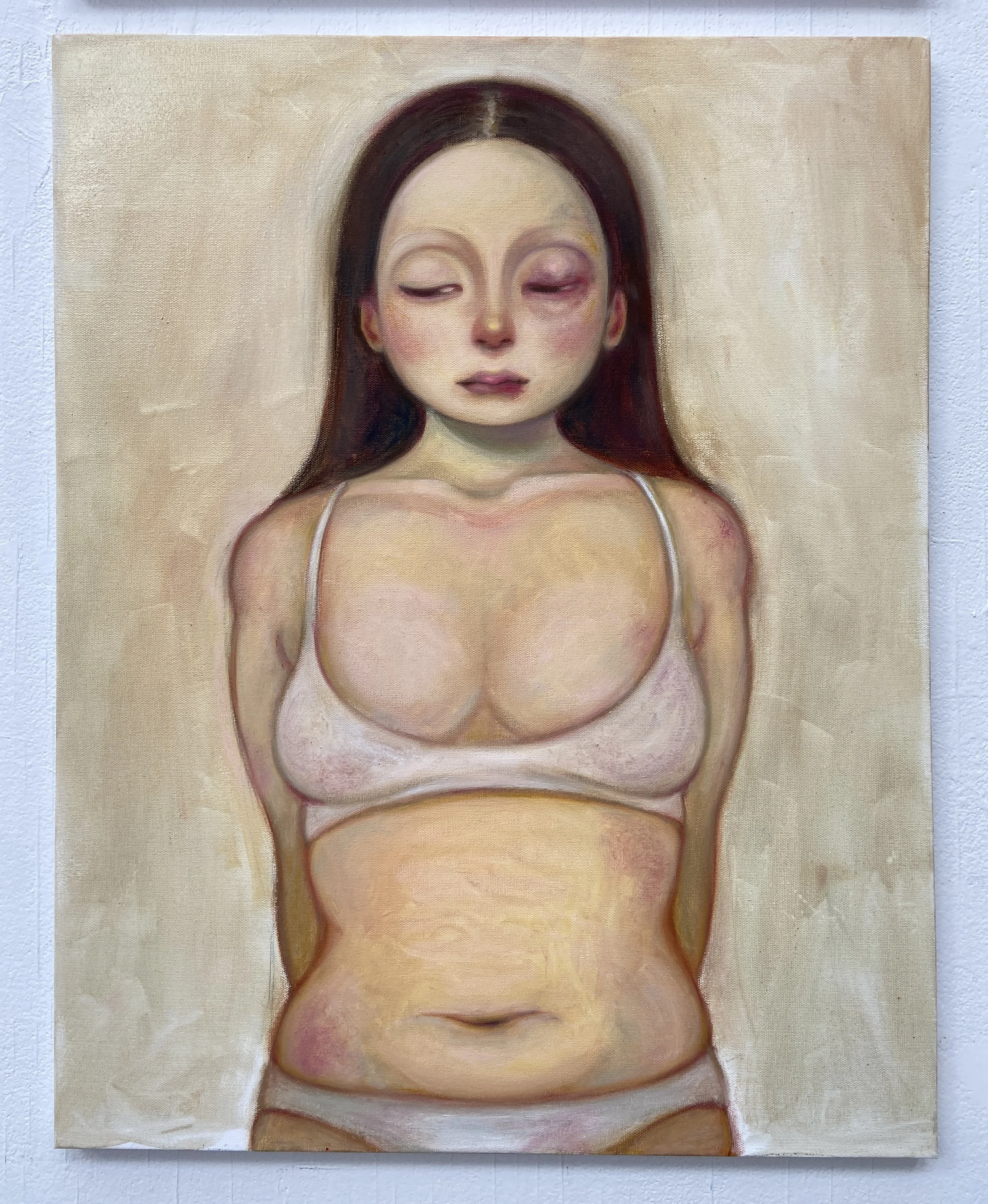
Nadia da Silva, Mother I Suffer,(2024), Oil paint, charcoal, oil pastel, and ink on canvas, 61 x 50.8 cm. Courtesy of the Artist.
After recently moving to London to pursue a master’s degree at the Royal College of Art, Nadia’s process has taken on a more physical and, at times, destructive dimension. They work with found frames and surfaces that they deliberately disrupt by cutting, reassembling, and layering into what they describe as ‘Frankenstein’ compositions. These gestures are not acts of carelessness, but of intention: a way of embedding imperfection, even failure, into the work itself. In pieces like Decay or In Death’s Bed, the violence done to the surface becomes inseparable from the image, producing works rooted in a willingness to relinquish control; time and impermanence are central. Inspired by Renaissance painting and artists like Fra Angelico, Nadia considers how artworks endure, fragment, or deteriorate. They anticipate these trajectories, selecting unstable materials and incorporating gestures of fragmentation. Decay is embedded from the start.
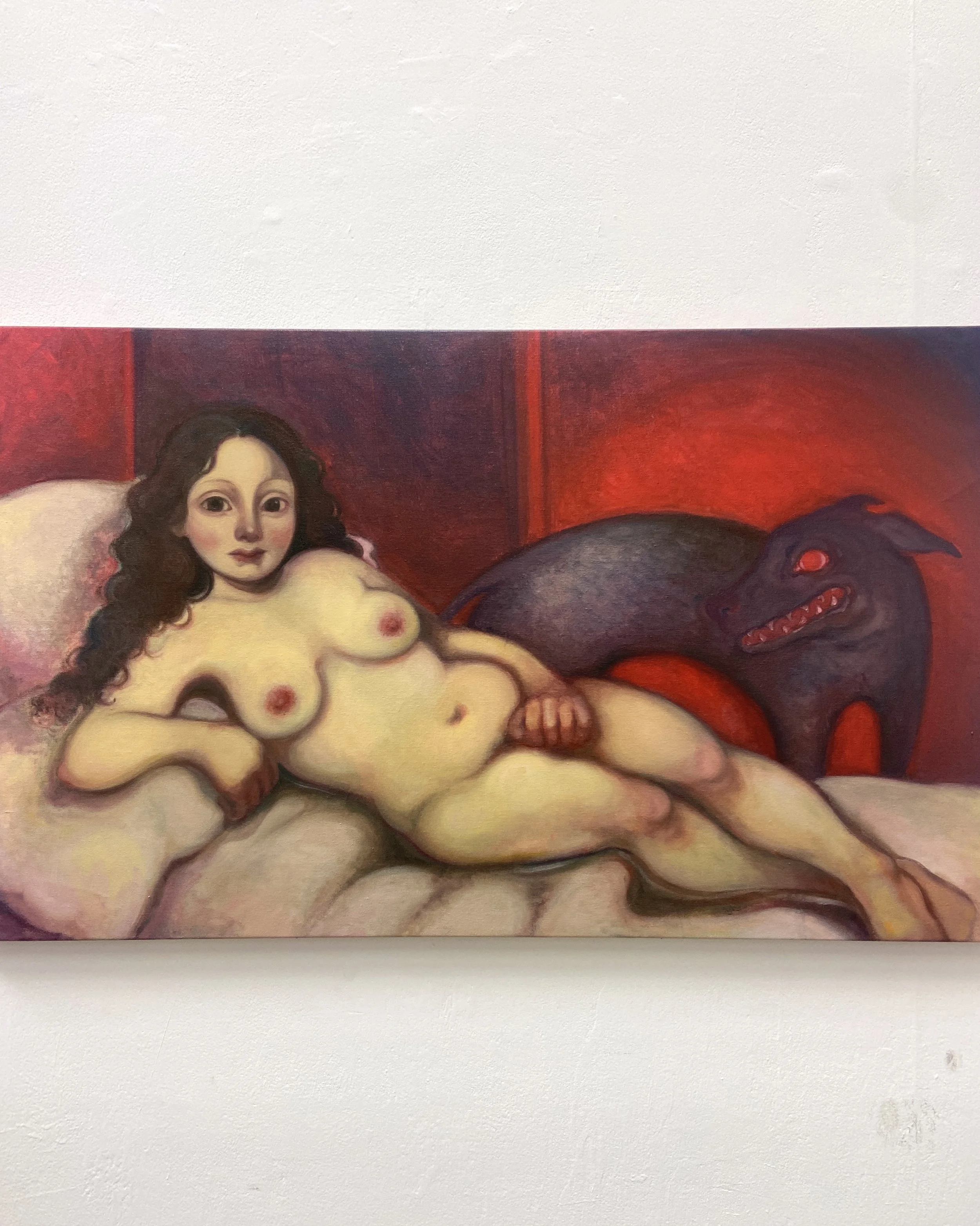
Nadia da Silva, In Death’s Bed,(2025), Oil and charcoal on overlapping canvas, 70 × 122 cm. Courtesy of the Artist.
Nadia’s engagement with the body is shaped by a Catholic upbringing. Recurrent references to the Virgin Mary and Mary Magdalene explore extremes of purity and transgression. Bodies are contorted, opened, and rendered with surgical precision. ‘When I’m painting the body, I envision myself almost like a butcher, contorting the flesh and positioning it in a way that aligns with my own gratification.’ Painting becomes an act of intervention, reclaiming the gaze historically imposed upon women. Repetition allows continual exploration of identity, culture, and faith—themes that remain fluid and in flux.
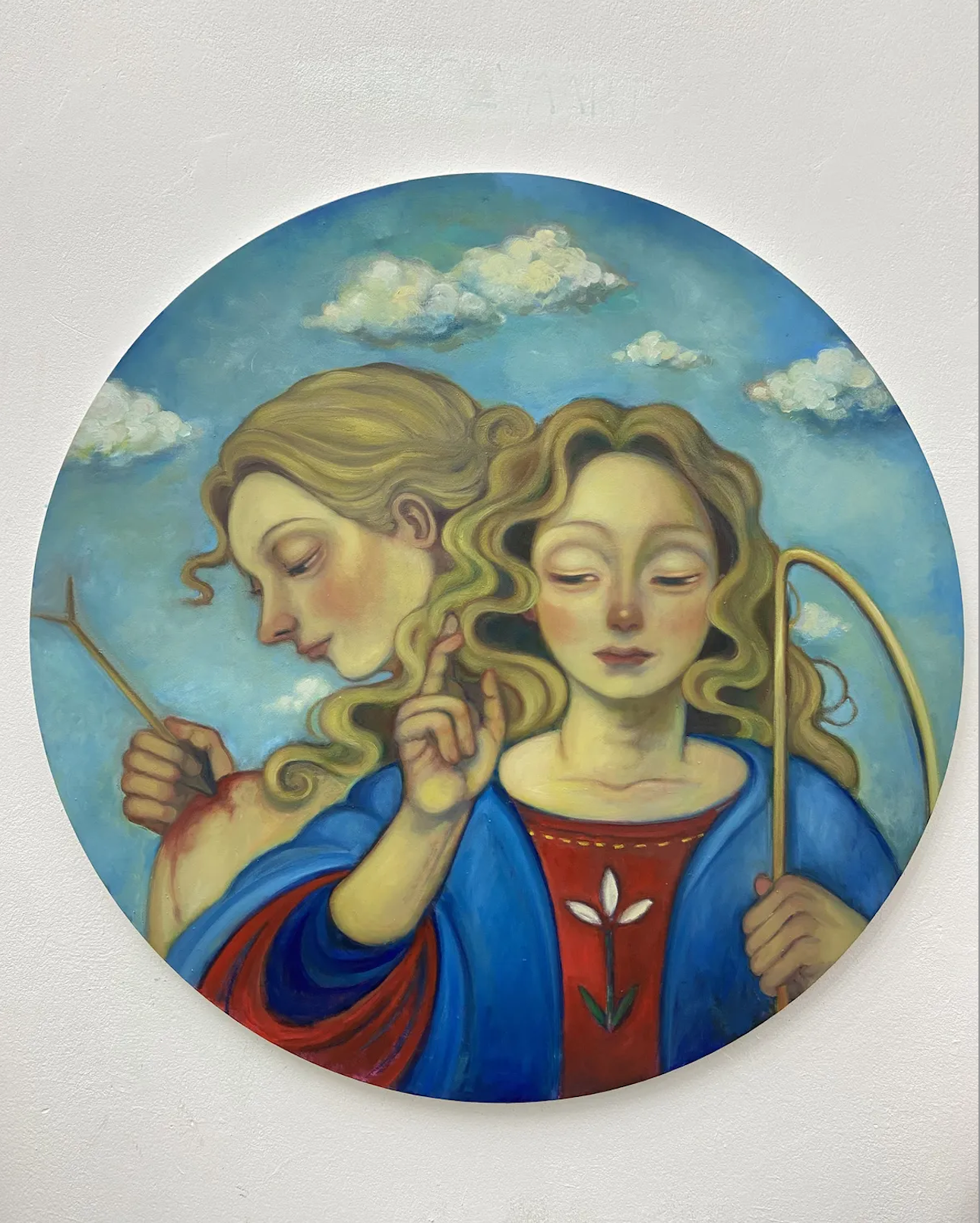
Nadia da Silva, Purity,(2026), Oil on canvas, 90 cm. Courtesy of the Artist.
Nadia is often compared to Sandro Botticelli and Yoshitomo Nara, affinities they openly acknowledge. From Botticelli, Nadia draws a sense of compositional gravity and reverence rooted in Renaissance painting. At the same time, from Nara, they admire a certain lightheartedness and emotional immediacy that they seek to carry into the work. These comparisons, though often unintentionally tied to male figures, sharpen Nadia’s commitment to articulating a distinctly female experience, reworking visual languages through their own perspective and intentions, while holding them in deliberate tension between gravity, immediacy, and a sense of whimsical expansiveness.
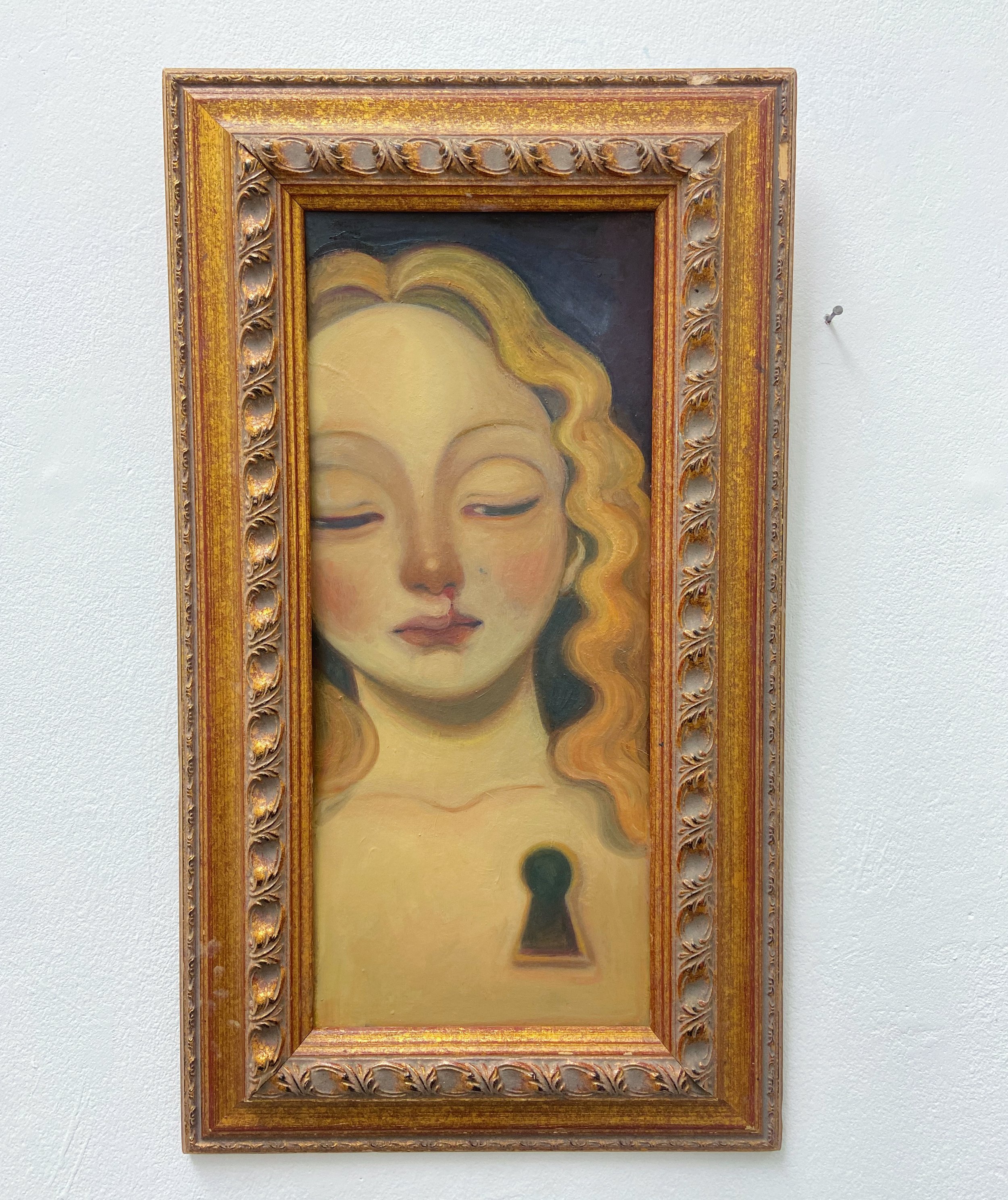
Nadia da Silva, The Key,(2025), Oil on found frame, 64.5 × 36.5 cm. Courtesy of the Artist.
For much of their life, Nadia did not see themselves as an artist. Making was primarily for their own gratification, pursued without expectation. Only during Nadia’s final year at OCAD, during the graduate show, did they experience a sense of stillness: a moment of recognition that the work could exist beyond their own doubt. That openness extended into dialogue. Nadia’s interaction with a visitor who engaged deeply with the Mary archetype work created a space for trust and vulnerability not previously anticipated, teaching them that an audience could hold the work carefully.
Newly represented by Riana Raouna Gallery, Nadia approaches materials, display, and documentation with intention and openness. Several works, now available through the gallery, present Nadia’s signature figures, where beauty is held in tension between reverence and distortion, control and surrender.
In December, Nadia kindly created a portrait work for MADE IN BED’s Features Co-Editor, Xénia Chudinova.
Stay up to date with their latest works on Instagram, their website, and at Riana Raouna Gallery.
Xénia Chudinova
Features Co-Editor, MADE IN BED