

Artificial Nature: Environmental Intervention in Leandro Erlich’s ‘Concrete Coral’
Installed just weeks before Miami Art Week 2025, Leandro Erlich pushes the notion of ‘traditional sculpture’ into new territory with Concrete Coral, a subaquatic installation suspended six metres beneath the ocean’s surface off the coast of Miami. Evoking a surreal traffic jam of cars frozen underwater, the work inaugurates Ximena Caminos’ Reefline project, an ambitious initiative led by the Argentine environmental activist to revitalise Florida’s fragile marine ecosystems through a network of site-specific artworks spanning seven miles of underwater infrastructure. Conceived not as fixed objects but as a living system, each car is designed to host marine life, allowing the installation to erode and evolve, becoming inseparable from its environment. Concrete Coral’s unique positioning invites a reconsideration of the boundaries between art and ecology, posing a fundamental question: at what point does sculpture cease to depict nature and begin to become part of it?
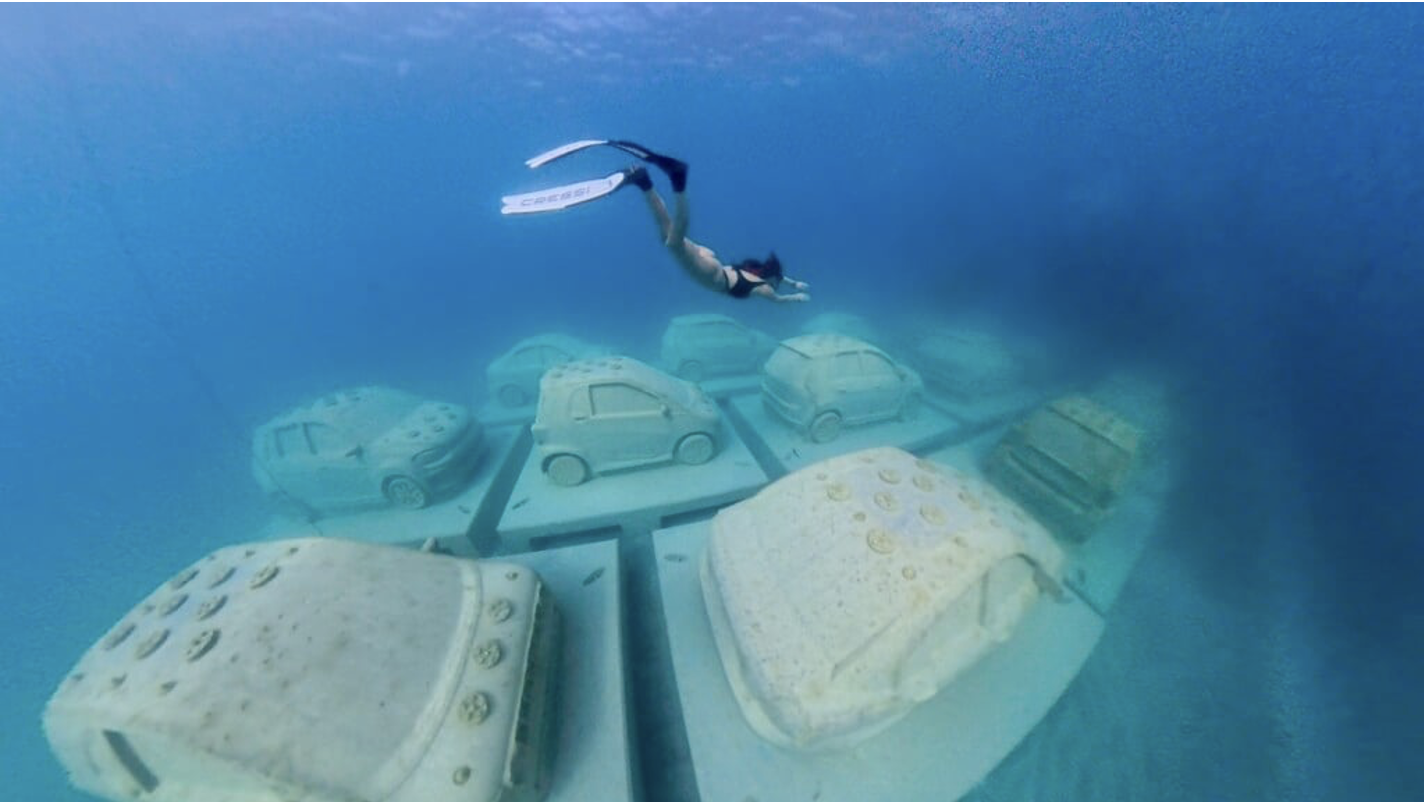
Leandro Erlich, Concrete Coral, 2025, Image Courtesy of Britany Weber.
Concrete Coral, installed in October 2025, comprises twenty-two life-sized concrete cars arranged bumper-to-bumper in three submerged traffic jams along the Florida Reef Tract, the third-largest coral reef system in the world. Each sculpture is cast from a 3D-printed mould in marine-grade, pH-neutral concrete, carefully engineered to withstand the storm-prone conditions of South Florida. Prior to installation, the structures were tested at The University of Miami’s SUSTAIN Laboratory to ensure resilience to hurricane conditions; only after meeting these criteria were they approved for deployment on the seabed. The work thus has a dual nature, serving as both an aesthetic project and as scientific infrastructure.
Formally, the cars are solid and retain their recognisable silhouettes. However, they appear uncannily sealed: windows that would typically be transparent are rendered opaque by solid concrete, lending the vehicles an eerie, ghostly stillness. Circular protrusions extend from each roof, designed to facilitate coral growth; over time, these surfaces will soften and dissolve beneath layers of marine colonisation, gradually obscuring the vehicles until they become unrecognisable. In the months following installation, thousands of coral fragments—cultivated at ReefLine’s Miami Native Coral Lab—were seeded onto each car using Cora Coral Lok™, a system engineered to secure the corals rapidly and effectively.
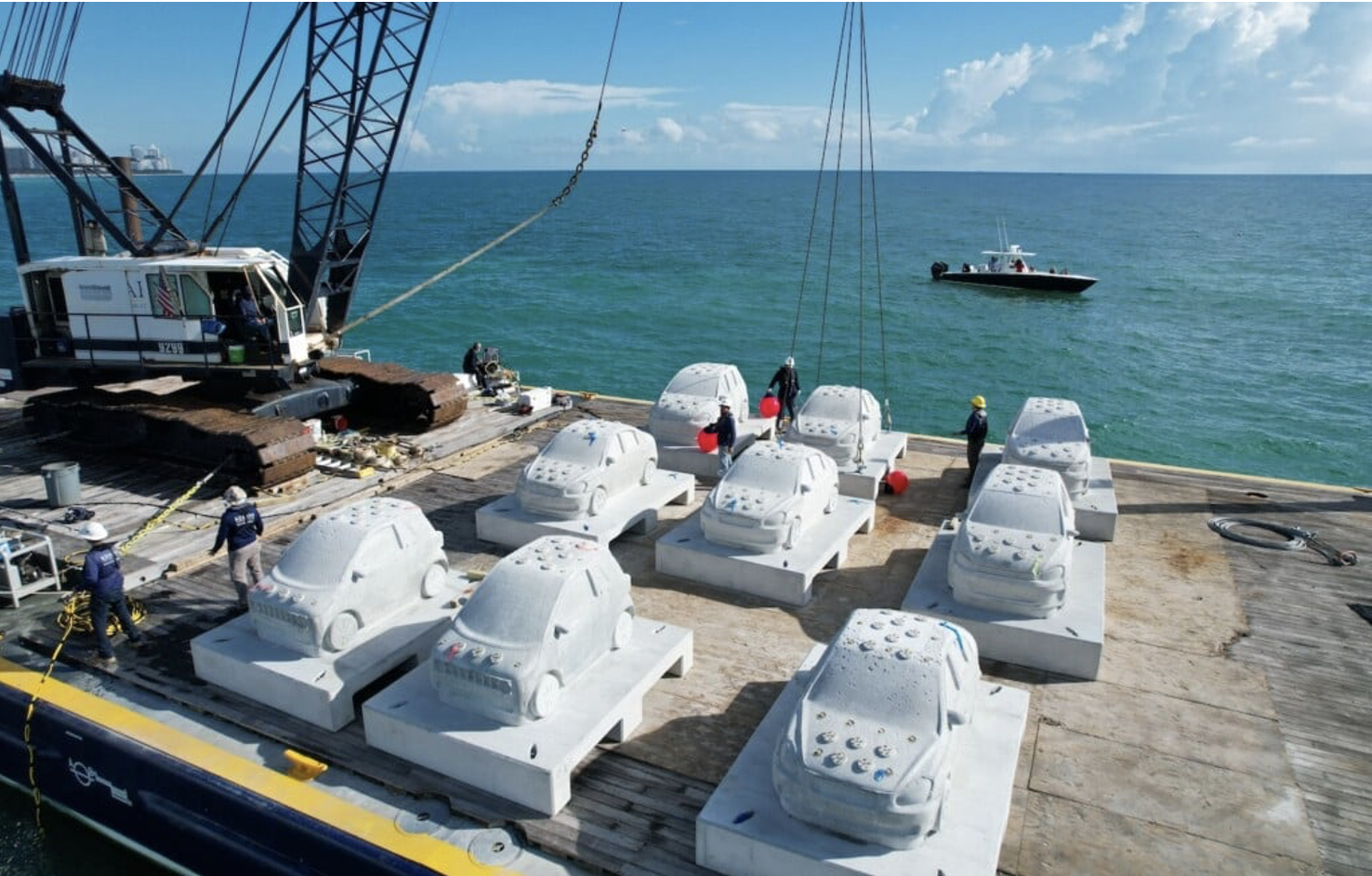
Leandro Erlich, Concrete Coral, 2025, Image Courtesy of Nico Munley.
Beyond their sculptural presence, the vehicles function not only as catalysts for coral regeneration but also as physical barriers that may help mitigate coastal erosion. Yet, despite its ecological intentions, the installation carries an inherent tension. The use of man-made structures to ‘repair’ the natural environment raises a subtle contradiction, prompting questions about the limits and ethics of intervention: to what extent should artificial interventions act on behalf of damaged ecosystems? Some argue that these ecosystems should be left undisturbed; however, given the accelerating degradation of coral reefs, the alternative may be irreversible loss, as there remains the risk they may not recover at all.
Unlike conventional en plein air installation art, the presence of Concrete Coral is largely imperceptible, with access restricted because the cars are reachable only by diving. Erlich’s central motif is a deliberate, not incidental, decision. As the artist notes, ‘the choice of cars is metaphorical: once carriers of pollution and speed, they now become vessels of regeneration. What once drove us away from nature becomes a stage for its return.’ Removed from their original function, the vehicles operate as potent symbols of environmental degradation, recontextualised to become agents of renewal. Though fixed in place, they exist in a continual state of transformation, integrating into the marine ecosystem while moving away from their origins as products of human manufacturing.
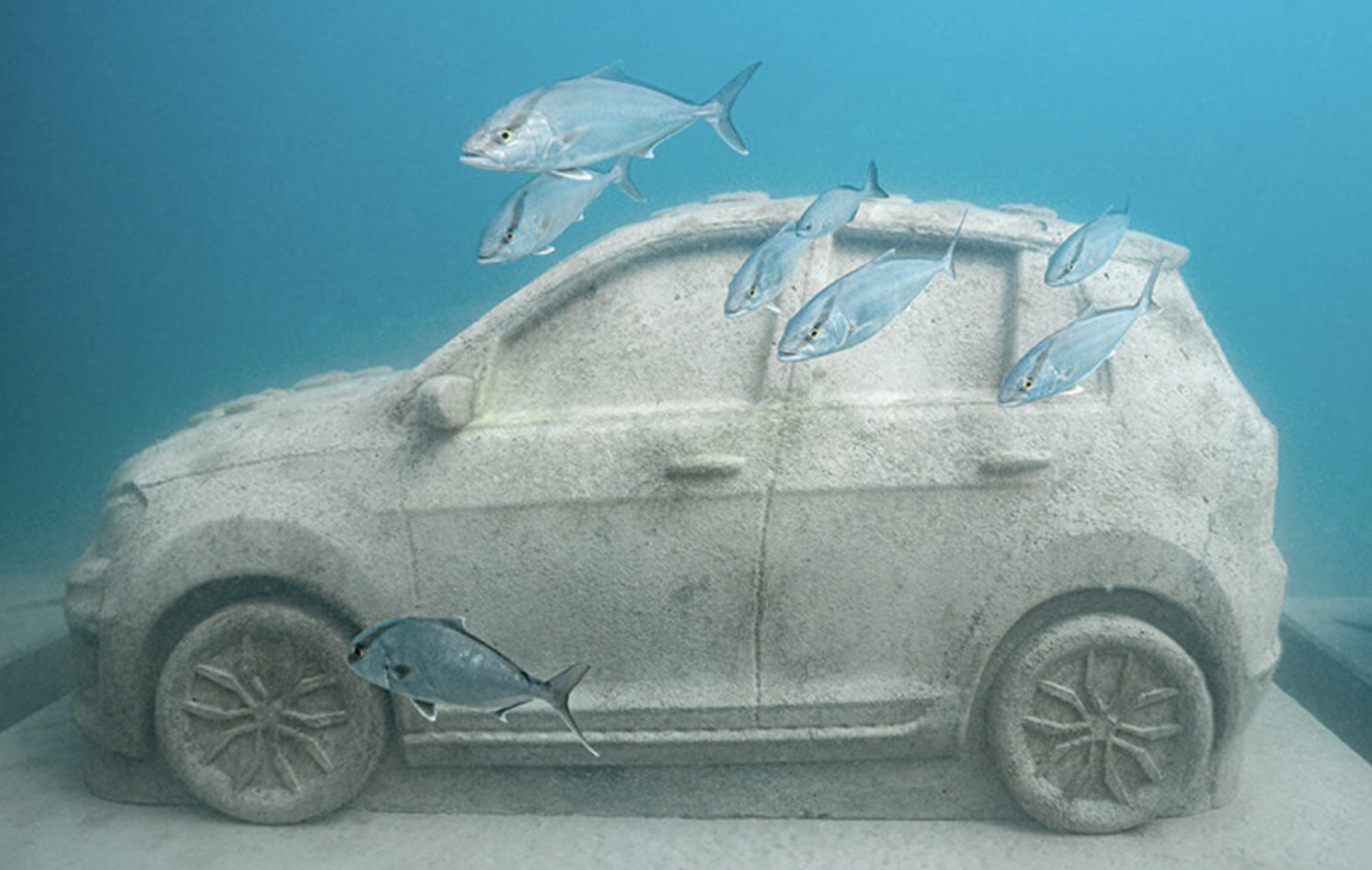
Leandro Erlich, Concrete Coral, 2025, Image Courtesy of Nola Schoder.
‘It’s not about transportation anymore; it’s about transformation. The car stands as a reminder of where we’ve been – and, once submerged, an invitation to imagine where we could go. In the end, art lives in interpretation; its magic lies in how it invites each of us to pause, reflect, and wonder.’ – Leandro Erlich
The engagement with environmental themes is his first. In recent years, the use of nature as an artistic material to address the climate crisis has become increasingly prominent in Erlich’s work, alongside many other conceptual artists exploring similar themes. In Rendering of Order of Importance (2019), presented at Miami Art Week, the artist staged a vast traffic jam of vehicles on the beach near Lincoln Road. Comprising sixty-six life-sized cars and trucks—more than double the number in Concrete Coral—the installation is his largest work to date, relying on scale and spectacle to convey its message. While both works interrogate the climate crisis through the motif of congestion, Concrete Coral marks a significant evolution in his practice. Here, the work does not merely represent environmental collapse but actively intervenes in it, in an attempt to facilitate positive change.
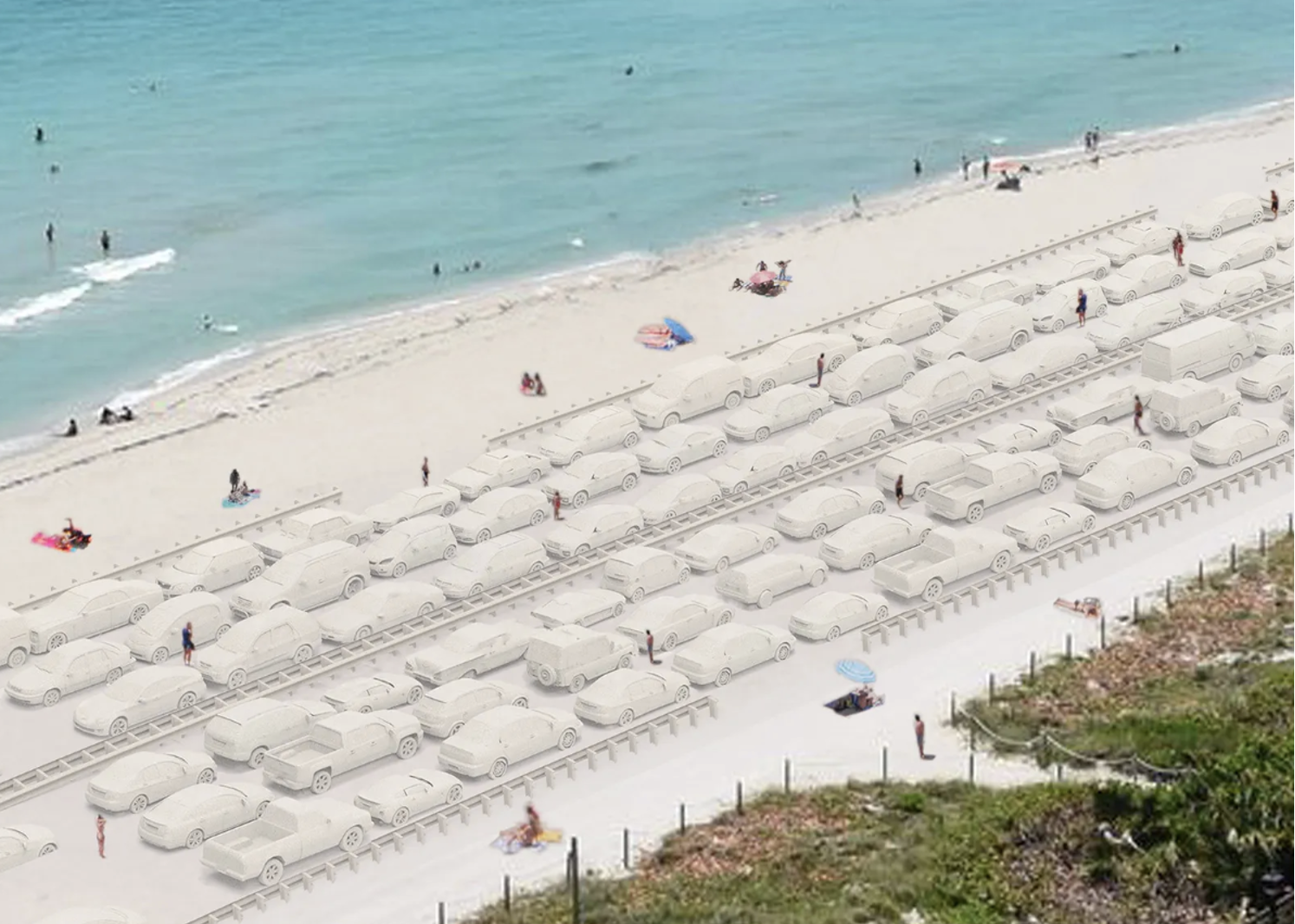
Leandro Erlich, Rendering Order of Importance 2019, Image Courtesy of Leandro Erlich Studio.
‘Visually, [the installation] will create the appearance of a forest overgrowing a traffic jam as nature reclaims it as its own.’ – Colin Foord, Director of Science, ReefLine
The shift from mere representation to active participation signals a broader trajectory within contemporary installation art, in which nature is no longer treated merely as subject matter but also as material and collaborator. This approach is not without its risks; Erlich’s previous en plein air installations, such as Rendering of Order of Importance, while visually compelling, verge on aestheticising the climate crisis, transforming environmental degradation into a spectacle. By contrast, Concrete Coral attempts to move beyond representation by embedding itself within ecological processes, though whether this constitutes meaningful intervention or symbolic gesture remains to be seen. What is certain, however, is that the work complicates the boundary between art and environment, positioning sculpture not as a reflection of nature but as an active participant within it.
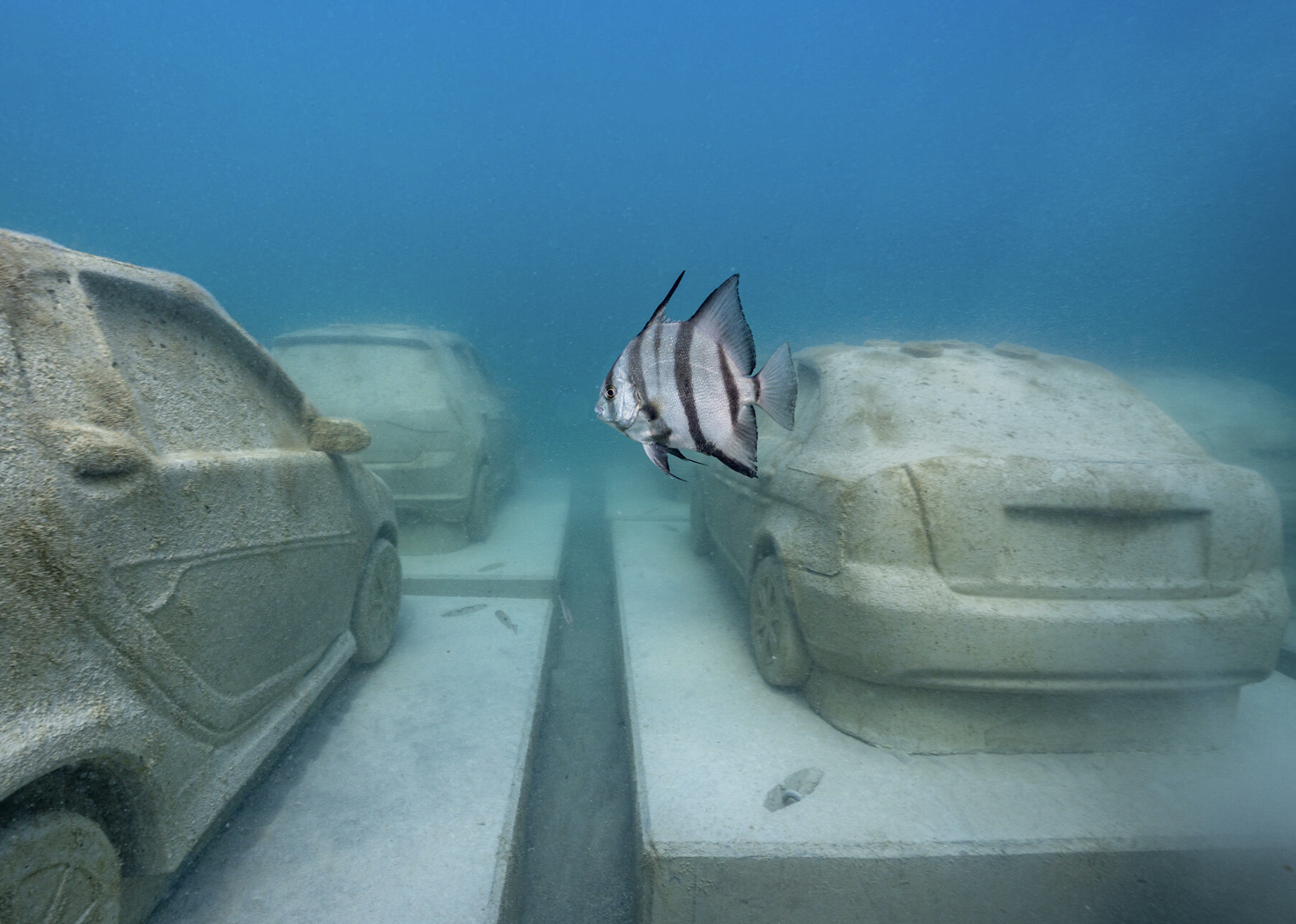
Leandro Erlich, Concrete Coral, 2025, Image Courtesy of Nola Schoder.
Sophie Harris
En Plen Air Editor, MADE IN BED