

Alexis Kleeman in conversation with Alban Leroux

Image provided by Alban Leroux.
Alban Leroux is a furniture restoration expert trained in France at the “Association Ouvrière des Compagnons du Devoir du Tour de France, with an official creation date in 1941, but it from Xe century before JC.” Alban now has a workshop in Wallis House, Brentford and has worked on furniture for some of the most prestigious houses and museums in the United Kingdom and France, including Versailles, Chambord, Dumfries House, and Chatsworth House, also known as Pemberley on the BBC’s Pride and Prejudice series. Alban has been restoring historical and creating modern furniture for nearly twenty years and has developed his career as an industry specialist, often working for high-profile clientele and accepting commissions for unique pieces of furniture or installation of textile-covered walls with his unique approach, passion for the craft, and love for creating and preserving furniture and interior decor.
AK: Please tell us about your education and experience as an upholsterer who has worked in some of France's most prestigious locations, including Versailles, Chambord, and Valencay castles, as well as at the Prince of Wales's Dumfries House and for the Duke and Duchess of Devonshire at Chatsworth House.
AL: Yes, I enrolled in a two-year apprenticeship program for upholstery at the Association Ouvrière Des Compagnons Du Devoir Du Tour De France. Alongside other crafts like carpentry, metalwork, stonework, and more. After completing the apprenticeship program, I found a company that was working for prestigious clients, and they took me on as an apprentice, so I was working six days a week in the workshop as well as attending school from 2007 to 2009. The work day was from eight in the morning until five in the afternoon, and then a dinner break, and then academic courses like English and Math from eight to ten at night, this was five days a week. And then on Saturday, we would work on independent projects for the apprenticeship program, to create something special and improve our skills. If you really wanted to be involved, you could also work on Sunday and commit to seven days a week of apprenticeship. It is tiring, but if you love what you do, you don’t see the time and just enjoy the process.
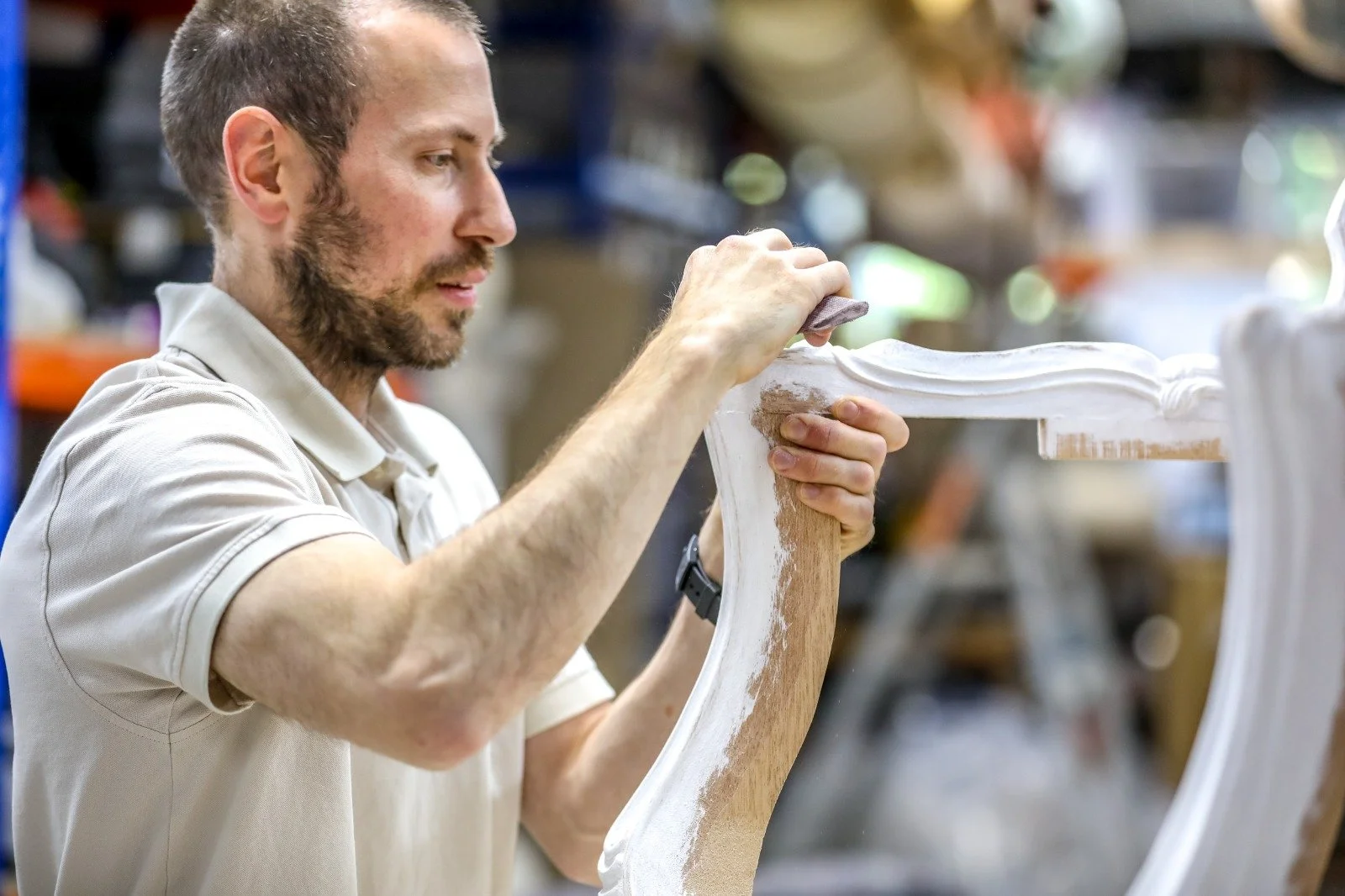
Alban at work, Image credit Cristina Schek.
AK: Could you tell us about some of the unique challenges of restoring historically important pieces of furniture while preserving the original structure and/or intent?
AL: You need to be really careful with some pieces, for example, pieces with decorative gilt work are extremely delicate. Some of the pieces I work with are over 250 years old, so you must be extremely meticulous any time you interact with the piece to not cause any further damage to the work, and make sure that you repair as much as possible without affecting the essence of the work. Gilt work, for example, is extremely delicate, and any damage is easily visible, so it requires extreme attention to detail, a meticulous eye, and a steady hand.
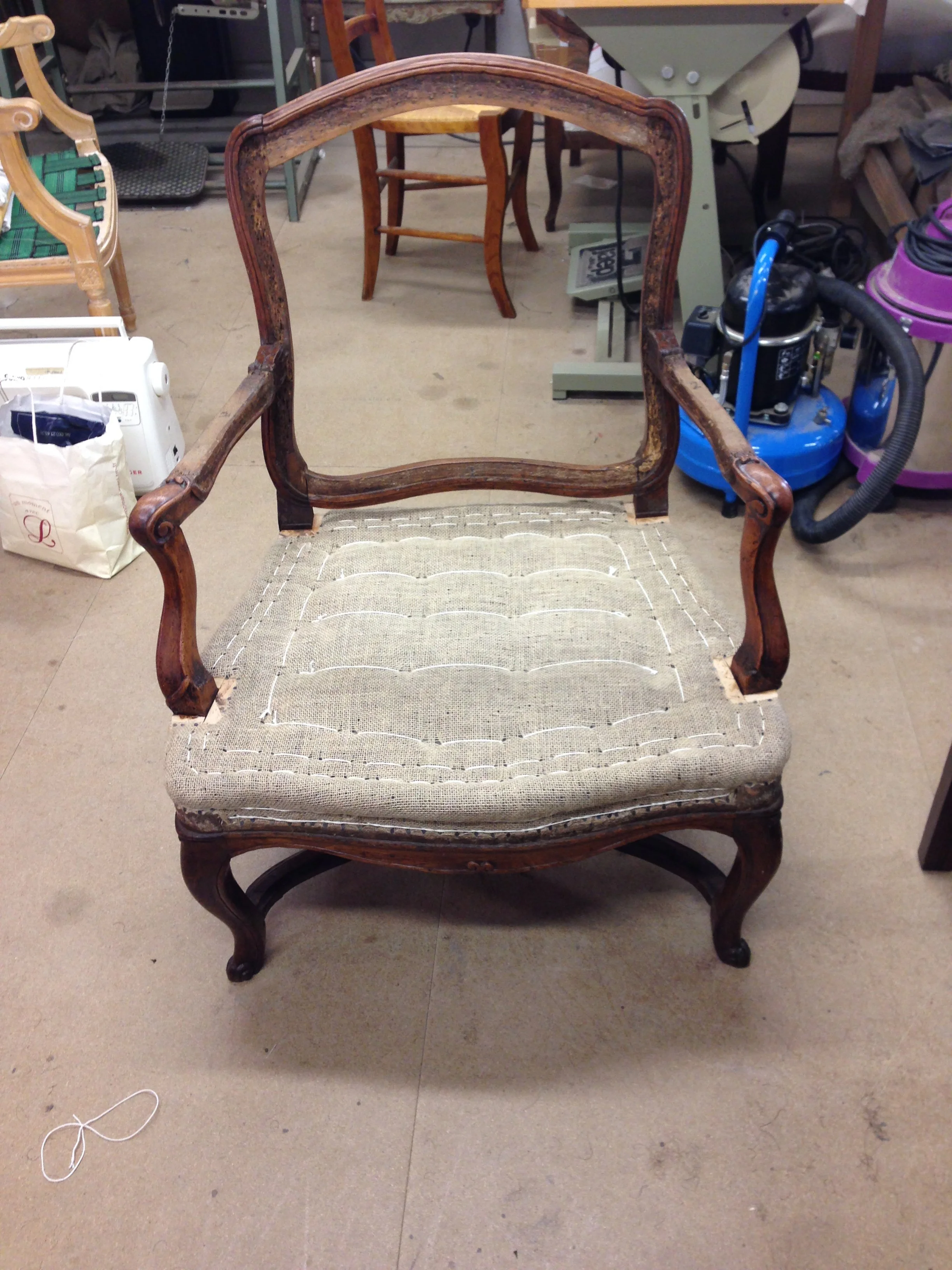
Image of chair restoration provided by Alban Leroux. Photo of a chair from Chatsworth House under restoration.
AK: What has your favourite or most challenging restoration project been?
AL: It was when I was in England for a year, and I worked for The Duke and Duchess of Devonshire at Chatsworth House on a set of over 150-year-old chairs. I was hired to restore the chairs to “brand-new” condition. This involved removing all of the original upholstery, repairing the frame, and then carefully restoring each layer to restore the shape of the original piece of furniture. This project was a bespoke fabric, so in addition to everything else, the fabric was irreplaceable and required extreme attention to detail. I spent two weeks restoring just one of these chairs because of the traditional methods of furniture reconstruction we used. The tapestry was the most delicate part of the process because it was removed and replaced on the same chair afterwards, meaning that the fabric is already cut and has no space for error, if you use too much horse hair when reconstructing the arms or seat of the chair the tapestry will not fit, but if you understuff it willy be visibly too big, it has to be one hundred percent perfect, there is no time or space for mistakes, which means it is very time consuming and meticulous process for every piece of furniture I work on, but it is a process I enjoy.
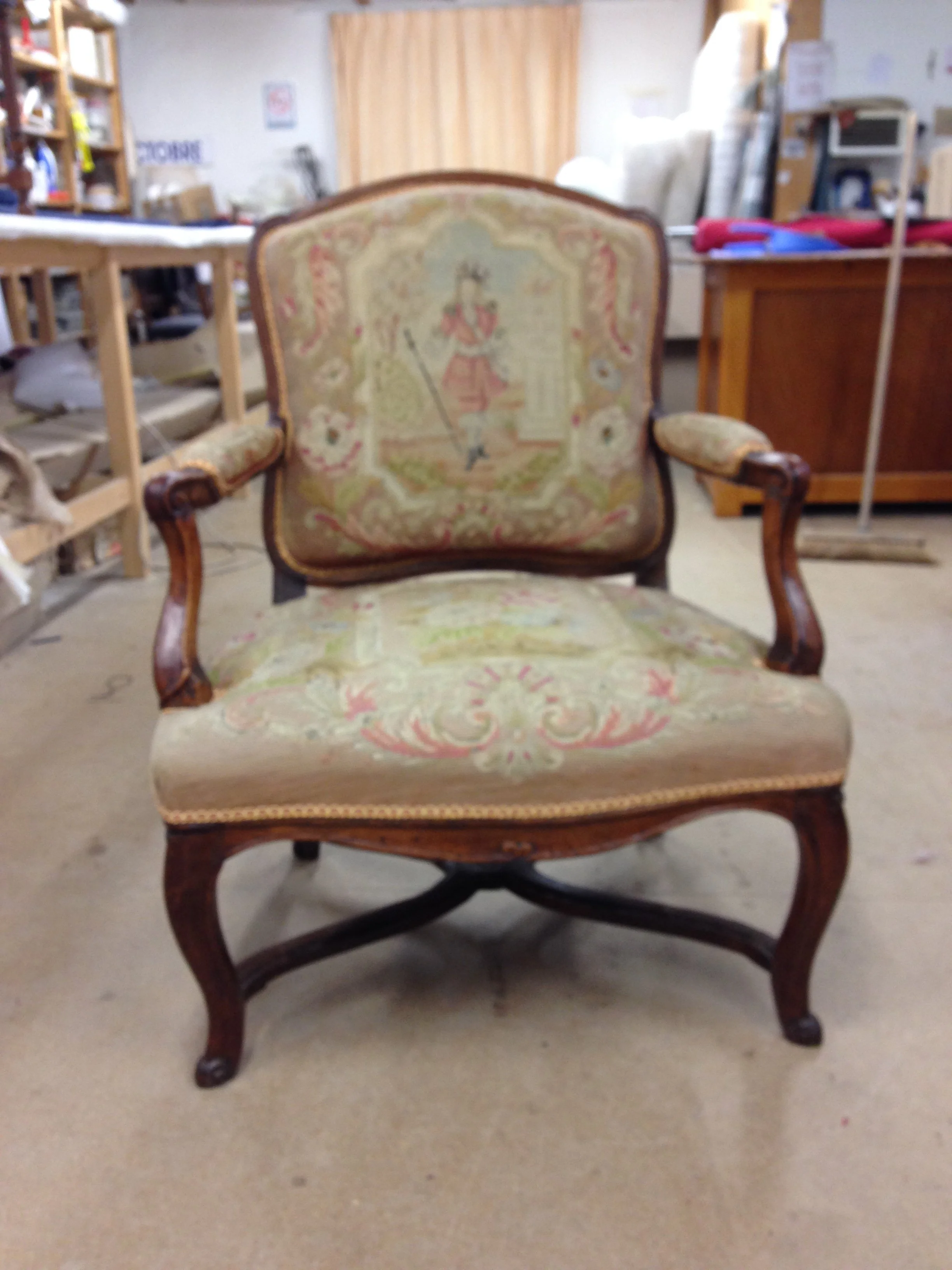
Image of a restored historical chair, provided by Alban Leroux.
AK: Could you tell us about some of the key differences between working on historical and modern furniture? Are there unique challenges that come with different materials or techniques?
AL: As you can imagine, some of the pieces I work on are over 200 years old. And, the traditional methods take a really long time, but they are also more comfortable and last way longer than modern methods of furniture construction. Modern furniture construction is much quicker and more stylish. Because of my education, I try to combine these methods and create pieces that have the comfort of the traditional model and the style of the modern to create the best piece of furniture I can when I am commissioned. I want to make pieces that will last a long time and be comfortable, but still fit into modern spaces.
AK: Please tell us what inspired you to get into this industry and what some of the biggest challenges were along the way.
AL: Yes, when I was a kid, I lived near all the châteaux in France. Some of the châteaux mentioned in the first question, Chambord and Valency, were near my childhood home. So I was always surrounded by historical artefacts and exposed to historical sites at a young age. When I was in college, I was required to do a one-week work-study, and at the time I was researching possible jobs, I didn’t yet know that my career existed. She suggested that I try upholstery, like the furniture in the châteaux. So I found an upholsterer in my city, and they agreed to let me do my work study there. When I finished the required week, I went back on the weekends to finish the little chair I had started during my work study program, and after that, I was just waiting to finish college and get into the furniture restoration industry. There were many challenges and mistakes along the way, but I took these as learning opportunities, especially because I was young and experimenting with new techniques, so the most important thing was to learn from my mistakes and use that knowledge to improve future projects and remember that every project is different and to continue learning.
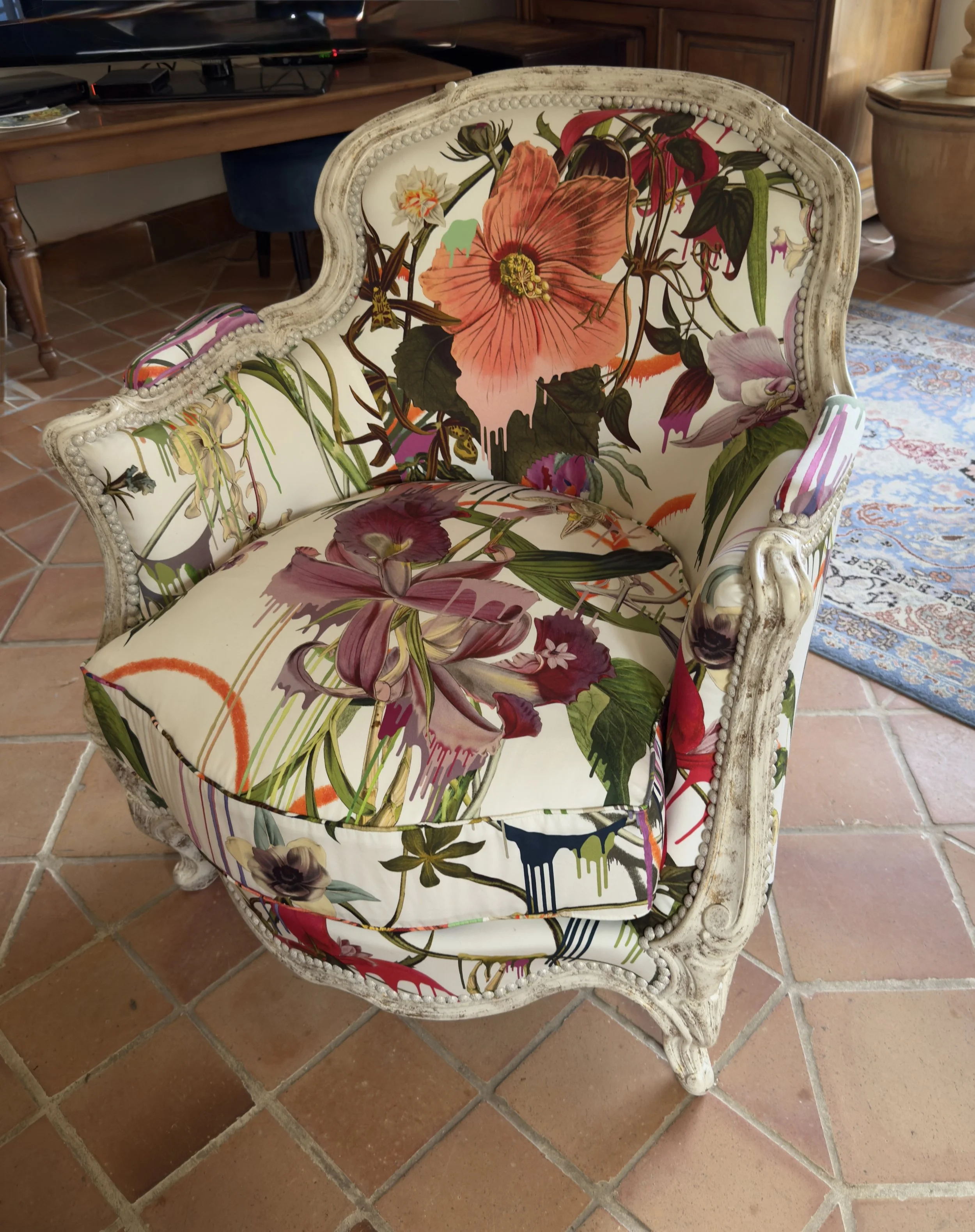
Image of restored chair, provided by Alban Leroux.
AK: Are there any projects you have worked on where you can share details about the damage to the furniture and how you repaired or recreated the piece's original look?
AL: Yes, once I had to repair an armchair, part of a set of twelve chairs, after a dog had eaten the legs; it had chewed the little feet off the chair. When I saw the chairs again, the dog had chewed the feet again, and some of the seats and backs were loose, so I will need to repair them when I return to London.
AK: Could you tell us about the construction of the fabric walls and doors mentioned on your website, and the unique challenges that come with creating a utilitarian object like a door covered in a material not designed for that function?
AL: The process requires many techniques to achieve the finished product. Like, on my website, you can see that there is no trimming or anything to hide between the wall and the fabric, meaning that it must be perfectly aligned, or the seams will be visible on the finished wall. This is a very challenging process, especially because at the moment I am working on a project that has a ceiling over five meters high, using this technique, by myself. I am also using silk fabric, and the wall has a lot of shapes and moulding that must all be followed perfectly by the material. It is a big challenge in many ways. I currently have three rooms to do this technique on, each in a different fabric and size, so some will be quicker than others, but they all have different challenges, whether it be the stretch, the direction of the fabric or the environment of the building. There are new challenges to adapt to all the time.
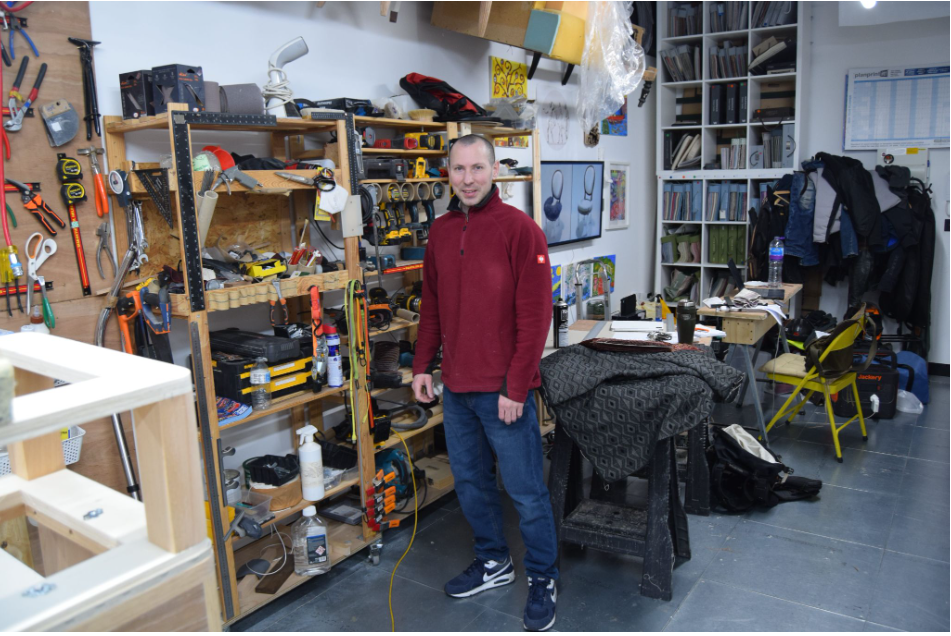
Alban at work, image provided by Alban Leroux.
AK: Please tell us about the importance of attention to detail in your craft, and how you stay focused on the job at hand when there are so many details to keep track of.
The details are important because when you look at a piece of furniture for the first time, it's the details that are going to make you say, “Wow, it's beautiful.” So, it is the attention to detail that makes the difference because it affects your first impression of the piece, whether it is in your friend’s house, a family member’s or a piece of furniture in a museum. It's the first three seconds of looking at an object that makes the difference and makes you want to interact with it and look more closely, take pictures, and ask questions like, How was this made? I think the attention to detail is important because of the emotional impact the details can have on a person, because if you are just looking at a piece to look at it, you won’t understand it.
I stay focused on the job and details because of my passion. If you rush the process all the time, you cannot focus, so passion for the task is essential. What I like about my job is that I get to use many different materials to create, wood, stains, metal, and textile, one time even concrete, and I get to learn many techniques with all the different materials. I get to be fully immersed in each project and follow my interests along the way as I learn about and I get to create unique things.
I also like to put on a little music; it helps me focus and keeps me from getting distracted.
Alban’s work and services can be seen on his website, Interior Art Craft and Instagram @Interior_Art_Craft. He is also working with the Guild of Master Craftsmen and continues to provide high-quality services and products in the United Kingdom, France, and Italy, while he works with passion on every piece of furniture he restores and creates and continues to learn about his craft and explore new facets of furniture restoration and design. A special thanks to Alban for interviewing for MADE IN BED via video call from his current project in France.
Alexis Kleeman
Interviews Co-Editor