Guardians of Time: Jiang Qiong Er @ Waddington Custot
Waddington Custot’s Guardians of Time introduces Jiang Qiong Er in her first UK exhibition, internationally recognised for her practice that moves fluidly between traditional Chinese craftsmanship and contemporary design. The exhibition unfolds in a space that feels quietly intentional, almost ceremonial—as though arranged to accommodate the slow breathing of the works on display.
Qiong Er treats tradition not as a fixed inheritance but as living architecture shaped through her materiality and the cultural rhythms rooted in her Chinese heritage. Her sculptures, cabinets, wax paintings and crafted objects transcend the concept of time and for a brief encounter her symbols are understood without translation. She creates a place of transformation and cultural exchange for visitors to almost instinctively question: how does tradition resonate across centuries and still reach us today? Or more simply, what does it mean to carry time?

Guardians of Time, Waddington Custot, Cork Street. Photo: the author.
From the large windows of the first room, a warm amber light spills through onto Cork Street. Whispering Clouds, a display of bamboo marquetry panels, catches the light and casts soft, honeyed shadows across orange walls. The palette instantly links to the artist’s psyche and interest in constructing a balanced harmony of ancestral technique and contemporary design, signalling an architectural sensitivity to place.
These bamboo marquetry panels introduce visitors not only to Qiong Er’s materials but also to her lineage. Born into a family of artists and creators—her grandfather one of the first Chinese painters to study abroad, her father the architect behind the Shanghai Museum—Qiong Er’s foundations were laid early. She later expanded her practice at the École des Arts Décoratifs in Paris, a cross-cultural fluency that led her to co-found SHANG XIA collaborating with Hermès, helping forge a new vocabulary for contemporary Chinese luxury.
Here, in the first room, these histories appear in softened, atmospheric form. The notched bamboo reliefs and precise geometries of Whispering Clouds revive an intricate craft dating back to the Qing Dynasty. Yet Qiong Er’s reimagining makes them feel unmistakably current to the present, where tradition becomes structure, design becomes language, and craft becomes the threshold into her world.

Installation view: Guardians of Time, Waddington Custot, Cork Street. Photo courtesy: Waddington Custot.
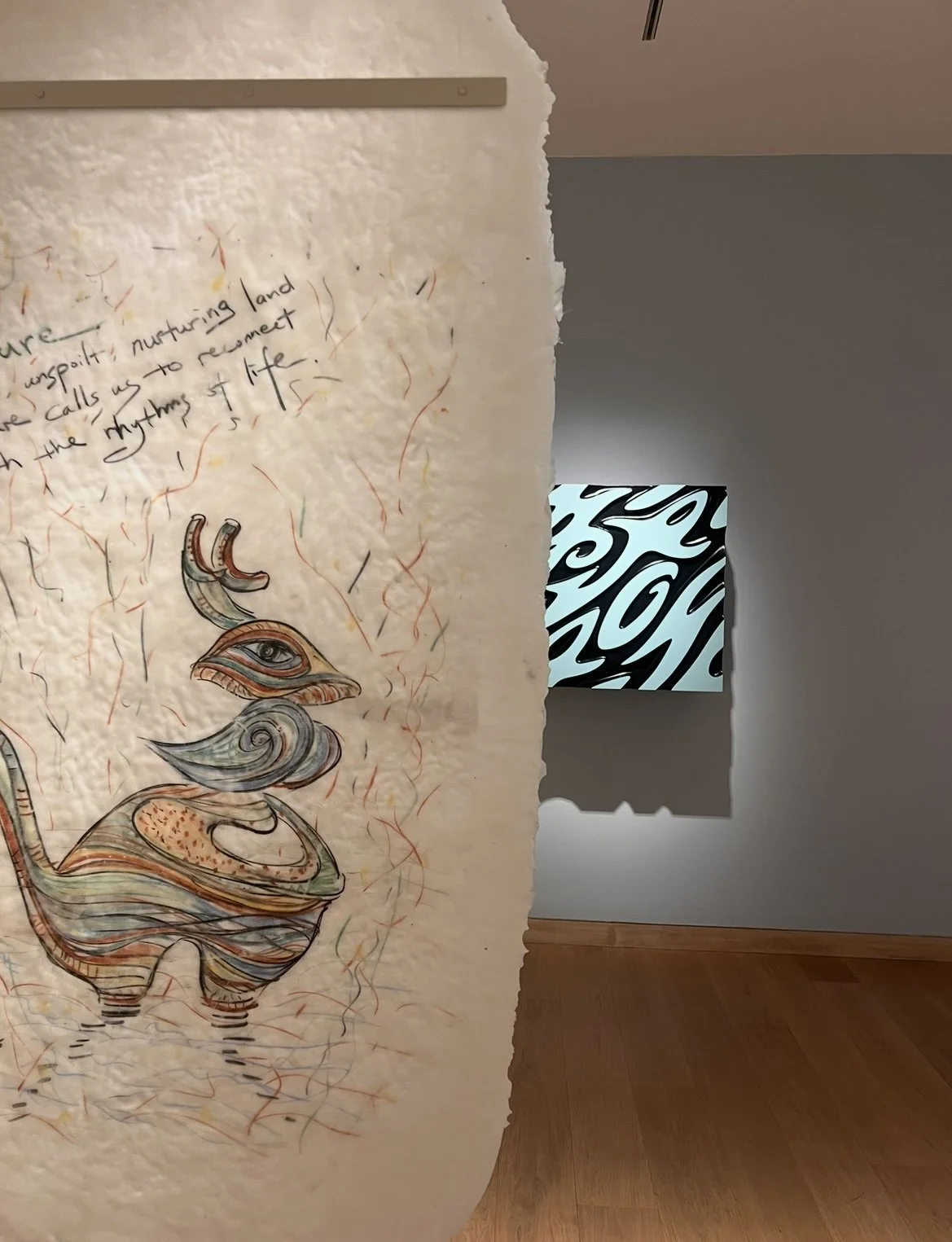
Turning into the second room, the lighting softens. At the centre, Qiong Er’s delicate wax paintings, scattered all throughout the room, appear as if floating through space. Almost weightless, their shadows pool gently beneath them, giving the works a strong commanding presence in the room and an unexpected gravity.
Made through a slow accretive process of transferring charcoal to silicone plates, the works are layered repeatedly with molten wax at 80º C. For Qiong Er, wax becomes her ‘new paper’, a strong metaphor for time’s reversibility capable of solidifying, melting and returning. The paintings hold time within the surfaces; each image is embedded with sentiment, across dozens of repetitions.

Installation view: Guardians of Time, Waddington Custot, Cork Street. Photo courtesy: Waddington Custot.
Up close, the wax reveals faint impressions and markings, the writing and textured surface all reminiscent of an ancient script. She has a way of storytelling and conveying a language half-remembered. Underpinning her broader practice are symbols of resurfacing, of histories returning through the tactility of her work.
Installation view: Guardians of Time, Waddington Custot, Cork Street. Photo: the author.
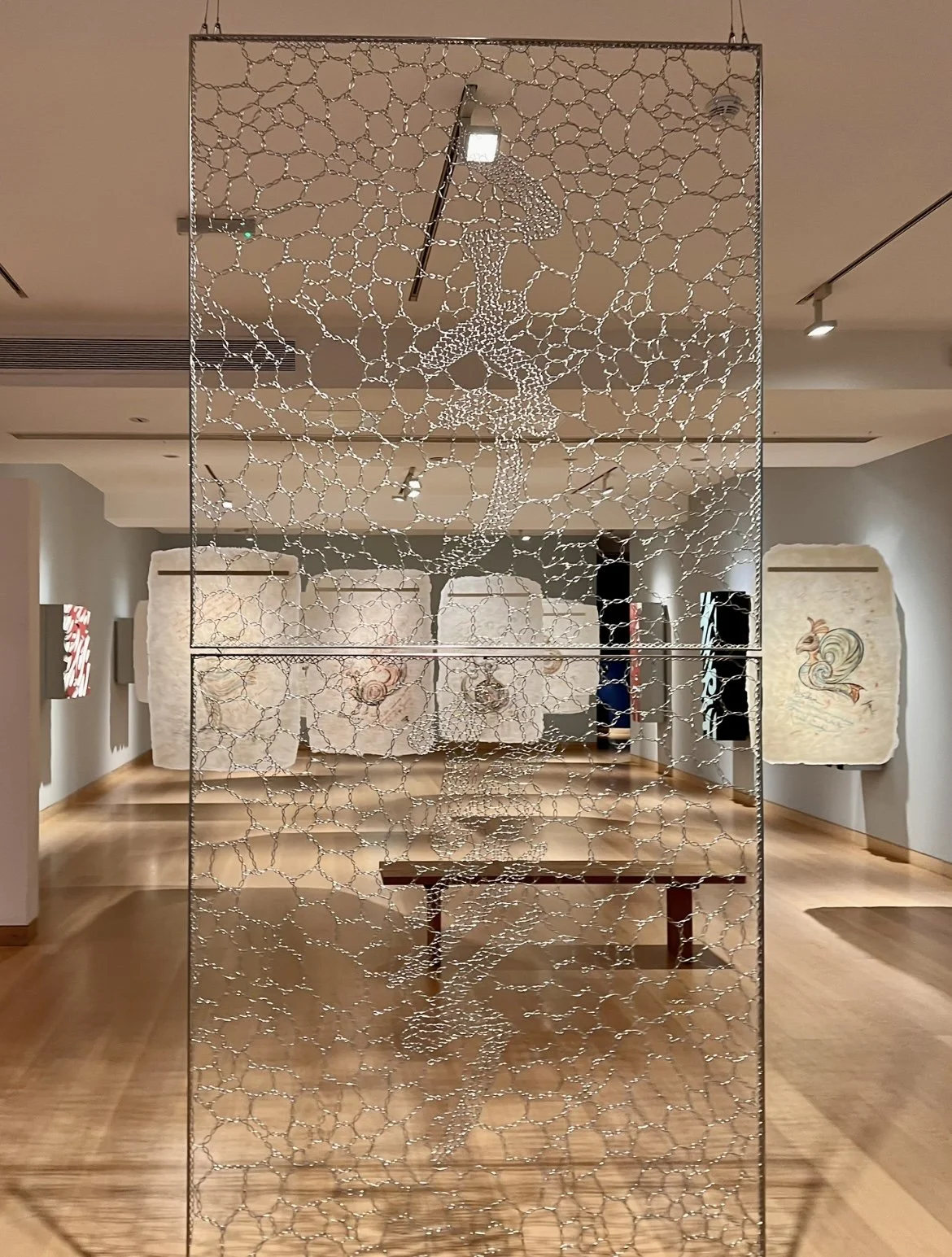
Across them, an intricate transparent structure of metallic embroidery draped from the ceiling forms one of the most striking encounters of the exhibition. Her Voice, a powerful installation honouring Nüshu—the endangered women’s script from Hunan Province—is used historically as a secret form of communication in a patriarchal society. Qiong Er preserves the timeless female voice through material; writing projected by light and shadow offers a subtle reminder of courage woven together by contemporary Chinese women. Its placement next to the window feels deliberate especially when viewed from the outside, as though to foreground the endurance of culture; the strong metal structure resisting the soft, delicate fragility of traditional fabric.
Installation view: Guardians of Time, Waddington Custot, Cork Street. Photo: the author.
Although at first glance visitors may be deceived by their sculptural presence, the objects around the wax paintings lining the room are in fact cabinets. Once opened, their subtly tilted shelves disrupt the symmetry and logic of traditional furniture. Jiang proposes the quiet yet radical act of opening something long concealed, and the bravery involved in doing so. These pieces are not decorative; they are mnemonic, making visible a history at risk of being forgotten, a form of communication carried between women and preserved through secrecy.

Installation view: Guardians of Time, Waddington Custot, Cork Street. Photo: the author.
The third room shifts the mood to an almost nocturnal atmosphere. The walls deepen into a twilight blue, creating a quiet, intimate space for contemplation. Across the room, Qiong Er’s bronze creatures from XII Calls, first shown on the façade of the Musée Guimet and now part of UNESCO’s permanent collection, stand on shelves of varying heights. Their intimate scale draws the viewers in, almost as if approaching small guardians waiting to be met.
Each hybrid creature embodies a universal value—bravery, wisdom, authenticity, freedom—and together they operate as a mirror of society’s ideals. This room encapsulates one of the exhibition’s central propositions: that ancient mythologies and contemporary sensibilities are not opposites but continuations of the same story. Qiong Er gives life to her figures through a contemporary re-exploration of Chinese civilisation and global mythological forms, infusing them with subtle futurist details borrowed from technology and imagination.
The viewer feels an almost instinctive urge to approach these creatures, to encounter them at eye level. Their quiet, alert, and strangely tender presence reminds us that the values they represent are not relics but living principles still shaping our collective imagination.

Installation view: Guardians of Time, Waddington Custot, Cork Street. Photo courtesy: Waddington Custot.
Across its three rooms, Guardians of Time proposes that time is not linear but layered, porous and carried through materials, symbols and memory.
What makes the exhibition compelling is restraint. No spectacle, no overcrowding, no insistence on a single reading, is what allows Guardians of Time to resonate. The exhibition does not tell us what to think about tradition; it lets us experience how it feels to stand inside it. It lets visitors step into time, moving through it. Qiong Er’s creatures and cabinets do not shout for relevance. Instead, they hold their ground gently, like values remembered rather than imposed.
The exhibition arrives with reputation in tow. Qiong Er has exhibited widely, with works held in the V&A, the British Museum, and the Musée Guimet—where an earlier iteration of Guardians of Time transformed the entire façade into a monumental bestiary. Yet in the more intimate rooms of Cork Street, the scale shifts. What was once a public spectacle becomes a contemplative encounter, myth and material distilled.
It all circles back to Qiong Er’s core belief, the importance of having a ‘gap’ , a concept tied to her lineage inherited by her grandfather; a space in between to create a dialogue, echoing through time, transcending cultures and reconnecting people through the ancient symbols and scripts lost in time—now brought anew through the exhibition.
Guardians of Time is on view at Waddington Custot, 11 Cork Street, until 23 December 2025.
Natalia Makri
Emerging Artists, MADE IN BED
Disclaimer: The views, thoughts, and opinions expressed in MADE IN BED are solely those of the individual authors and not those of MADE IN BED magazine or of Sotheby’s Institute of Art.