Under Examination @ Triangle Space, Chelsea College of Art
At Triangle Space, a group exhibition curated by Sotheby’s Institute of Art students examines the body as both an object of scrutiny and a means of understanding an increasingly uncertain world.
To examine something is to assume that it can be known. It suggests a controlled process of observation through which uncertainty might be measured, categorised and ultimately resolved. Under Examination, however, begins at the point where this confidence breaks down. Curated by Sotheby’s Institute of Art students Isabel Emmett, Arielle Etheridge, Katarzyna Jabłońska and Tara Kubik, the exhibition brings together work by Lara Chahine, Qiyue Huang, Zili Jiang, Esmé Matthews, Karson Selah Samons and Zhu Wanqi. Across painting, sculpture, installation and moving image, the participating artists explore the tension between the body as something that can be observed from the outside and the body as the site through which emotion and experience are felt.
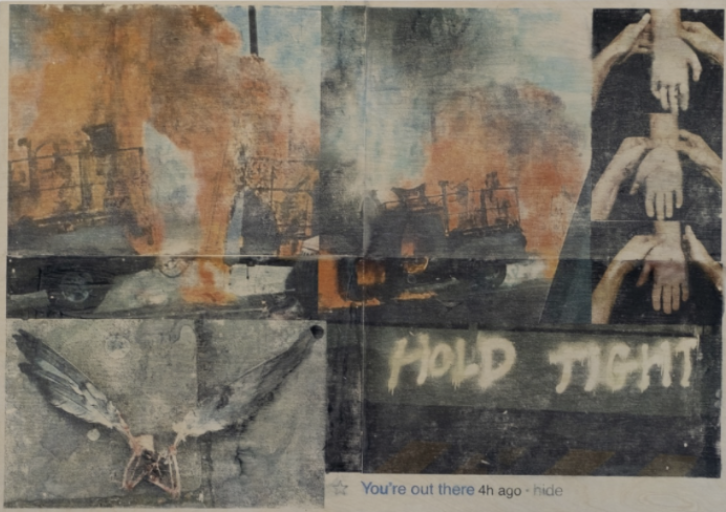
Karson Selah Samons, Shooting the Dark, 2026, 59.4 x 84.1 cm, Image transfer on wood canvas.
The exhibition adopts the visual language of a laboratory, creating an environment associated with classification and control. Within it, fragmented bodies, ruptured surfaces and unfamiliar materials appear to have been placed under scrutiny. Yet the works continually resist the possibility of detached observation. Fear, grief, desire, anxiety and memory cannot be neatly isolated like biological specimens. Instead, they emerge through material, atmosphere and physical discomfort, implicating the viewer in the act of examination.
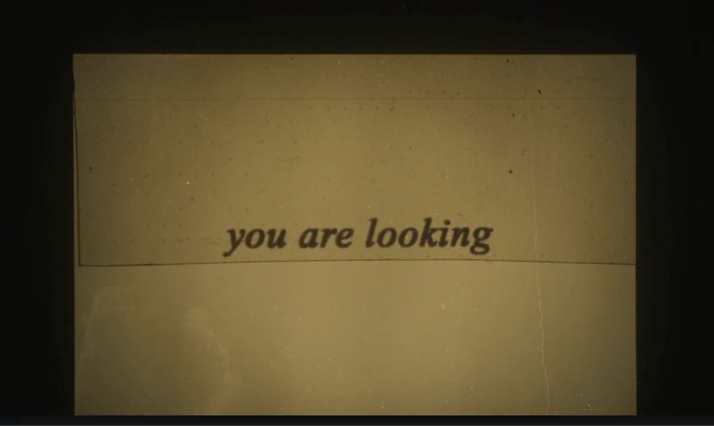
Karson Selah Samons, April Like A Dream, 2026. 35 mm slide projection poem with sound, 5 min
Karson Selah Samons’s April Like A Dream (2026), a five-minute 35mm slide projection with sound, captures the instability of memory. Images from two alternating projectors appear and disappear alongside fragments of text, bodies, animals and natural forms. Accompanied by an eerie, melancholic soundscape, the work rejects a continuous narrative in favour of something more elusive. The mechanical rhythm of the projectors emphasises the physical process through which each image becomes briefly visible before vanishing again. Photography may preserve a moment, but here it also reveals how difficult that moment is to retain.
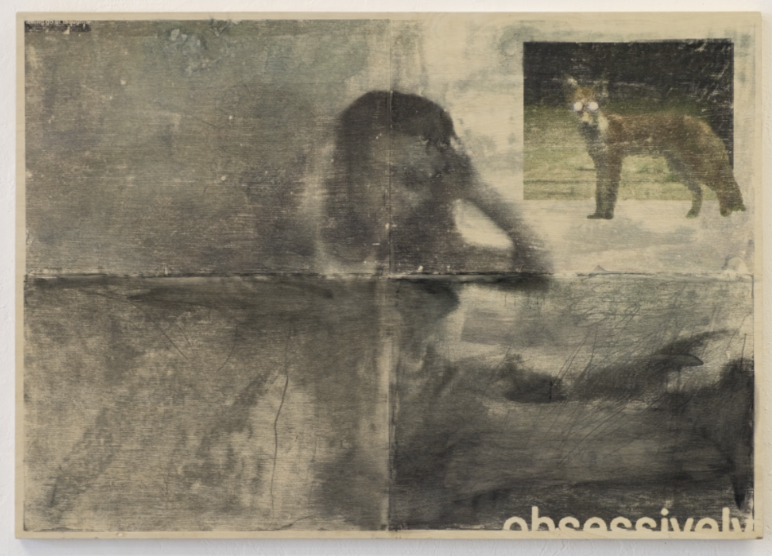
Karson Selah Samons, What Are the Options When There is No Control?, 59.4 x 84.1 cm, Image transfer on wood canvas
This concern continues in Samons’ image transfers on wood. What Are the Options When There Is No Control? (2026) brings personal and found imagery into uneasy proximity: body parts, dead animals, text and industrial landscapes overlap without settling into a fixed sequence. Meaning is formed intuitively rather than chronologically, reflecting the fragmented manner in which memory and anxiety are often experienced. In Shooting the Dark (2026), a blurred image of a woman appears alongside a pale fox and partially concealed text. Hovering between witnessing and recording, the work presents photography as an attempt to hold onto a present that is already disappearing.
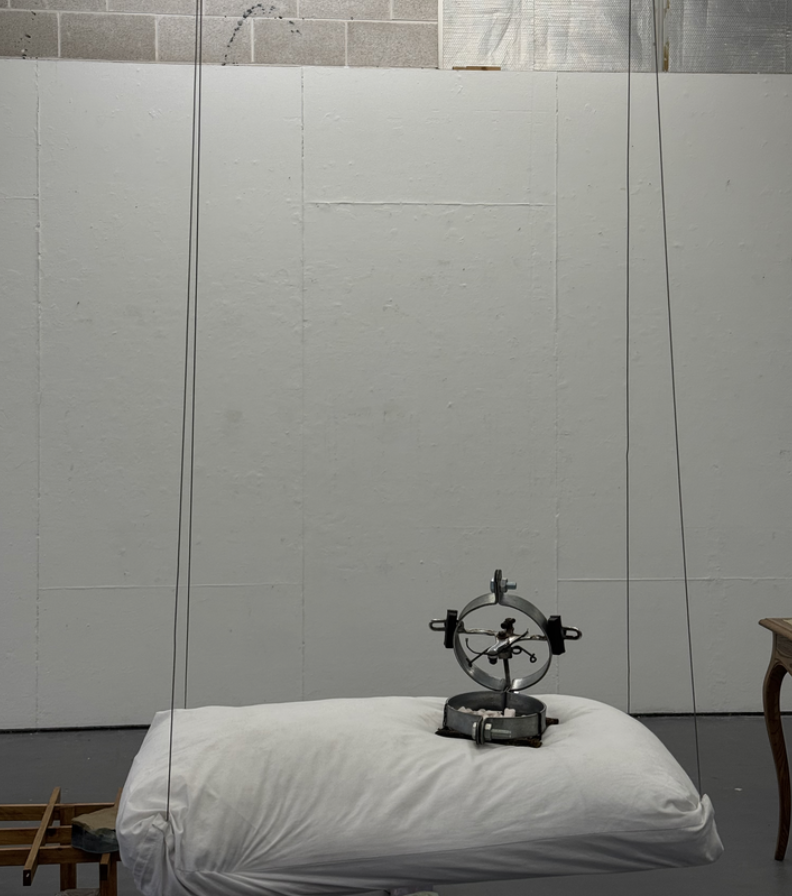
Lara Chahine, Bruxism, 2026, 15 x 15 x 10cm, Sculpture, metal, found objects. To be suspended from the ceiling.
Elsewhere, anxiety manifests through the physical symptoms it produces. Lara Chahine’s Bruxism (2026) transforms metal and found objects into a suspended sculptural form reminiscent of a head or jaw. Resting on a floating pillow, its screws, rods and stretched wires evoke teeth grinding during sleepless nights. The pillow promises rest, yet the metal structure above it suggests a body unable to escape its own tension. A private psychological state is made visible through the imagined pressure of one material against another.
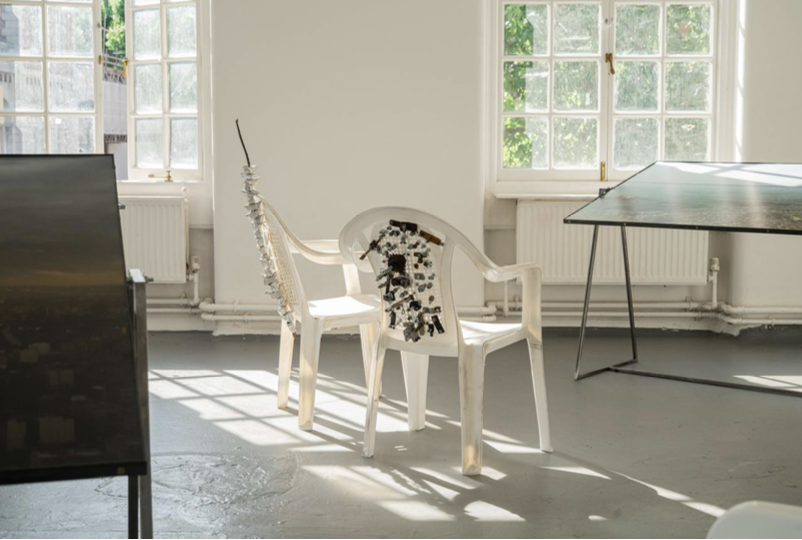
Lara Chahine Thrones of Earth and Heaven
2 Lebanese monobloc chairs with metal and ceramic fixings 2025-2026
Chahine’s Thrones of Earth and Heaven (2025–26) expands this bodily unease into the social and political landscape of Lebanon. Two plastic monobloc chairs, familiar features of Lebanese streets, have been altered with ceramic and metal attachments. Some of these additions resemble a spine, giving the chairs an uncanny bodily presence. Once associated with rest and communal gathering, they have become uncomfortable and unusable. The work brings violence into contact with ordinary social life, revealing how political instability can become embedded in the objects and spaces of the everyday.
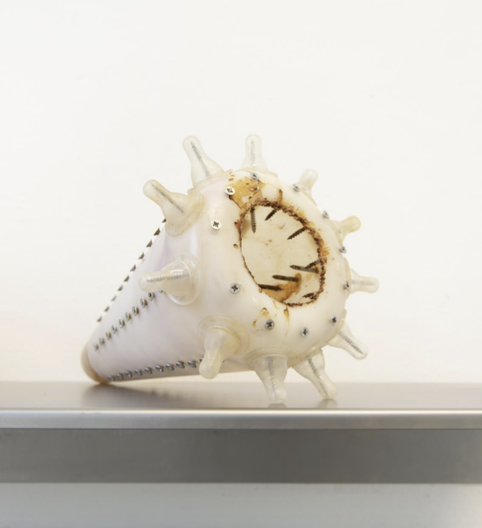
Enthrope 2, 40cm x 25cm, Nursing nipples, Screws, Discarded bottle, Rust Composite.
Esmé Matthews similarly unsettles familiar objects by transforming items associated with care into sources of bodily horror. In Clogged Duct and Entrope 2 (both 2026), plastic nursing nipples are attached to discarded bottles using rusted nails and screws. Their soft, nurturing function is disrupted by materials associated with puncture and injury. These hybrid objects imitate parts of the body while remaining visibly artificial, producing an uneasy relationship between intimacy, care and industrial waste.
Matthews’s Breathe, Maybe? (2026) addresses the physical management of anxiety more directly. Displayed as text on an LED screen, the title reads like an uncertain instruction issued during a moment of panic. Breathing and meditation are frequently presented as ways of regulating the nervous system, yet the hesitant “maybe” acknowledges the limitations of individual self-soothing when confronted by ecological disaster and global conflict. The work asks what it means to process problems of planetary scale through the vulnerable limits of a single body.
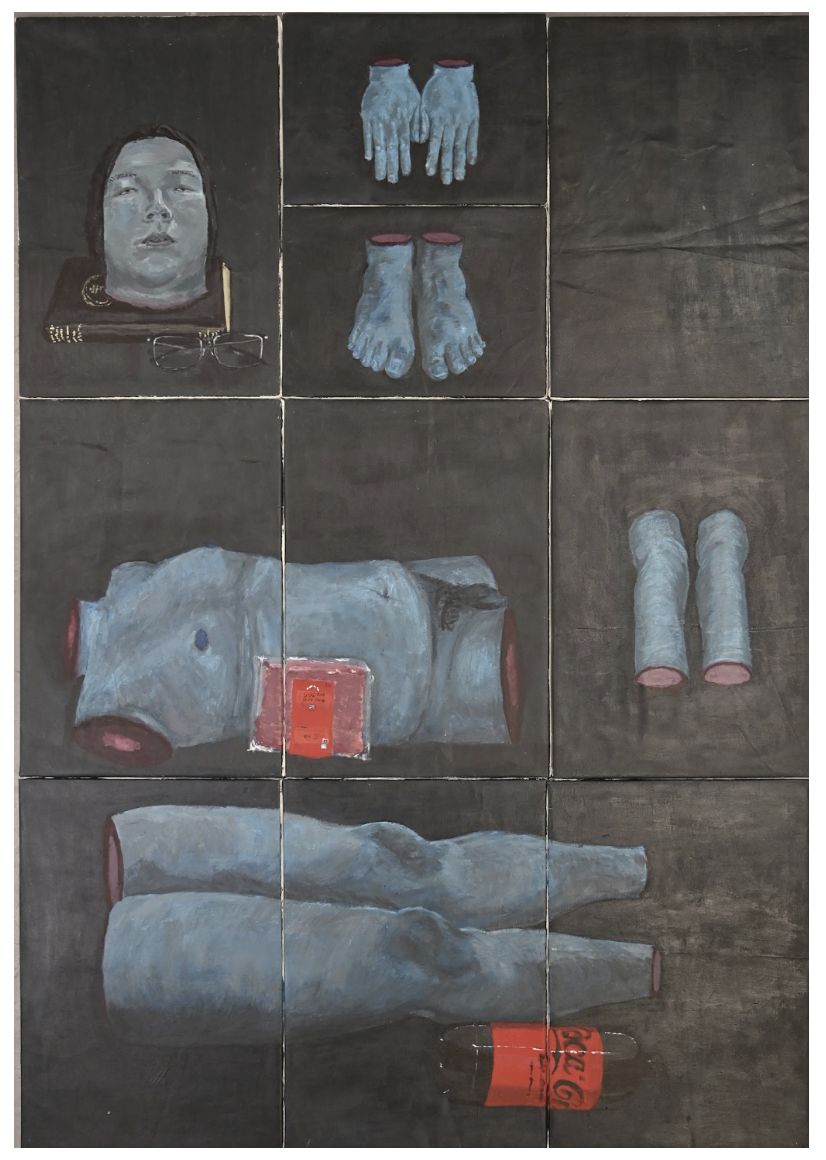
Zili Jiang, Still, Acrylic on Canvas, 126 x 178cm.
Questions of mortality become particularly explicit in Zili Jiang’s paintings. Composed of ten canvases arranged on the floor, Still (2026) depicts a fragmented corpse in blue against a dark background. Its bodily sections appear at once horrific and clinical, as though they were biological specimens prepared for study. Everyday objects, including a Coca-Cola bottle and books, place the remains within the material world while heightening their strangeness. The work’s title also recalls Damien Hirst’s 1994 sculpture Still, extending its examination of death, preservation and display.
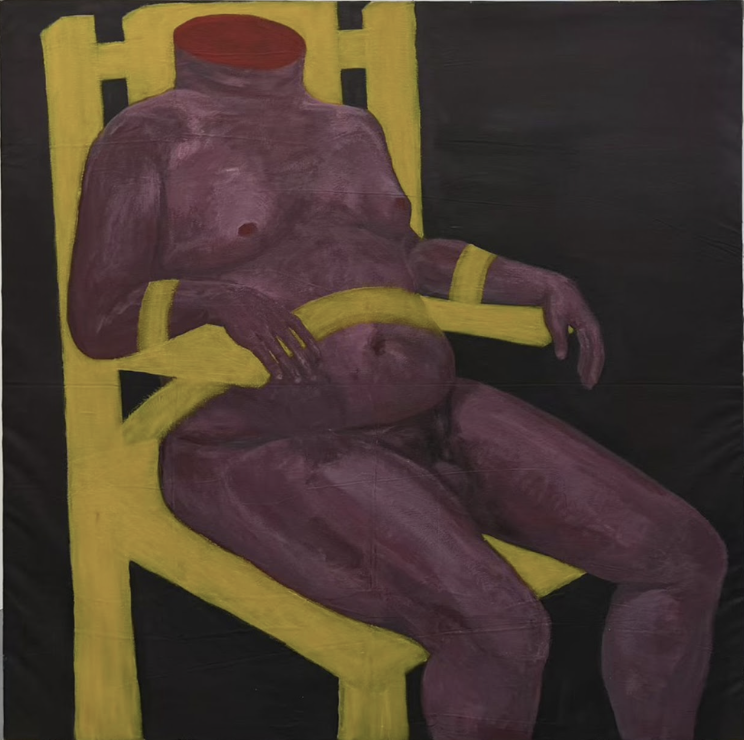
Big Electric Chair (Yellow), 2026, 172 x 172 cm, Acrylic on canvas
In Jiang’s Big Electric Chair (Yellow) (2026), a decapitated purple figure occupies an electric chair against a black ground. Death is presented through two forms of violence: beheading and state execution. The painting nevertheless creates a paradoxical distance between the viewer and mortality. To experience fear in front of the image is also to remain conscious of being alive. Death becomes simultaneously immediate and unreachable.
Qiyue Huang’s The Endometrial Archive (2026) challenges the authority of medical observation by preserving menstrual blood in eight small resin works, each accompanied by a metal plaque bearing the artist’s text. Created in relation to Huang’s experience of polycystic ovary syndrome, the installation turns material normally discarded as waste into a lasting bodily record.
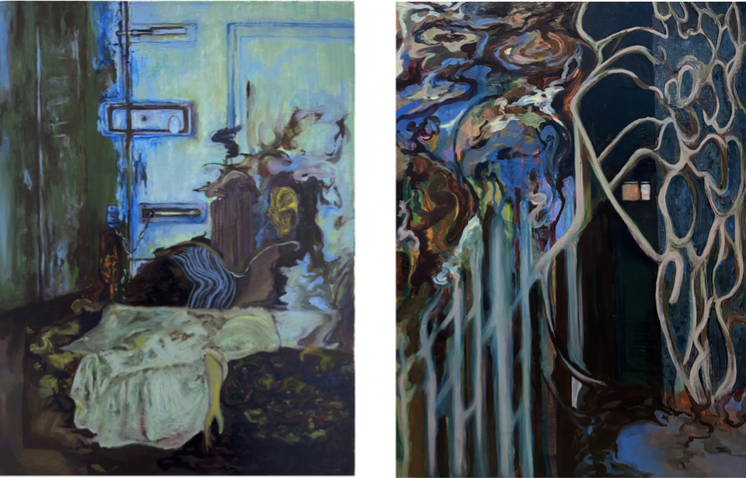
Wanqi Zhu, Spider, 2026, oil on canvas, 30 x 40cm & Bones, 2026, oil on canvas, 30 x 40cm
Wanqi Zhu’s paintings offer quieter, more ambiguous encounters with embodiment. In Spider and Bones (both 2026), cold blue interiors and enclosed architectural spaces are interrupted by partial figures and flowing skeletal forms. Bodies appear to merge with their surroundings, complicating the division between physical presence, memory and space. What initially seems recognisable gradually becomes uncertain: an arm dissolves into an interior, while pale organic forms suggest bones without fully becoming them.
Throughout Under Examination, the body moves between the intimate and the political, the psychological and the ecological. Scientific and medical systems promise that careful observation will produce knowledge, but these works suggest that the body cannot be understood through external scrutiny alone. It is never merely an object placed beneath the examiner’s gaze. It is also the instrument through which fear, longing, violence and uncertainty become real.
To understand the world, Under Examination suggests, we must do more than look at the body. We must also recognise what it means to feel through it.
Under Examination is at Triangle Space, Chelsea College of Art, 16 John Islip Street, London SW1P 4RL, from 17–25 September 2026. The opening reception takes place on Wednesday 16 September, from 6–8pm. Follow @under_examination on Instagram.
Amelia Holdsworth
Reviews Editor, MADE IN BED