Rama Duwaji, Bad Bunny, and the Return of the Metaphysical
In a constantly turbulent world, celebrities and political figures increasingly function as symbols of the present, embodying both its tensions and its escapist desires. Yet in the portraits of Szilveszter Makó, these figures appear curiously removed from such volatility. By rendering highly visible public figures in states of composed stillness, Makó transforms them into near-metaphysical icons, reflecting a broader cultural impulse to stabilise and aestheticise instability through image-making.
In the United States, where cultural and political life is amplified by the country’s dominance in the entertainment industry, this transformation is particularly pronounced. When Bad Bunny stepped onto the stage for the Super Bowl halftime show this year, the spectacle felt as inevitable as it was divisive. For some, it stood as a forceful assertion of Latin identity upon one of the nation’s most visible cultural platforms; for others, it reopened familiar debates surrounding politics, representation, and national identity within an already polarised climate. The event unfolded in motion, choreography, sound, spectacle, and controversy circulating in real time across millions of screens. Yet, away from the commotion, the lens of Szilveszter Makó captures the singer seemingly suspended in time.
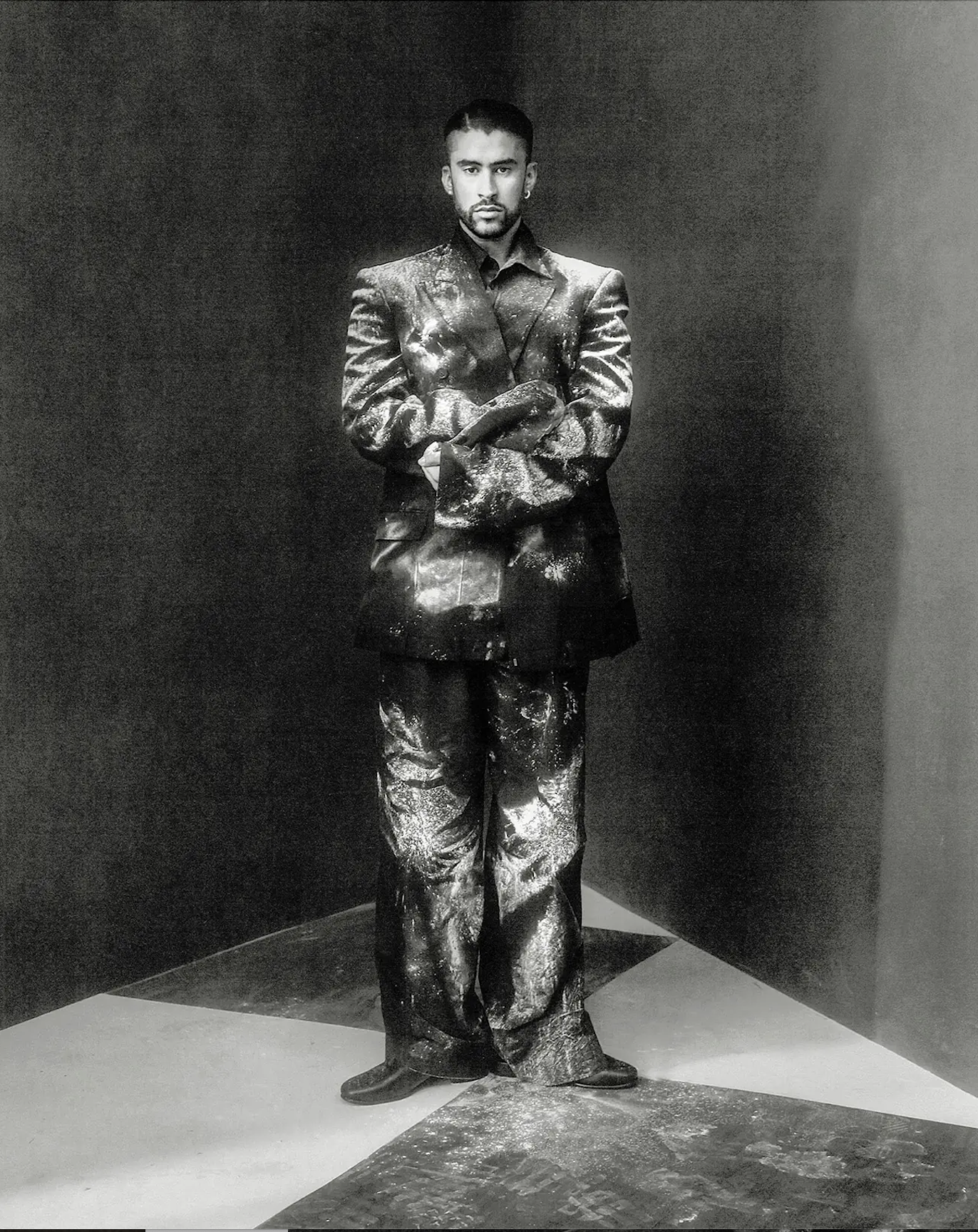
Szilveszter Makó, Bad Bunny (2026). Photo courtesy: Vanity Fair.
Makó, a Hungarian-born photographer currently based in Milan and working between Europe and the United States, steadily emerges as a distinctive voice within contemporary portraiture. Educated within a European artistic framework and open about his interest in Surrealism, his practice balances theatrical construction with emotional restraint. His portraits often blur the boundary between fashion photography and fine art, staging public figures within meticulously composed interiors that feel at once intimate and architecturally deliberate. While his recent images of high-profile cultural figures have circulated widely in media and online spaces, his visual language resists immediacy. Instead, they cultivate suspension: a sense that the subject exists slightly outside the flux of current events.
This tension between turbulence and stillness lies at the heart of Makó’s recent portraits of highly visible public figures, including Bad Bunny and Rama Duwaji, the artist and wife of New York’s newly elected mayor. Both figures occupy charged symbolic positions within contemporary American culture. Both are embedded in political discourse. And in Makó’s images, both appear curiously removed from urgency—poised, composed, and faintly estranged from the volatility that surrounds them.
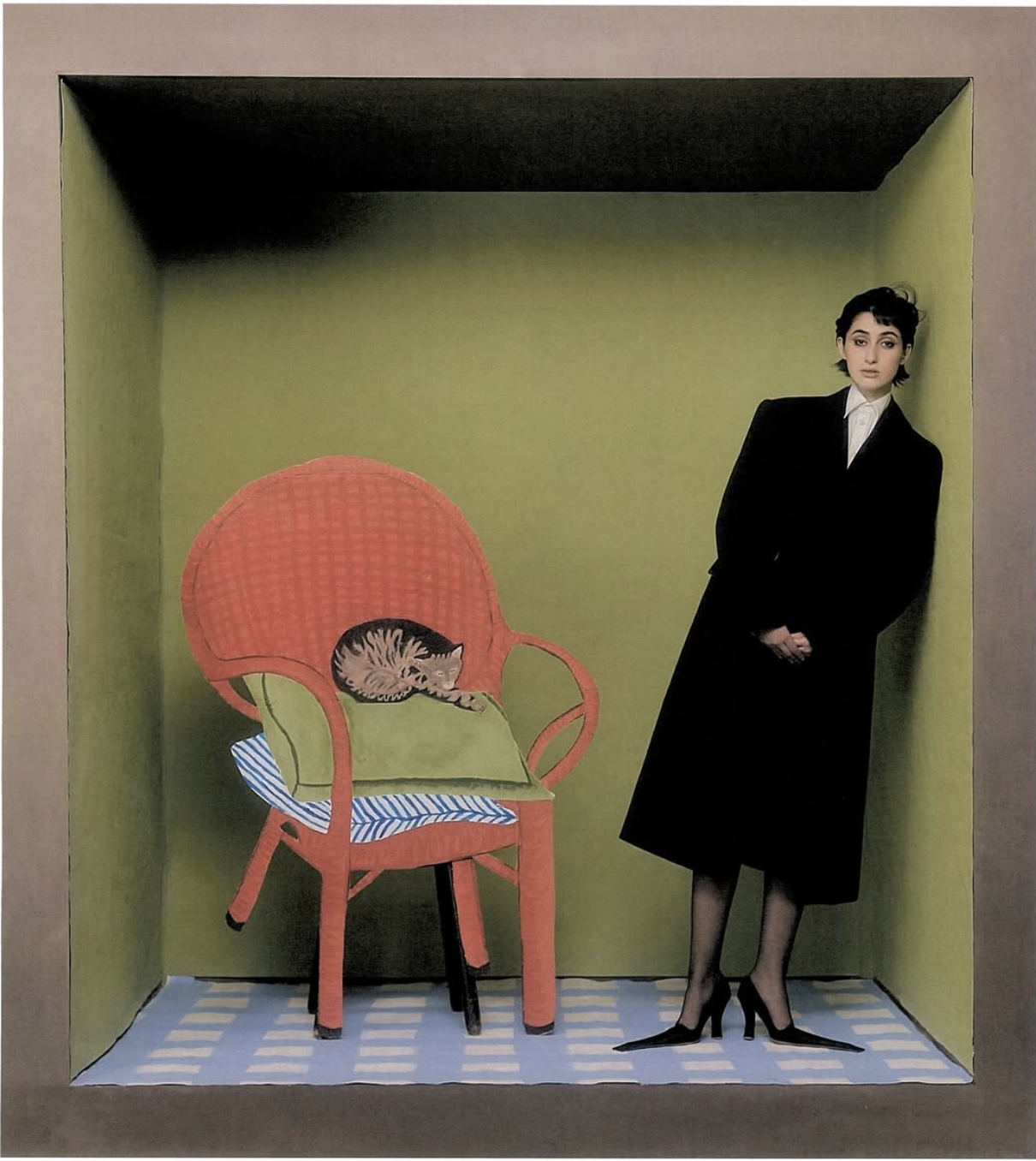
Szilveszter Makó, Rama Duwaji (2026). Photo courtesy: The Cut.
Makó has spoken of his desire to create images that contain an element of fantasy while remaining balanced. In his research folders, he has referenced Oskar Schlemmer’s Triadic Ballet of the 1920s, in which dancers hover somewhere between bodily presence and abstract geometry. Schlemmer once described his work as driven by a desire to discover a form suited to our present moment. The phrase resonates sharply today: what is the appropriate form for an era defined by political fragmentation, digital hyper-visibility, and cultural anxiety? Makó’s portraits suggest one answer: stillness.
In his images of Rama Duwaji, we encounter not a candid political spouse but an icon carefully staged within architectural space. She stands sharply dressed, her silhouette clean against a composed backdrop. The framing feels deliberate, almost geometric. The body appears disciplined within its environment; the surrounding architecture does not merely contain her but participates in her construction as image. The effect is controlled and faintly uncanny. Duwaji looks present yet removed, grounded yet suspended. We are not simply looking at a person but at a figure arranged into symbolic clarity; a representation of generational shift and cultural soft power distilled into sculptural form.
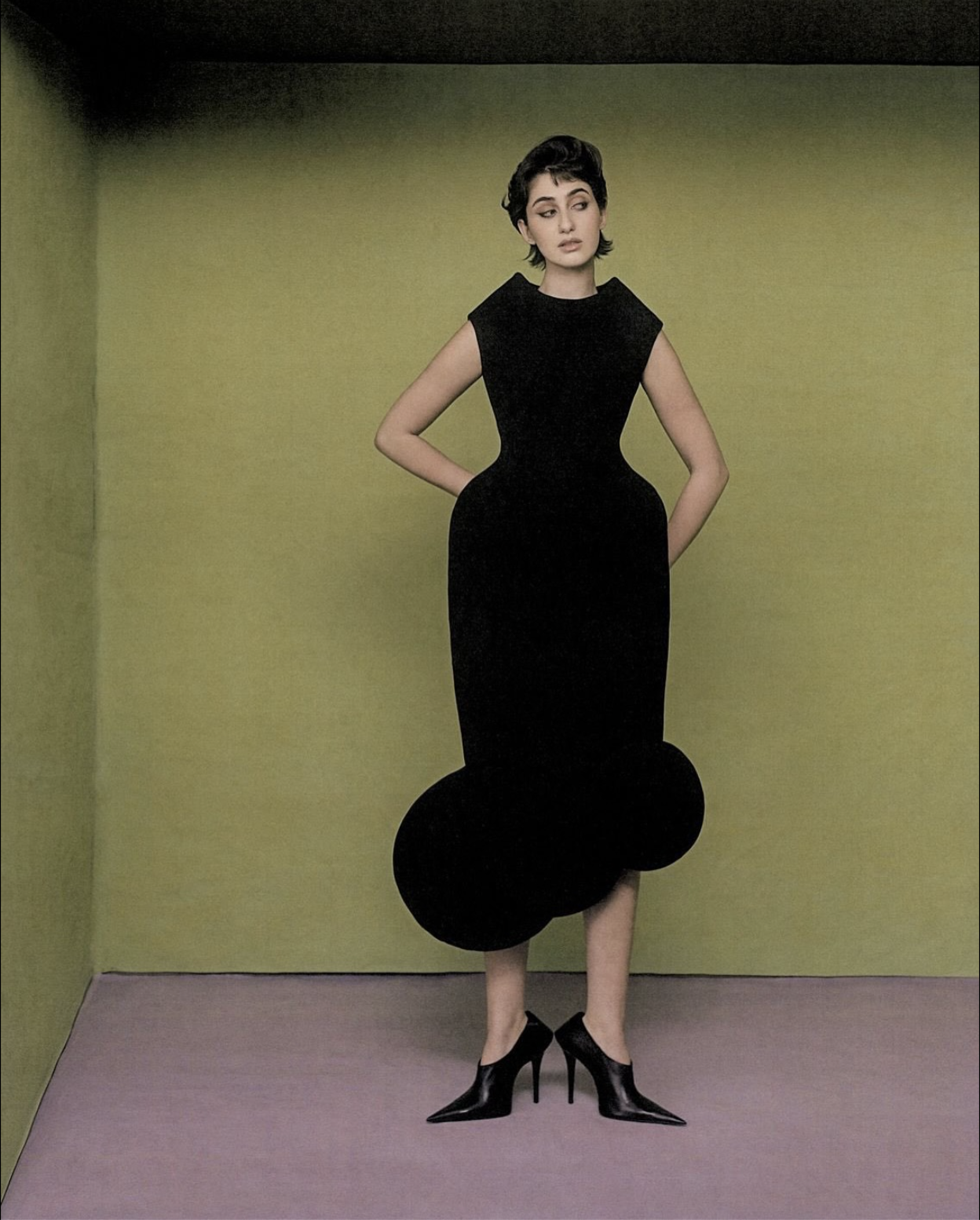
Szilveszter Makó, Rama Duwaji (2026). Photo courtesy: The Cut.
Makó’s treatment of Bad Bunny operates similarly. Known for kinetic performances and a recent album, Debí Tirar Más Fotos, which engages with Puerto Rican identity and questions of colonial history, Bad Bunny embodies movement and disruption. Yet in Makó’s portrait, he is rendered motionless. Theatrical lighting sculpts his presence; the setting appears staged rather than spontaneous. He seems monumental, almost statuary, distanced from the media storm that often accompanies him. The dream-like atmosphere does not erase his political significance, but it reframes it. The volatile becomes contemplative.
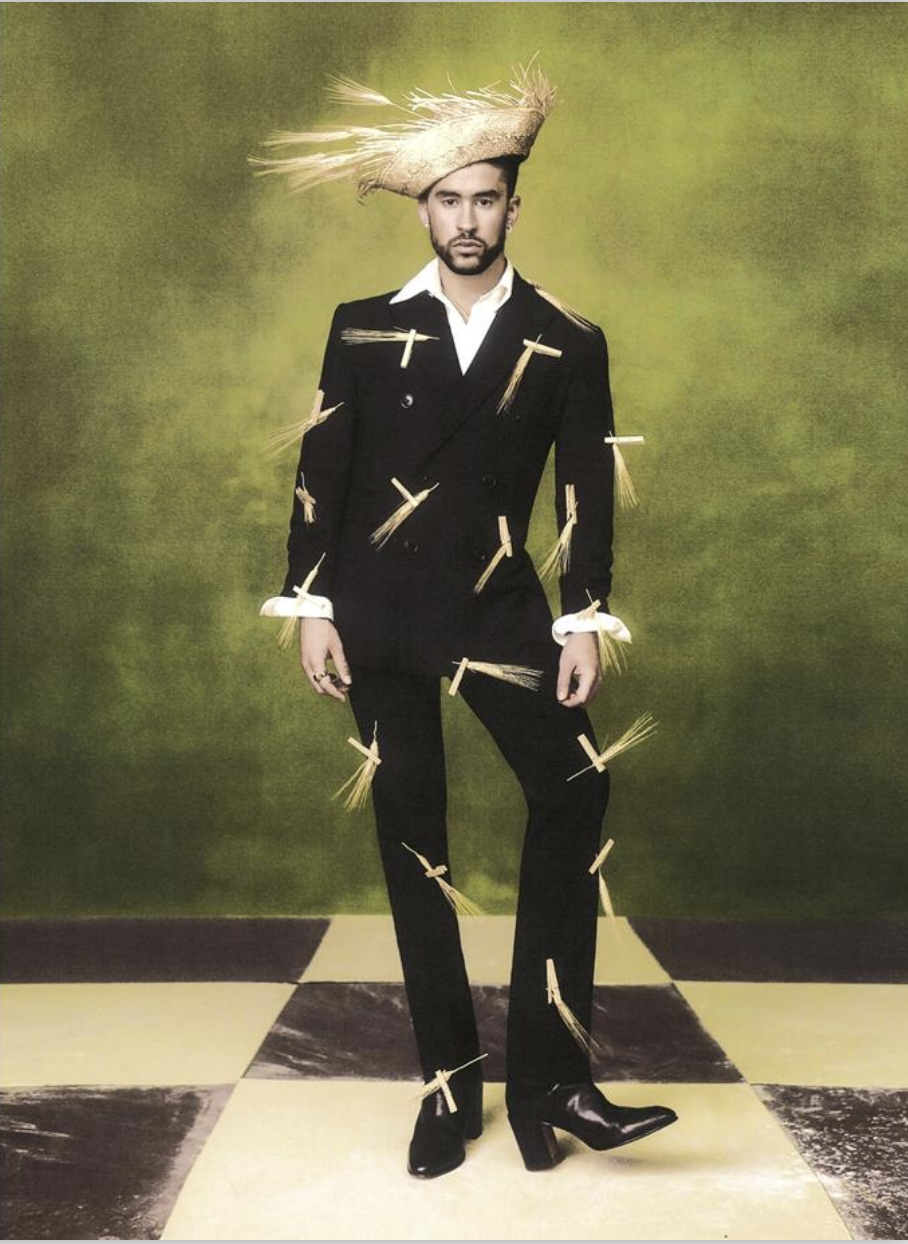
Szilveszter Makó, Bad Bunny (2026). Photo courtesy: Vanity Fair.
In this composed theatricality, a historical echo begins to surface. The aesthetic strategies visible in Makó’s work recall the early twentieth-century movement known as Pittura Metafisica—or Metaphysical painting—initiated by Giorgio de Chirico and Carlo Carrà in Ferrara around 1917. Using a realist style, these artists painted eerily empty Italian piazzas populated by statues, mannequins, and strange juxtapositions of objects. Shadows stretched across deserted squares; human figures appeared immobilised, often mannequin-like, caught between life and objecthood. The result was a visionary world of the mind, a reality beyond physical immediacy.
Though the collaborative phase of the movement was brief, its influence was lasting, shaping later Surrealist approaches and particularly the oneiric visions of artists such as Max Ernst. Crucially, Metaphysical painting emerged during a moment of profound instability. Pre- and post-war Europe grappled with national upheaval, technological acceleration, and existential uncertainty. The emptied squares and frozen figures of de Chirico’s canvases did not merely depict architecture; they materialised a climate of displacement.
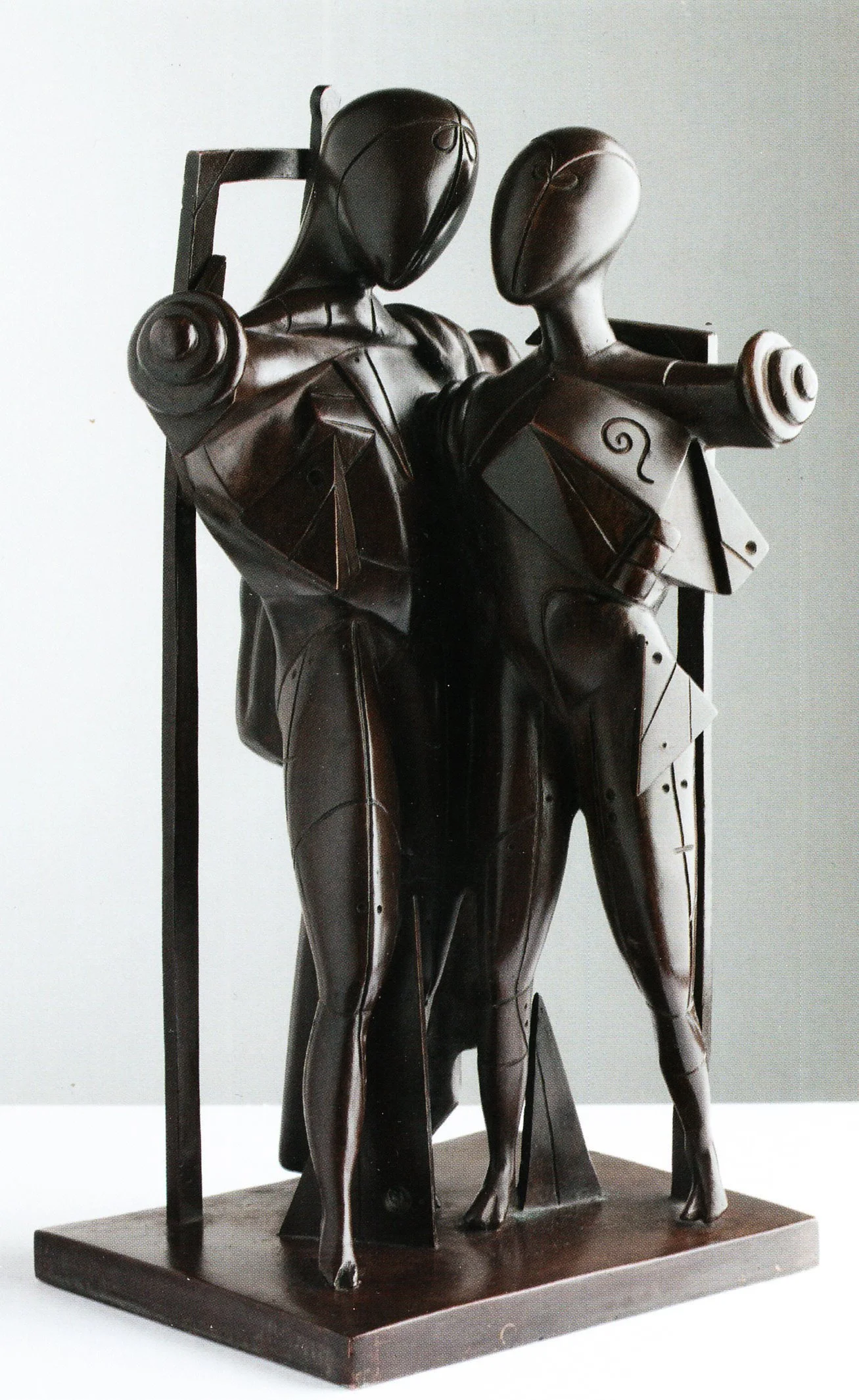
Giorgio de Chirico, Hector and Andromache, (1968). Photo Curtesy: Estorick Collection.
The resonance with the present is difficult to ignore. Contemporary America is marked by political polarisation, identity debates, and cultural fragmentation. Public figures such as Duwaji and Bad Bunny become lightning rods for these tensions. They are not simply individuals but surfaces upon which collective anxieties are projected.
Makó’s work, whether consciously or subconsciously shaped by artistic lineage, appears to translate this instability into composed visual order. His Hungarian origins invite a subtle parallel with artists such as Sándor Bortnyik, whose painting The New Adam presents the human figure stylised and integrated into a geometric, modernist spatial logic. In that painting, the body becomes architectural, disciplined, constructed, and emblematic. Makó’s portraits echo this dynamic: his figures appear crystallised within their environments, as though contemporary identity itself were something staged and engineered.
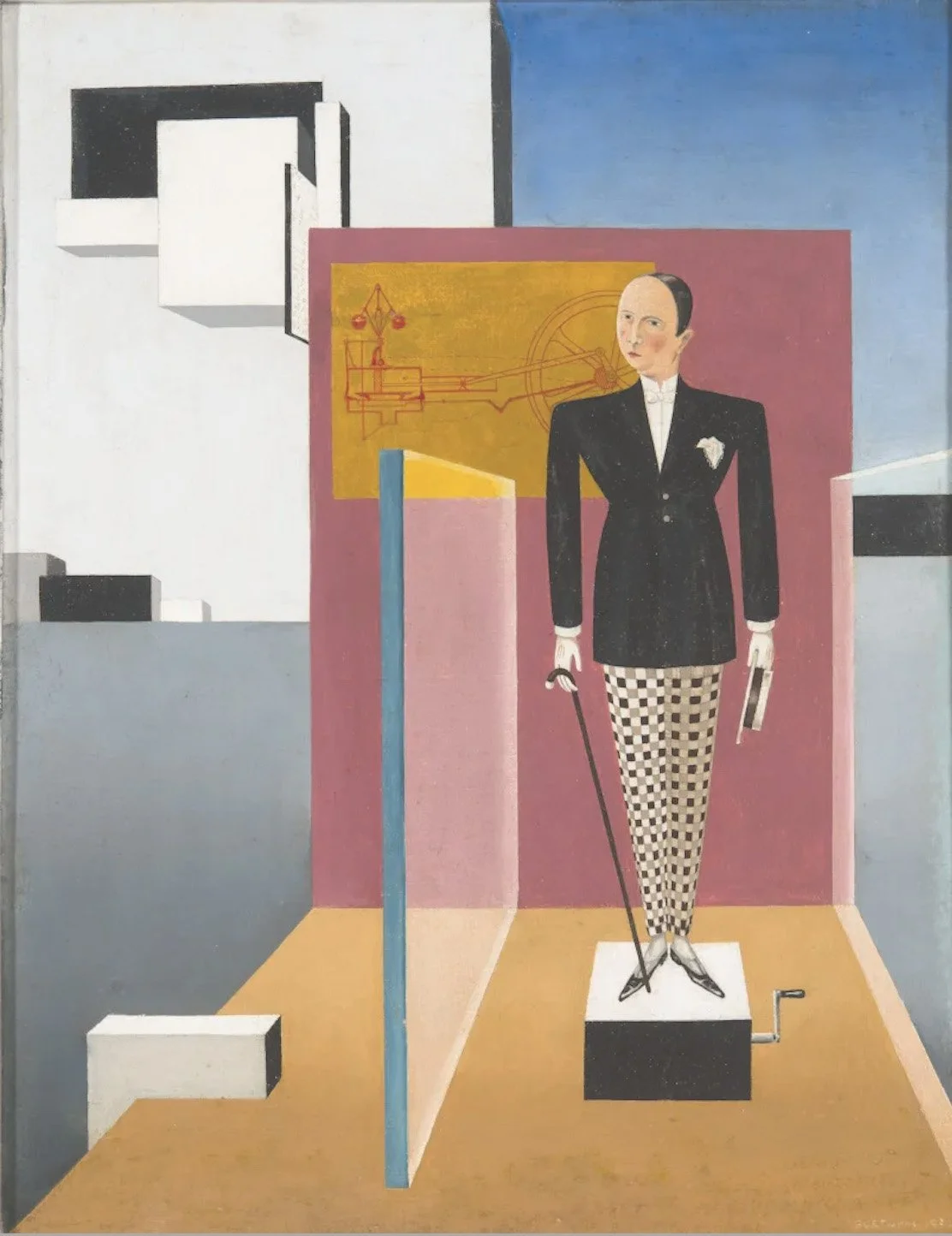
Sándor Bortnyik, The New Adam, (1924). Photo Curtesy: CRAACE.
Artistic forms have a way of resurfacing during moments that demand them. During periods of instability, representation often shifts from spontaneity to symbolism; we seek forms capable of stabilising what feels fractured. By rendering volatile public figures as composed, almost timeless presences, Makó’s portraits slow the image down. They monumentalise the moment.
This aesthetic move is not without ambiguity. Does transforming politically charged individuals into sculptural icons elevate them into myth, granting them enduring symbolic weight? Or does it neutralise their volatility, freezing living politics into consumable imagery? The tension remains unresolved, and perhaps that is precisely its power.
If the early twentieth century produced metaphysical piazzas in response to existential rupture, the early twenty-first century appears to have produced metaphysical portraiture. The media differ—oil paint replaced by high-gloss photography—yet the impulse feels familiar. Both attempt to find a visual language appropriate to their times.
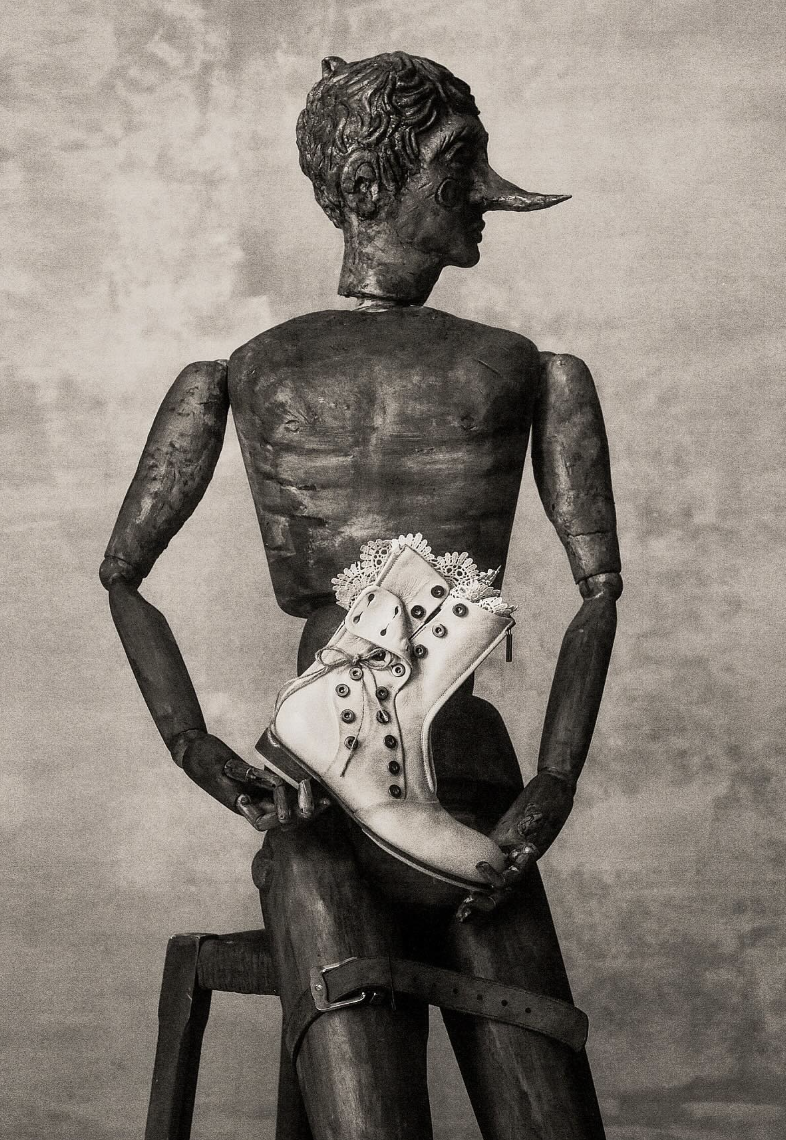
Szilveszter Makó, Idas Campaign (2025). Photo courtesy: IDAS.
Makó’s portraits of Rama Duwaji and Bad Bunny thus extend beyond celebrity documentation. They participate in a longer artistic conversation about how instability is pictured and contained. Through geometry, theatricality, and stillness, contemporary cultural figures become metaphysical icons: embodiments of a political present that feels both urgent and suspended. In rendering turbulence motionless, Makó does not escape history. Rather, he demonstrates how persistently it returns, and is reshaped and reframed in the faces that come to symbolise our era.
Further Reading:
Andres, Jackie. “Szilveszter Makó’s Surreal Photographs Reconstruct the Boundaries of Portraiture.” This Is Colossal, February 12, 2026.
Carrà, Carlo. Metaphysical Painting. Florence: Vallecchi, 1919.
Healy, Claire Marie. “Szilveszter Makó: Theatrical, Painterly Photographs That Take Us Back in Time.” WePresent, WeTransfer, 2026.
“Metaphysical Marvels: Giorgio de Chirico and Carlo Carrà.” Estorick Collection of Modern Italian Art.
Xénia Chudinova
Features Co-Editor, MADE IN BED
Disclaimer: The views, thoughts, and opinions expressed in MADE IN BED are solely those of the individual authors and not those of MADE IN BED magazine or of Sotheby’s Institute of Art.