

Music as Material: How Sound Shapes Visual Experience in London Exhibitions
Contemporary exhibition-making has progressively shifted beyond the limits of simply looking, now creating spaces that activate multiple senses through immersive and interdisciplinary approaches. With this shift, sound has evolved into a material in itself, capable of engaging audiences by guiding their movement through space and reshaping how the visual counterparts to sound are perceived. This creative exchange between the audible and visual manifests through two distinct, yet comparable, London exhibitions. In both the V&A East Storehouse and Serpentine Gallery, music no longer functions as a supplementary backdrop, but a crucial component in restructuring how exhibitions are presented, experienced, and understood.
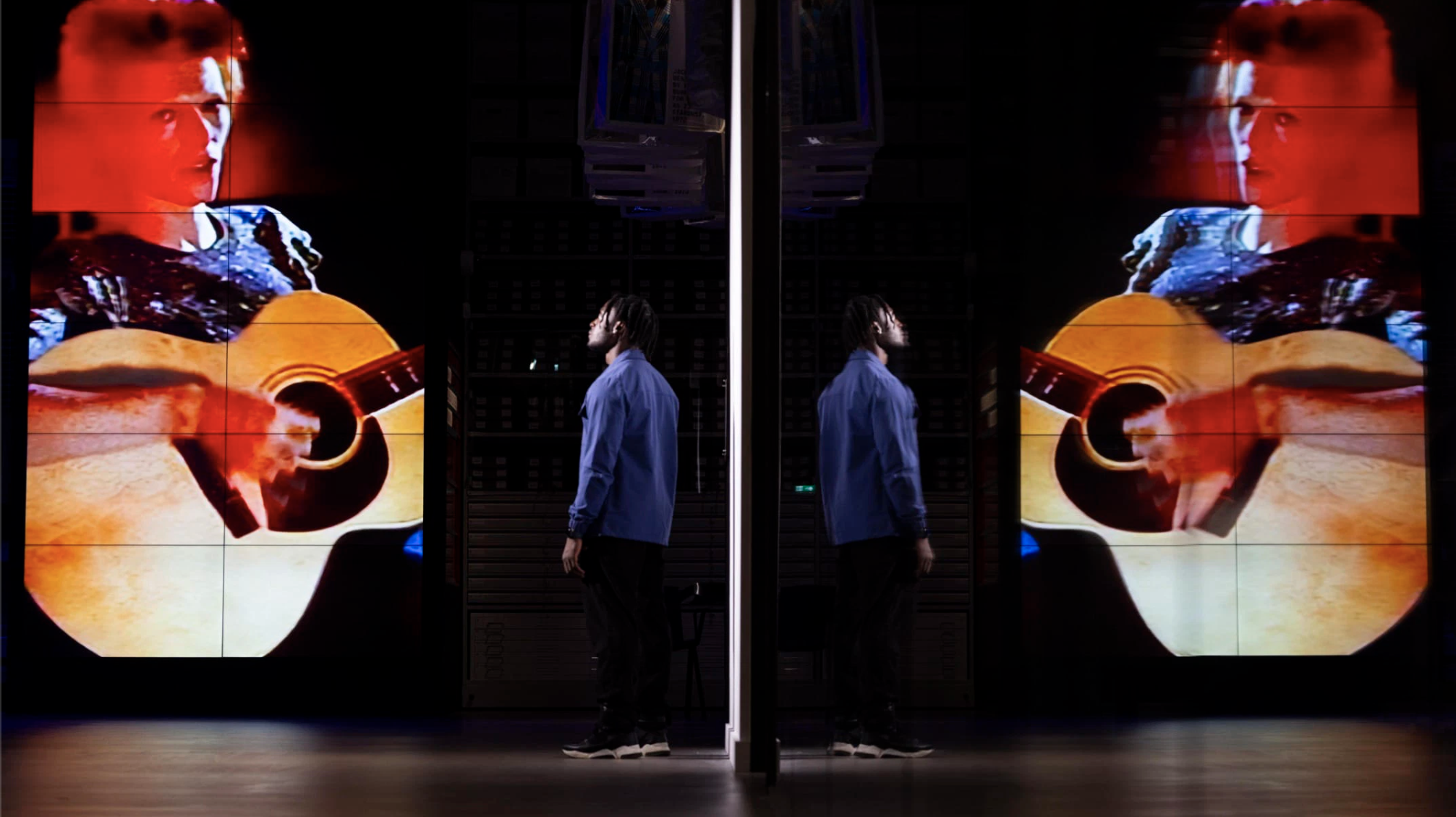
David Bowie Centre, V&A East Storehouse. Photo Courtesy: David Parry.
Amidst the V&A East Storehouse’s vast collection of objects, artworks, and research operations, exists a room permanently dedicated to one of the greatest musicians and performers of all time, the David Bowie Centre. Upon entering, visitors are immediately greeted by the familiar funky guitar riffs and ranging vocals of the artist before the space and its contents reveal themselves visually. Garment bags labeled with prominent designers and significant performance dates line the ceiling, suspended above a table where dedicated fans sift through an expansive wall of portfolios. Opposite, numerous glass display cases house costumed mannequins and props, presented alongside awards, sketches, photographs, and handwritten notes related to the respective events for which they were designed. At the centre of the space, a floor-to-ceiling monitor plays key performances and iconic music videos, drawing a crowd that engages with the footage as if it were currently happening rather than being a recorded projection. From this screen emerges the recognisable sounds that fill the room, linking the objects on display in a static, formal arrangement to their live, performing forms captured on film. Rather than producing new, original artworks, the archive offers an intimate look into the rock legend’s creative process through the display of existing artifacts, with sound actively shaping how these objects are experienced. It is a space focused on celebrating legacy while simultaneously reactivating its contents, inspiring new generations to engage through memory and research.
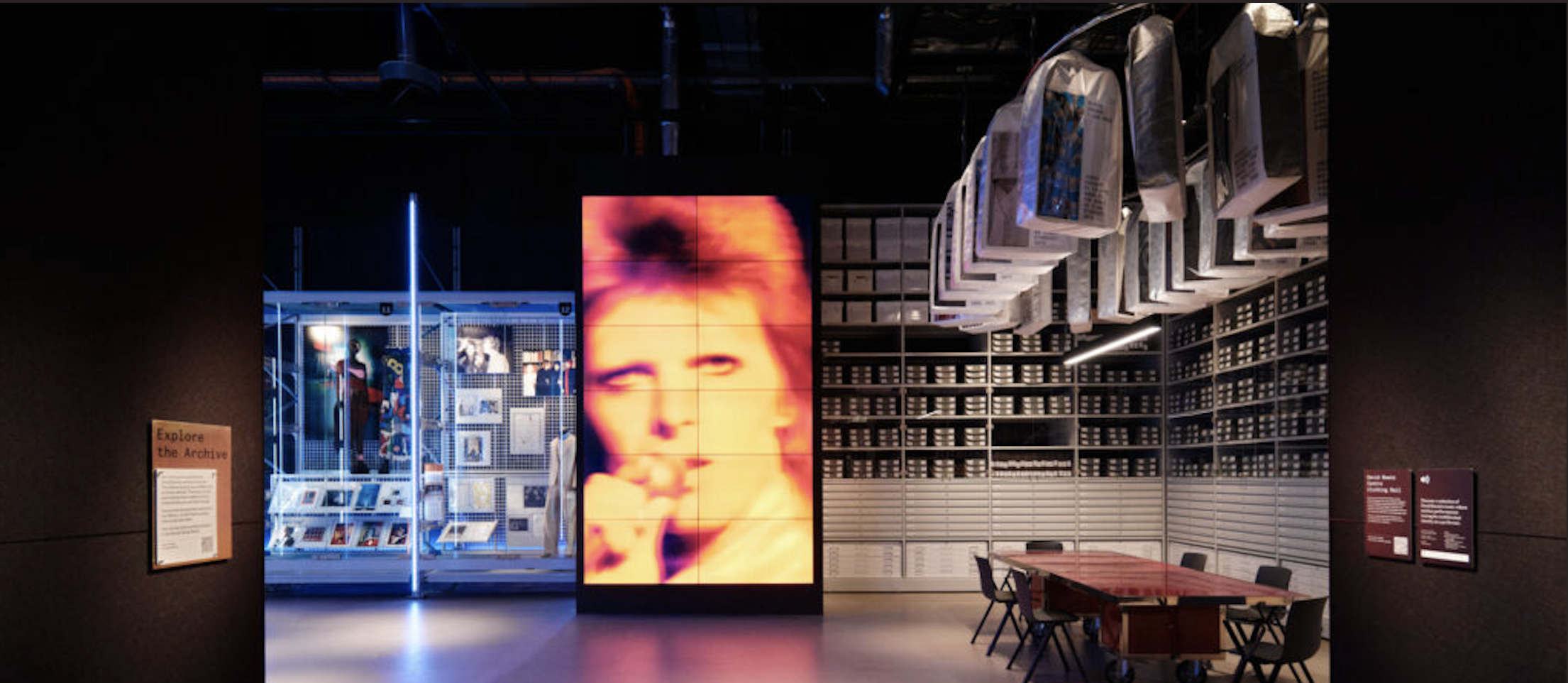
David Bowie Centre, V&A East Storehouse. Photo Courtesy: Henry Woide.
While the David Bowie Centre utilises music for preservation, a contrasting approach can be found within a more conventional gallery context. Inside London’s Kensington Gardens stands Serpentine South Gallery, a site that has presented contemporary art for over 50 years through interdisciplinary displays spanning art, architecture, performance, and community projects. Their recent exhibition, Peter Doig’s House of Music, transformed the traditional gallery space into a multi-sensory environment, bridging painting, sound, and antique objects. Doig views music as a physically invisible art form, however, he believes that songs have the capacity to become highly visual through listeners’ imaginations and interpretations. Inspired by this idea, the exhibition aims to explore the visuals conjured from auditory experiences. Rooted in Doig’s life in Trinidad, the paintings’ recurring visual motifs depicting musicians, dancers, and everyday scenes mirror the audience’s direct engagement with sound in the space. Upon entering the gallery, visitors are met with a series of paintings against white walls, while faint echoes of nearby music subtly fill the space. As visitors are naturally guided to the following room, they encounter the first of three restored vintage cinema speakers, playing music selected by the artist from his personal collection of vinyl records and cassette tapes accumulated over decades. A 1950s wooden Klangfilm Euronor speaker stands against a vibrant chartreuse curtain, surrounded by similarly toned wooden tables and chairs. The brightly lit room and canvases’ color palettes reflect the upbeat playlist curated by the artist, inspired by modern influences of Trinidadian jazz and reggae such as James Brown, Patti Smith, and Prince. The second Klangfilm Euronor speaker is positioned within the final room of the exhibition, a darkened space with spotlights intentionally directed toward both the paintings and the speaker. An arrangement of low-height reclining chairs invites visitors to dwell within the space, encouraging them to linger while viewing, listening, and at times, fostering quiet conversation among one another. Although seating was available in the first room alongside the speaker, visitors appeared to find greater comfortability settling into the darkness of this space. This final room becomes a culmination of loud music, captivating paintings, whispered conversations, and moments of individual contemplation. At the centre of the exhibition is a large-scale Western Electric / Bell Labs sound system, originally manufactured for the emergence of sound cinema in the 1920s and 30s. It serves to connect the surrounding speaker installations and showcase the evolution of sonic devices throughout the twentieth century. All three speakers, acquired from vacant cinemas across the UK, provide a historical and mechanical backdrop to the paintings, bridging technological innovation, contemporary practice, and sonic experience.
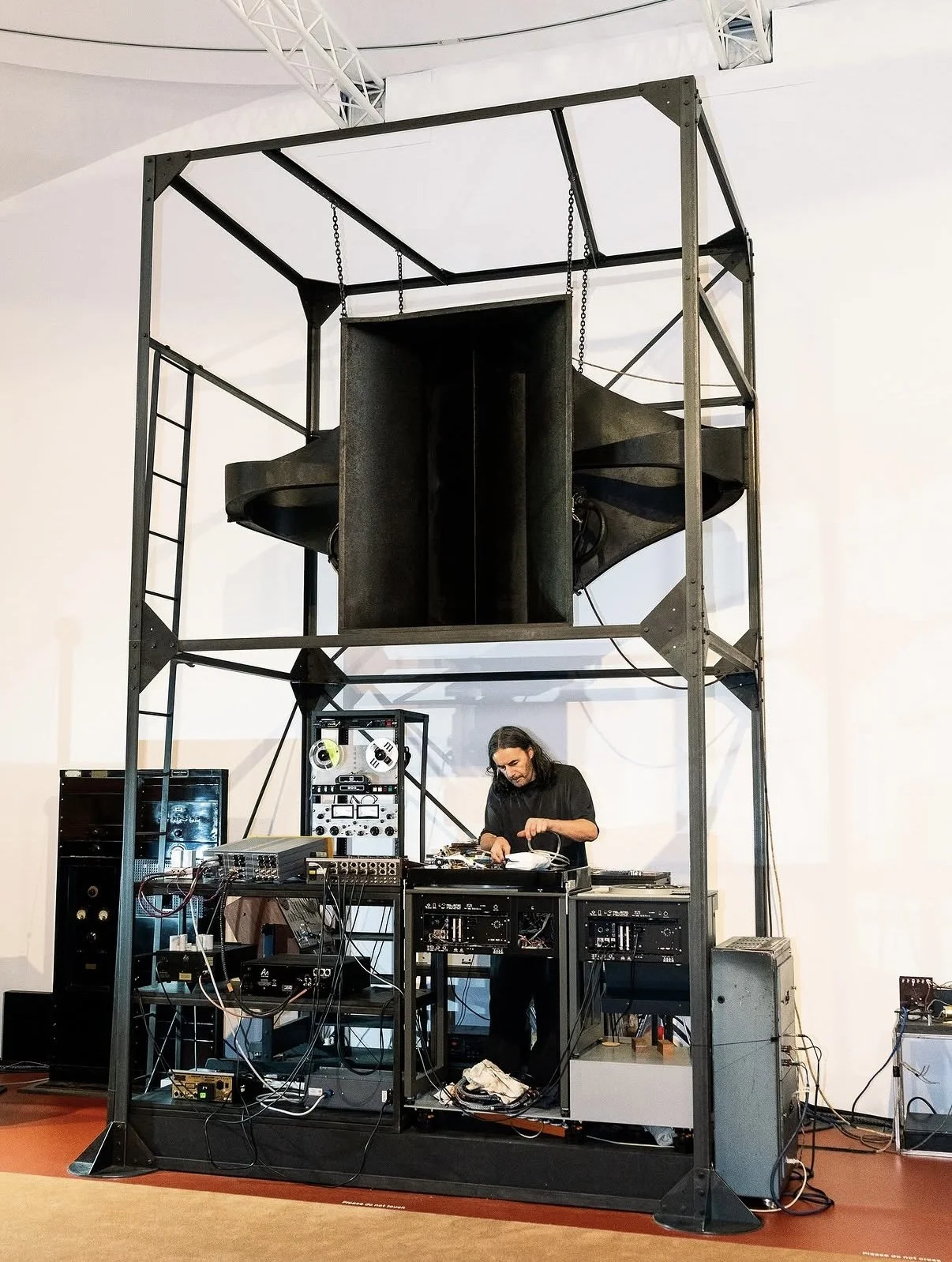
Western Electric / Bell Labs sound system, Peter Doig: House of Music, Serpentine South, 10 October 2025 – 8 February 2026. Photo Courtesy: @serpentineuk on Instagram.
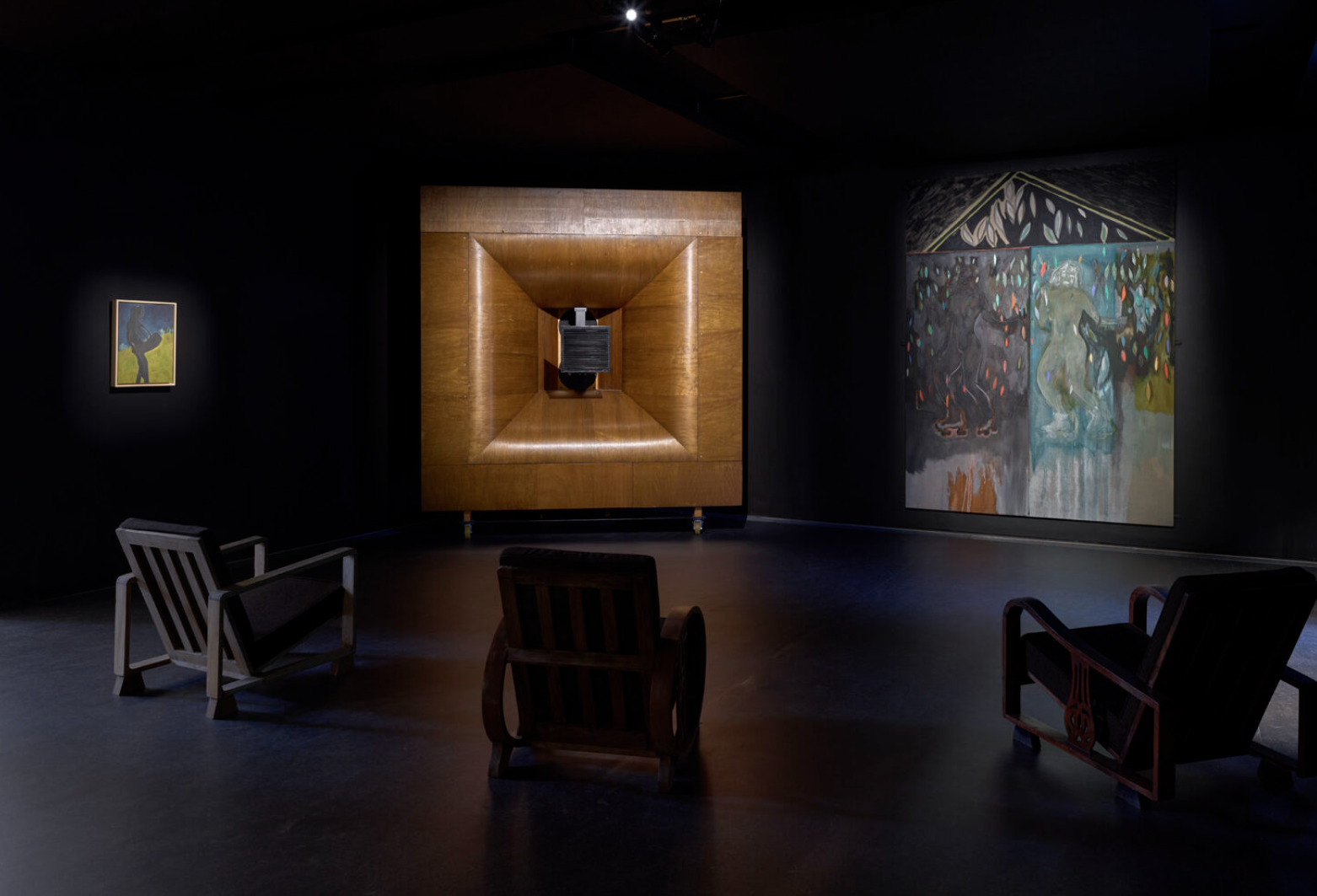
Klangfilm Euronor speaker, Peter Doig: House of Music, Serpentine South, 10 October 2025 – 8 February 2026. Photo Courtesy: Prudence Cuming Associates.
Both the David Bowie Centre and House of Music format music production and sound technology as active agents within the exhibitions, creating multi-sensory environments instead of music being purely background noise. Sound shapes the spatial experience, guiding audiences through both exhibitions with not just visual cues, but through rhythm, listening, and physical movement. However, the role sound plays is significantly different in each space. Within the David Bowie Centre, the music is what first existed before any of the objects, reconnecting the pieces to their origins. It allows audiences to step back into real points in history and experience close encounters with the physical remains of iconic musical moments. In contrast, the sounds and artwork of House of Music simultaneously bounce off of each other to generate an immersive environment. The use of antique speakers introduces a grounding sculptural and historical presence that shapes how the paintings and their accompanying selected soundtrack are encountered. While the archive uses sound to preserve the past, the gallery looks forward, using sound to produce a direct sensory experience.
These exhibitions are a transcendence beyond traditional, purely visual narratives, instead creating multi-sensory, interdisciplinary atmospheres that engage the audience’s experience in each space. Sound is not simply an addition, but a fundamental element crucial in shaping how both exhibitions are encountered and understood. There is a clear balance between the two disciplines, demonstrating a coexistence in which neither the visuals or music overpowers the other. In both exhibitions, the act of looking becomes deeply interconnected with listening, ultimately dismantling the boundaries between the two artistic practices and instead presenting them in collaboration. By treating music as a material rather than an additional element within an established exhibition, these spaces showcase the potential for how sound can redefine how visual art is experienced, transforming it into something active, immersive, and continuously evolving.
Ashley McCuller
Features Co-Editor, MADE IN BED
—————————————————————————
Bibliography
Doig, Peter. House of Music. Exhibition catalogue. Serpentine South, 10 October 2025 – 8 February 2026.
Serpentine Galleries. “Peter Doig: House of Music.” Accessed 29 March 2026.
https://www.serpentinegalleries.org/about/press/peter-doig-house-of-music/.
Serpentine Galleries. “Peter Doig: House of Music.” Accessed 29 March 2026.
https://www.serpentinegalleries.org/whats-on/peter-doig-house-of-music/.
Victoria and Albert Museum. “David Bowie Centre.” Accessed 29 March 2026.
Disclaimer: The views, thoughts, and opinions expressed in MADE IN BED are solely those of the individual authors and not those of MADE IN BED magazine or of Sotheby’s Institute of Art.