Alexis Kleeman in Conversation with Cynthia Valianti Corbett

Cynthia Valianti Corbett, Director and Founder, Cynthia Corbett Gallery and Young Masters Art Prize. Image Credit: Emma Pratte.
Cynthia Corbett, a former American economist, art historian, curator, and avid supporter of emerging artist careers, established her London-based contemporary art gallery in 2004. The gallery is nomadic and attends a variety of international fairs, exhibitions, and collaborative projects worldwide, providing an inclusive international platform for artists of all cultural heritages and sexual orientations, and working across different artistic media. In 2009, Cynthia established the Young Master’s Art Prize, a paneled award to further support emerging artist careers and foster a dialogue between Old Master works and young innovative interpretations of classical materials, techniques, and sources of inspiration. Today Cynthia and The Young Master’s Art Prize continues to support and bring international attention and opportunity to emerging artists from British, American, and international backgrounds. The Young Master’s Art Prize exhibition “Line of Beauty” (15 January to April 2026) is currently on at The Exhibitionist Hotel in South Kensington, presenting the Young Master's People’s Choice Award Winners Cristina Schek and runner-up Alexandra Baraister.
AK: I understand that you have degrees from the University of Massachusetts and Harvard in law, and later transitioned your career to art history and curation via the Christie’s Education Institute (RSA-Christie’s Education Diploma in Modern and Contemporary Art). Could you tell us about how your background in political science influenced the decision to pivot your career from international economics to the arts sector and opening a gallery? And what is the most valuable thing from your education that you use to run a successful art gallery?
CC: I have a BA from University of Massachusetts in Amherst in Political Science, history and languages and then a Masters in Law and Diplomacy from the Fletcher School of Law & Diplomacy. This is part of Tufts University affiliation with Harvard where I took courses in addition to Harvard Business School. My training in political science, law and diplomacy taught me to read systems, negotiate across cultures, and make decisions with long-term consequences in mind. International economics taught me that frameworks matter, but so do human values, both determine what a society chooses to protect and promote.
I pivoted my career because art is a form of cultural diplomacy: it carries memory, critique and imagination across borders with an immediacy that policy rarely achieves. Throughout my life I have been passionate about history and art history I loved going to Museums, ancient churches and I think much of this was due to the influence of my Italian grandparents who were immigrated to the USA and my New England Yankee/ Irish grandparents who were incredibly well read and were always taking us to the library and museums. I am also a trained pianist and had a very strong musical education which has now culminated in my singing Jazz. Although I really loved my earlier career in international economics - I felt passionately about the arts and wanted to try to forge a career in the Gallery world. Being quite academic, Christie's was a perfect place for me to study and I relished all of my time there.
The most valuable thing I carried with me from my earlier career is disciplined judgement: due diligence, clear ethics, and the ability to build trust. A successful gallery is built as much on integrity and structure as it is on taste. One needs a lot of passion, the ability to be able to work hard, and multitask to succeed.
AK: You played a significant role as the founder and architect of the debt conversion plans for most of Sub-Saharan Africa throughout the 1980s. Please tell us about this experience, and if there is anything you learned from it that still influences how you handle the international aspects of running your gallery today.
CC: Working on debt conversion in Sub-Saharan Africa in the 1980s was complex, political, and deeply human. It trained me to listen carefully, navigate multiple stakeholders, and design solutions that hold up over time, not just on paper. That mindset translates directly to the international art world: cross-border logistics, legal frameworks, institutional relationships, and the responsibility of stewardship. As a woman, I was very much a pioneer in this field, and to my great delight, my respectful approach to the cultures I traveled to and worked with was recognized, and the return was phenomenal. Awareness of the differences in cultures but shared humanity is a gift and has helped me tremendously in my role as an international Gallerist and curator. This experience left me with a lasting respect for cultural context. In my gallery work, I’m always asking: what is the cultural and historical ground this work stands on, and how do we present it responsibly to a global audience? This has probably been one of the most important aspects for the development of the Young Masters initiative.
AK: You pivoted your career while raising a child. Are there any unique challenges to balancing a career in the art world and motherhood? Could you give us insight into these challenges and how they influenced your career? Is there any advice you would offer to other young women or mothers who have or want to pursue a career in the arts sector?
CC: Motherhood sharpened my sense of priorities and made me more intentional about time, energy, and focus. The art world runs on evenings, travel, and momentum; the challenge is balancing presence at home with visibility in the field. For me, it required building reliable support, learning to say no, and being clear about what I could do. When my daughter was young, I was mainly studying at Christie’s, so I had a lot of flexibility to juggle her schedule and mine. I think I am very lucky that I don’t need a lot of sleep since most of my research and writing was done once she was in bed. As she got older, I really felt I could share more of what I wanted to achieve with her, and she became involved in the art world at a young age. Her love of art and design is so rewarding for me to see as she has embarked on her own journey of motherhood with two young boys. I think it was instrumental for her to see her Mother work hard and believe in the work she was doing. My daughter is also in the creative world, although in a different field as an actress, singer, playwright, and Filmmaker.
My advice is practical and philosophical: protect your bandwidth, ask for help without guilt, and don’t postpone your ambition until life is “quieter.” It rarely is. What you can build is a practice of endurance and being kind to and patient with yourself. If you have the passion and ability to work hard and surround yourself with people who love and support you, you will have a chance of success.

Cynthia Corbett Gallery at Frieze Expo Chicago 2025. The gallery will be attending again in April 2026.
AK: As an American immersed in the UK art world, could you speak to the challenges of running an international art gallery and the logistics you use to accomplish this while remaining a prominent influence in the market and participating in art events in both countries?
CC: The challenge is both logistical and cultural: shipping, customs, taxes, insurance, documentation and timing across jurisdictions, alongside different collector habits and institutional rhythms. The solution is systems and trusted partners, in combination with curatorial clarity. A gallery’s identity must be consistent even when its operations are geographically dispersed.
For me, being international is not an add-on, it’s the frame. Many of the artists and collectors I work with already think globally; my role is to make that movement credible and coherent. Having been an international economist, I feel very comfortable looking at trends and following the international news to stay abreast of what may happen to the contemporary art market. There are huge challenges currently, like post-Brexit, post-COVID, AML regulations, tax changes, and probably the biggest worry now is the insecurity we all feel about the Tariff changes. Our costs - whether galleries are small or multinational conglomerates have increased between 100-300% in the last two years. We must stay on top of all this and be responsive to the collectors’ needs and wants in order to grow and sustain art sales. I think, like a lot of galleries, now we are being very sensitive to budget considerations and doing fewer art fairs, but more activities in our gallery programme, especially where we can partner and collaborate with public and private institutions, where our audience expands, and our venue costs are minimal.
AK: You are an avid supporter of many international arts organisations, including BFAMI, the Art of Wishes, the Royal Academy of Art, the Tate, the Serpentine Gallery, the Isabella Stewart Gardner Museum, and a Patron of the V&A Museum. Could you tell us about your philanthropic interests in these institutions and how you support/ work with them to improve programmes?
CC: I support institutions because they shape public access to art, cultural memory, and education. Museums, galleries, and commissioning bodies form the ecosystem that allows artists to be seen, studied, and sustained. My patronage is guided by impact: how programme members expand audiences, deepen scholarship, and nurture new work. I deeply love the V&A, and many of the artists I have nurtured and represent are now in this esteemed museum, amongst other collections.
I also support initiatives like BFAMI and The Art of Wishes because philanthropy assists with tangible outcomes for the arts and causes through funding, visibility, and real cultural benefit.
AK: If you could speak to your younger self at the beginning of your career pivot, what would you tell her? Is there anything you know now that you wish you had known then?
CC: I would say: trust the pivot. It’s not an abandonment of your past, it’s a reconfiguration of it. I would also say: build your network slowly, and with care. Relationships are the real infrastructure of this industry, and to develop a bit of a thick skin as I was hurt a lot in the beginning by people being unkind to me, as a bit of an outsider in London, the art world here can be snobby and I grew up in America where there is so much more of a “can do “ culture. I had people literally tell me to my face that I was too enthusiastic and positive. Now, if people say that to me, I laugh, and I love it, but at the start of my career pivot, it did hurt me deeply.
Finally, I would tell her to be patient with the pace of credibility. The art world is a long game, and consistency is its most undervalued currency. Believe in yourself and your vision, as this will take you farther than you can ever imagine.
AK: You support the emerging artist market and have helped many artists establish their careers. What inspired you to pursue the emerging artist market? Could you tell us what you find most fulfilling about working with emerging artists?
CC: I am drawn to the emerging market because it’s where language is being invented. Early-career artists often work with a particular clarity and risk, and thoughtful support at that stage of their careers can genuinely change what becomes possible. What fulfils me is not only the sale, but the trajectory: confidence, critical attention, collector relationships, and institutional visibility. Artists at the start of their careers really require tremendous guidance and exposure, and need to be visible on the international stage. It has been so rewarding to have worked with artists since the early 2000’s, like Andy Burgess, Klari Reis, Anne-Francoise Couloumy, and Deborah Azzopardi. They began as emerging artists and now have tremendous artistic careers. There is a constant stream of artists coming from both art school and self-taught backgrounds who require guidance by Gallerists, teachers and curators.
Young Masters in particular allows me to support these emerging voices while keeping them in conversation with art history, not as a constraint, but as a living resource.
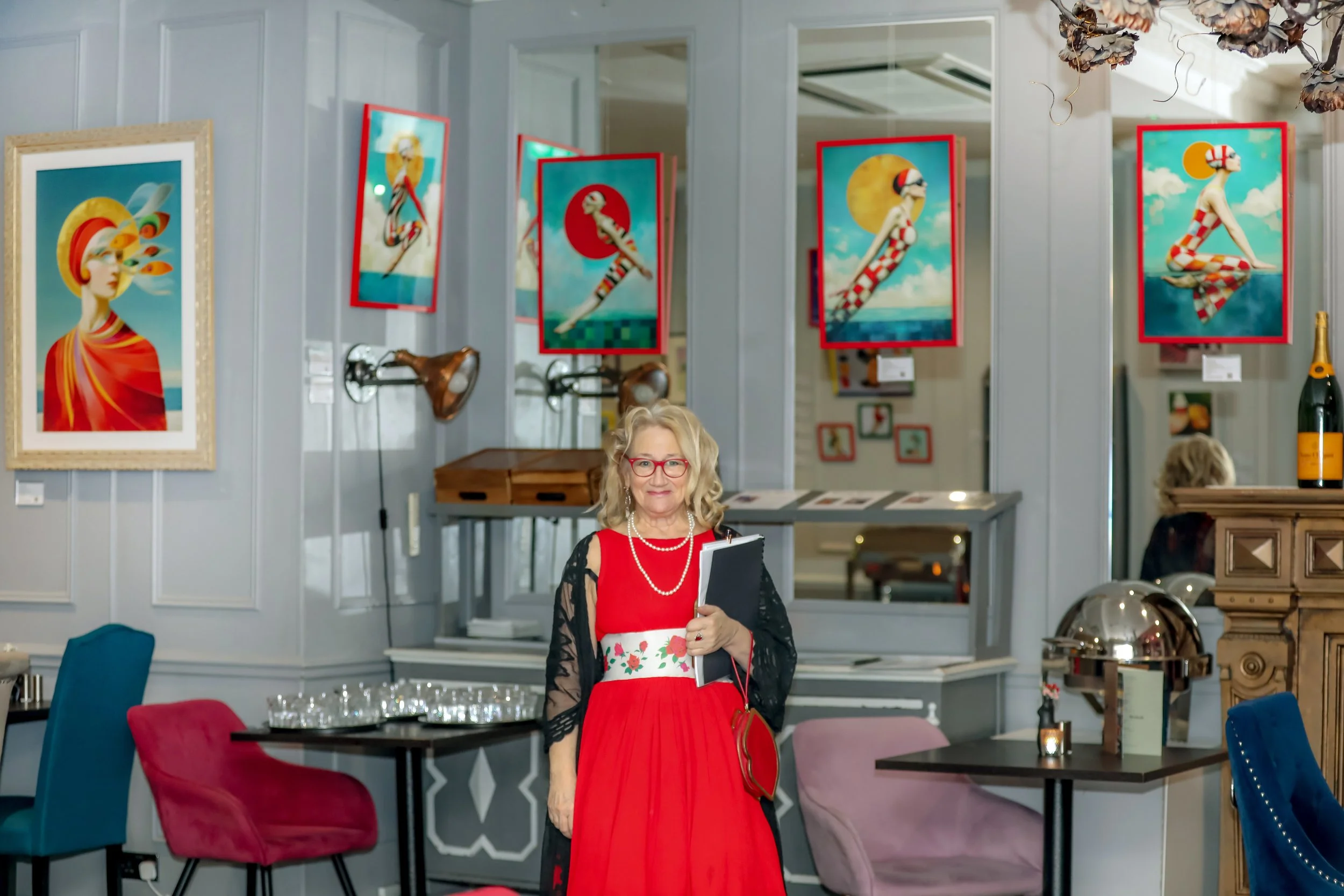
Cynthia Valianti Corbett, pictured in front of 'Line of Beauty' at The Exhibitionist Hotel. Image Credit: Cristina Schek.
AK: Could you tell us about the Young Masters Art Prize? What inspired you to develop the award and later expand it to include the Young Masters Maylis Grand Ceramics Prize (2014) and an Emerging Woman Artist Award (2017)
CC: I founded the Young Masters Art Prize in 2009, which is an independent, not-for-profit, curatorial-driven platform to champion emerging international artists who celebrate art history in their own unique way with artistic voices that are culturally diverse and challenge societal stereotypes of what contemporary art should look like. Young Masters began with a simple proposition: contemporary work becomes richer when it acknowledges, reframes, or challenges art history. The prize is a platform for emerging artists who are in dialogue with historical techniques, iconographies, and ideas, whether they embrace them or subvert them. From its inception, we relied on sponsorship, patronage, and independently judged awards from some of the most important people in the art world.
The Maylis Grand Ceramics Prize (2014) was established as a platform to celebrate the incredible medium of ceramic art - a huge collecting passion of both myself, my family, and my husband. We were very fortunate that one of Cynthia Corbett Gallery’s collectors offered to sponsor us, as they shared our deep love of ceramics, both historic and contemporary. Our judges and curatorial support included Danielle Wells from the Craft Council, as well as Preston Fitzgerald, a Christie’s and Sotheby’s alumnus and well-known craft connoisseur.
The Emerging Woman Artist Award (2017) followed naturally, and we also benefited from Dr Chris Blatchley’s patronage to support the Award, as well as the extraordinary artistic talent of women artists. In 2017, 12 independently judged prizes and awards were awarded to female artists. Ceramics as a medium is historically profound and currently resurgent, and women artists have long been structurally under-recognised. These awards are targeted ways to correct visibility, champion diverse voices, and expand opportunity.
AK: Could you give us insight into the revitalization of the Young Masters Art Prize in 2025 and how you are focusing on representing an international base of emerging artists with the platform, with the goal of providing them with a global audience and a plethora of opportunities, including sales, exhibitions, gallery representation, press, etc?
CC: The 2025 revitalisation has focused on making Young Masters more sustainable as a career platform, not solely a judged single biannual or triennial event. We’ve strengthened curatorial-themed exhibitions, sales, representation conversations, press, partnerships, and sustained visibility. The goal is global reach, not simply global rhetoric.
When we say “opportunity,” we mean practical outcomes and momentum: collectors, curators, institutions, and audiences meeting artists at the right moment, with the right context. We are also very excited to focus on artistic residencies and partnerships with other organisations, including international art fairs, retail and design, and public museums. More on this later to be announced soon!

The Ceiling In The Sky, 2022 by Cristina Schek. Winner of the W4th Plinth public art project curated by Abundance London and unveiled by Dame Siân Phillips in 2023; sold at Phillips BAFAMI Art 2026; and part of the 'Line of Beauty' exhibition, 2026.
AK: The Young Masters Art Prize has a foundation in art history. Could you tell us about this and how you use the programme to support diverse talent and connect creative voices across generations and geographies?
CC: Art history is not a closed canon; it’s a contested, evolving archive. Young Masters uses it as a bridge, allowing artists from different geographies, cultural backgrounds, and identities to enter a shared conversation while challenging inherited narratives. This is how diversity becomes substantive: not a theme layered onto practice, but a genuine re-authoring of what the past means.
The programme connects voices across time because it asks a scholarly question: how does the contemporary image think with, against, or through history? We now have over 400+ alumni who have been exhibited and awarded the Young Masters accolade from over 85 countries and every continent. My international relations and foreign policy background has driven this initiative.

Young Masters People’s Choice Award Winners. Left: Cristina Schek, Fiat Lux, Archival Pigment Print, 2025. Right: Alexandra Baraitser, Design Of Our Time, Oil on canvas, 2022. Image provided by Cynthia Corbett Gallery.
AK: Your gallery is currently hosting The Line of Beauty, Young Masters People’s Choice Award Winners Exhibition, January 15th – April 2026, at The Exhibitionist Hotel, in South Kensington. Could you tell us about this event, its nonprofit aspects, and the two artists, Cristina Schek and Alexandra Baraitser, who were selected for the exhibition through a people’s choice vote?
CC: Line of Beauty (15 January to April 2026) at The Exhibitionist Hotel in South Kensington presents the Young Masters People’s Choice Award Winners, who were selected through public vote, which I value because it reflects real audience connection. As part of Young Masters, the exhibition also supports our not-for-profit mission: visibility, professional opportunity, and sustainable momentum for emerging artists. It is also a fundraising exhibition for the Young Masters mission and ethos. To continue this initiative, we need to make sales to support the programme and the artists.
Cristina Schek and Alexandra Baraitser are in purposeful dialogue. Schek’s surreal, conceptual portraiture examines identity and representation; Baraitser’s figurative works and interiors heighten the psychology of space. Together, they produce an experience that is both elegant and quietly disorienting, in the best way. The curation and theme were also inspired by the Georgian beauty of The Exhibitionist Hotel, and we worked to create a homey atmosphere, albeit a very fancy one!

Ebony Russell, Rococo Delight Poke Pot, Porcelain and stain, 2024, will be exhibited at COLLECT, Somerset House in 2026.
The Cynthia Corbett Gallery continues its efforts to support emerging artists' careers and provide them with international opportunities and support throughout their journey in the art world. Cynthia also devotes significant time and financial support to many charitable societies, including her own nonprofit organizations, initiatives for women in the arts sector, and art-world opportunities for young people and artists from culturally and geographically diverse backgrounds. The “Line of Beauty” exhibition will be on view at the Exhibitionist Hotel until April 2026, welcoming all to view the exhibition and support their artists. Cynthia and her gallery will be showing at the COLLECT art fair at Somerset House (25 February to 1 March). For the most up-to-date information on the gallery and the “Young Master’s Art Prize,” please visit: https://www.thecynthiacorbettgallery.com/ and https://www.young-masters.co.uk/
Alexis Kleeman
Interviews Co-Editor, MADE IN BED
Disclaimer: The views, thoughts, and opinions expressed in MADE IN BED are solely those of the individual authors and not those of MADE IN BED magazine or of Sotheby’s Institute of Art.