Eliza Palmer in Conversation with Areen Hassan
Areen Hassan, a Palestinian artist, has already participated in exhibitions across the globe. Through her textile work, Hassan has brought Palestinian culture, colour, and life to the art world and to the broader world’s focus. Hassan’s work weaves history into the present day and creates a link between past and future that we can all learn from.
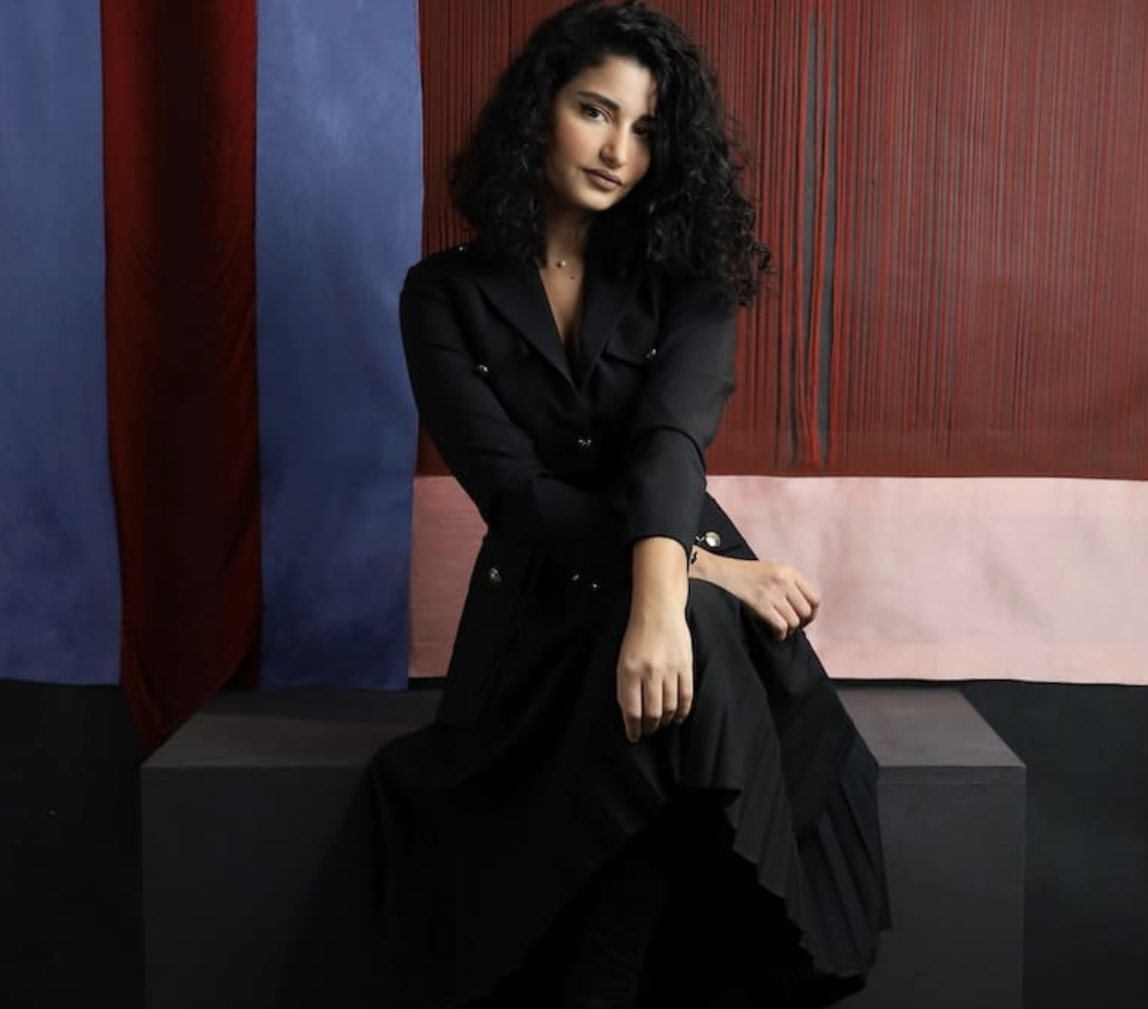
Areen Hassan. Photo courtesy of Areen Hassan.
Eliza Palmer: When did you first realise what art was, recognising that this thing was something different, that it was not just a picture, or a textile work, or a sculpture, but a piece of art?
Areen Hassan: I don’t think it was a single moment, but rather a gradual awareness that came through making, childhood, and the way culture shaped my early understanding of objects and meaning. Growing up, making was always part of life; clothes, embroidery, domestic objects, things that were functional first, but also deeply embedded in cultural practice and memory. That everyday proximity to craft and tradition is what slowly shaped my perception of what things can hold beyond their use. As I began to grow and understand more about culture and history, I started to notice that certain objects carried something beyond function; they held memory, emotion, and presence. I realised that a woven surface or embroidered piece could hold time in it, not just image. It could carry absence, repetition, rupture, and repair. That’s when I understood that what I was doing was not only craft or decoration, but a way of constructing meaning, an embodied language shaped by culture, childhood, and lived experience, and one that could stand as art.
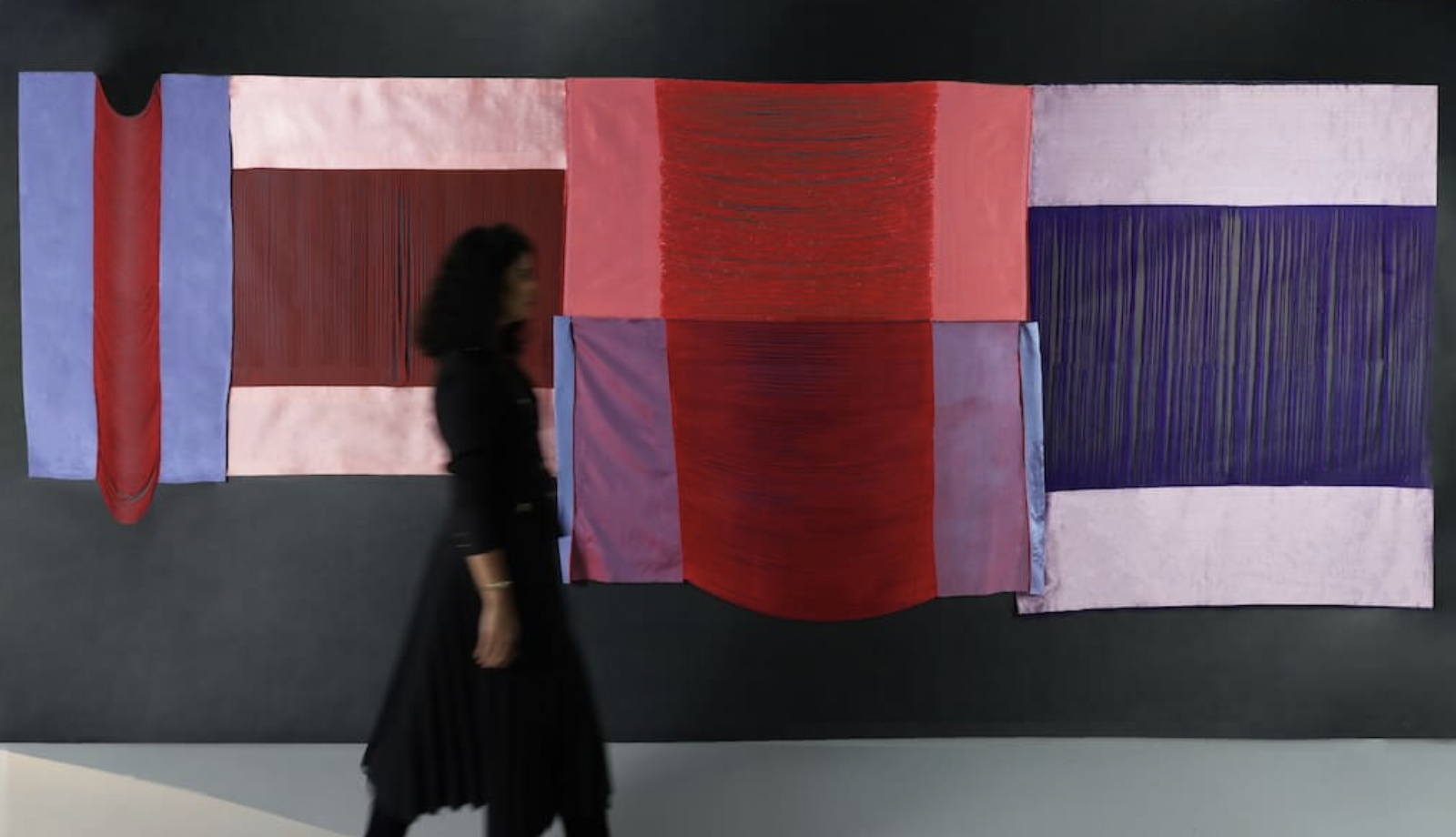
Areen Hassan, Unfold, 2023. Unraveling on silk. Photo courtesy of Areen Hassan.
EP: Was there a textile work that sparked your interest in this particular artistic medium?
AH: There wasn’t a single textile work, but rather a series of encounters that shaped my relationship with the medium. Palestinian embroidery, especially the thobe and its regional variations, was the first reference point that formed my understanding of textiles. It set a different standard for how I approach the medium. I was drawn to how each stitch carries something like DNA—identity, place, history, memory and symbol—and how patterns function almost like a coded language that travels across villages and generations. Later, I came across the work of Olga de Amaral, and her concept of “text-textile” deeply stayed with me—the idea that the word textile itself begins with “text,” and that weaving can be understood as a form of language. That connection between material and meaning made me think more consciously about textiles not only as objects, but as systems of communication. This opened a dialogue between contemporary textile practices and my own cultural background, especially Palestinian embroidery, where textile is already a form of writing—of memory and identity encoded through pattern and repetition.
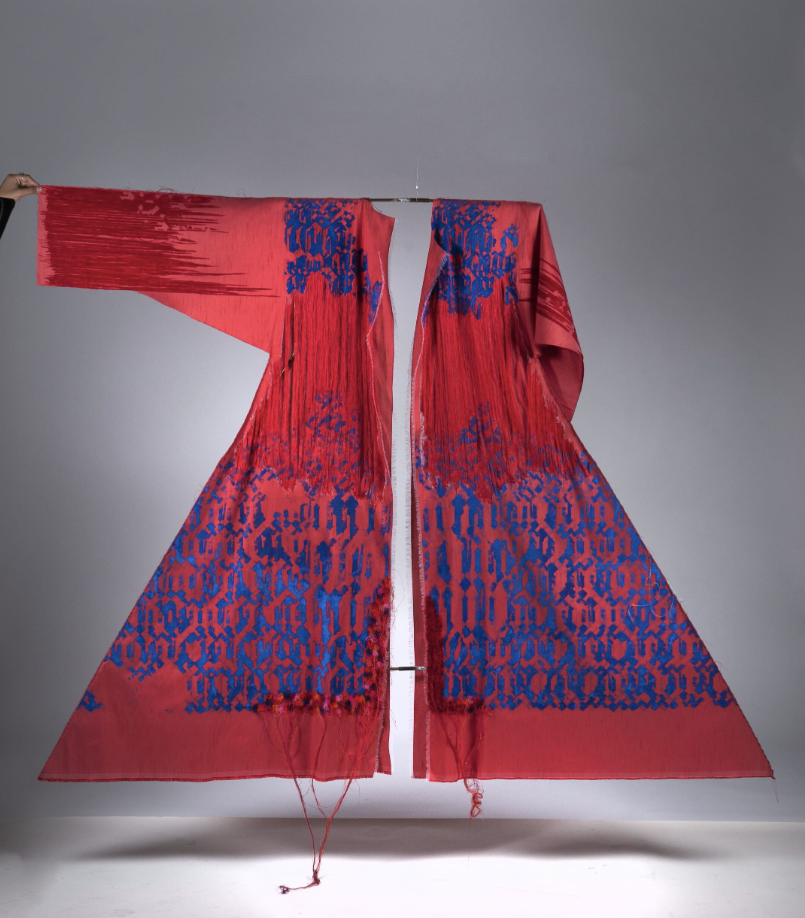
Areen Hassan, Urban Jerusalem, 2018. Silkscreen, embroidery, unraveling on silk fabric. Photo courtesy of Areen Hassan.
EP: On your website, it says, “She found textiles to be a flexible medium that allowed her to bring together different threads into one piece, something that is a reflection of her cultural identity. The meeting of materials, colours, shapes, orientation, and patterns in composition enables the viewer to observe the work as an embodied universe of symbolic meaning, often showing concern with the path we take through life.” This reminds me of historic heroes and characters, real and fictional, who wove together the fabric of fate, for example, the 3 fates in Greek mythology. Is fate a concept or idea that you believe in?
AH: I do believe that everything is already written, but I don’t see fate as something rigid or predetermined in a fixed way. I relate more to the idea of making meaning through what is given to us along the way, rather than a closed path that is already fully defined. At the same time, I am interested in fate as a structure of thought—an attempt to read the invisible threads that connect lives, experiences, and histories. The metaphor of weaving is close to how I think. Threads meet, diverge, break, return. Some things are intentional, others accidental, and the final form is always a negotiation between structure and what is carried forward from the past and what is being woven into the future.
EP: Is there a method of textile creation you prefer the most? For example, weaving, embroidery, draping, etc?
AH: It’s not about preferring one method of textile creation over others, because each technique carries its own language and logic. I see textile as a powerful medium in itself, regardless of format—whether it is weaving or other processes, each one holds its own specificity and way of thinking. But I feel most connected to woven structures, to the idea of fabric as something constructed through the interlacing of threads on a loom. Weaving, for me, carries a strong conceptual weight: it reflects how different elements, histories, and meanings come together to form a single surface.
EP: Your work is often in response to and inspired by your Palestinian culture. What are the elements of Palestinian culture that recur frequently in your work?
AH: ‘My Palestinian heritage is the thread that binds my art and identity ; Palestinian embroidery is more than echoes woven in every stitch; it is a legacy passed down through generations—from grandmother to mother to daughter. It is a living vessel of memory, resilience, and identity, pulsing through every thread and colour, carrying our ongoing stories.’ Palestinian culture has deeply shaped my artistic practice and continues to influence it. I grew up in Palestine, and I still feel constantly inspired by it—there is always more to learn and to rediscover. For me, it is not only about embroidery or textile craft, but about the wider cultural fabric: the food, the community, the people, the dabkeh, the olive harvest season, and many other everyday practices that carry meaning. What I learned from Palestinian embroidery, in particular, is that it is a language that embodies women’s identity. It is no longer just threads or decoration, but a living document of history—of the past, the present, and what is still unfolding. It holds ideas of survival and resilience, and it is something I return to each time I begin a new work. Recurring elements in my practice include traditional embroidery patterns, the logic of the Palestinian thobe, and references to domestic and agricultural life—especially olive harvesting, kitchen practices, and collective gathering. These elements function less as illustration and more as fragments of memory. Through them, I try to construct a visual language that speaks about belonging, displacement, and continuity.
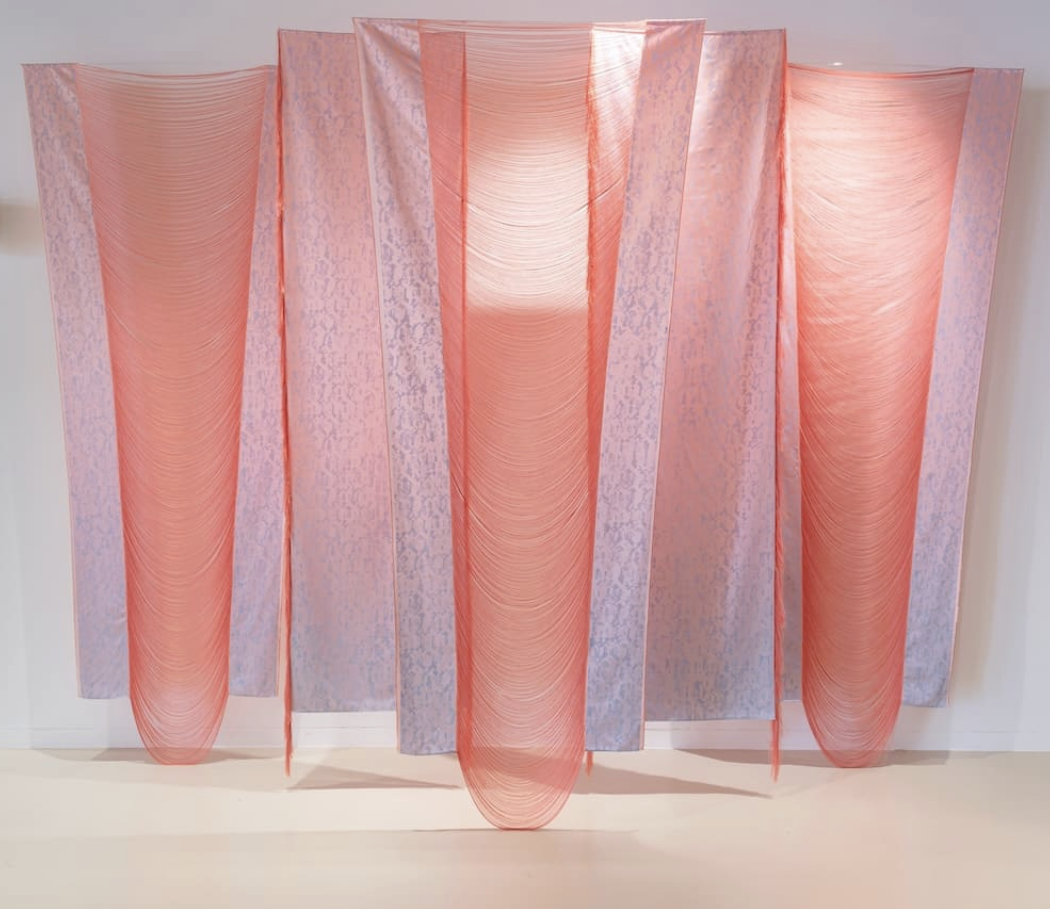
Areen Hassan, Heavenly Loom, 2025. Silkscreen and unraveling on silk fabric. Photo courtesy of Areen Hassan.
EP: As a Palestinian artist, as a Palestinian woman, the barbaric and cruel attacks on the people of Palestine must be unbelievably hard to experience and witness. I can only imagine what this period of time must be like for the Palestinian people and community, and I sincerely am sorry for the abuse and genocide that is ongoing. What, if there are any, are ways in which people in the art world and people in general can help the people of Palestine?
AH: For me, one of the most important forms of support is to keep speaking about Palestine, through art, through culture, through food, and through everyday narratives—and to continue sharing it across different spaces. The more we speak about it and share it, the more we keep it alive. In that sense, cultural presence becomes a form of protection. It ensures continuity and allows culture to be passed from one generation to the next. I believe that continuing to create, speak, and share is one of the most powerful forms of support, it is a way of preserving existence through visibility and memory, and ensuring that it continues and is carried forward into future generations. In terms of how people in the art world and beyond can help, I believe support begins with sustained visibility and a refusal of silence or simplification. It is important to continue creating space for Palestinian voices, artists, and narratives to exist on their own terms, without being reduced or filtered through external frameworks.
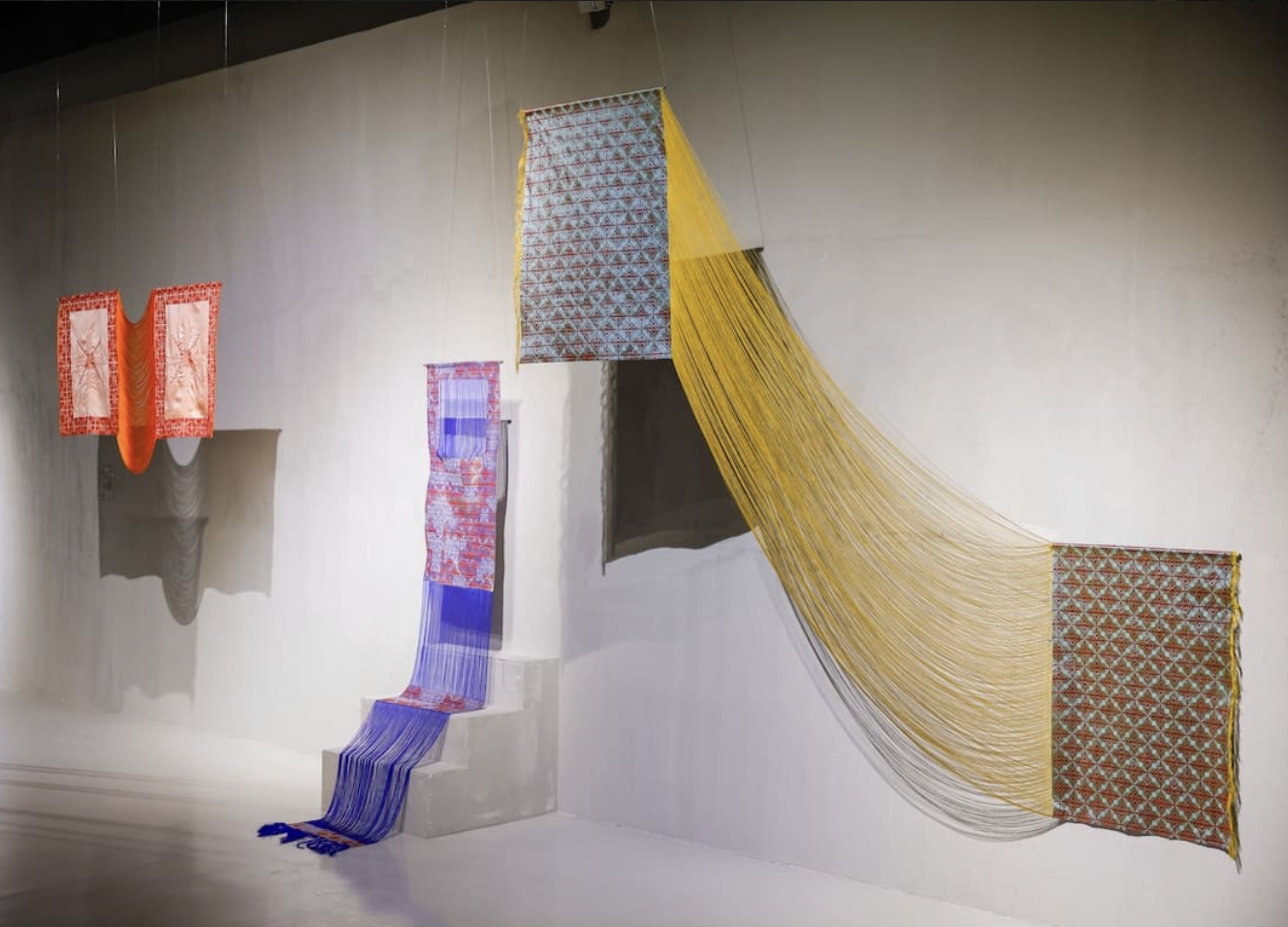
‘Sila’, Maraya Art Centre, Sharjah, UAE, 2025. Photo courtesy of Areen Hassan.
EP: You recently said in an interview with STST, “Palestinian culture is incredibly rich. It lives in the kitchen, in traditional dance and music, in the land, in olive season, in handcrafts, in the way people gather and share. All of these elements together form a language of survival, belonging and geography.” Would you mind sharing a memory or story from your experience growing up in Palestinian culture, please?
AH: What stays with me most from Palestinian culture is the idea of gathering and community as a way of living, not just an occasional moment. Everything happens together and through togetherness. When we cook, we cook together. When we eat, we sit around the same table and share the process as much as the meal itself. When we dance dabke, it is never individual—it is always collective, rhythmic, and carried by the group. Even during olive harvest season, we go as a community, working side by side in the fields, sharing labour, stories, and time. I remember how we would prepare a very simple breakfast there, in the middle of the olive trees, and somehow it always felt like the most delicious food. The taste is not separate from the place or the people—it is shaped by them. What stays with me is this sense of sharing as a form of life itself. Not as an idea, but as something embodied in everyday gestures. It is this collective rhythm—of cooking, eating, dancing, harvesting- that continues to shape how I understand culture, and how I return to it in my work. Even in my own practice, this continues. When I work, my aunties sometimes sit with me, and we work together on the fabric—unravelling it, thread by thread, on the ground. It becomes another form of gathering, where making is not isolated, but shared, slow, and deeply connected to conversation, memory, and presence.
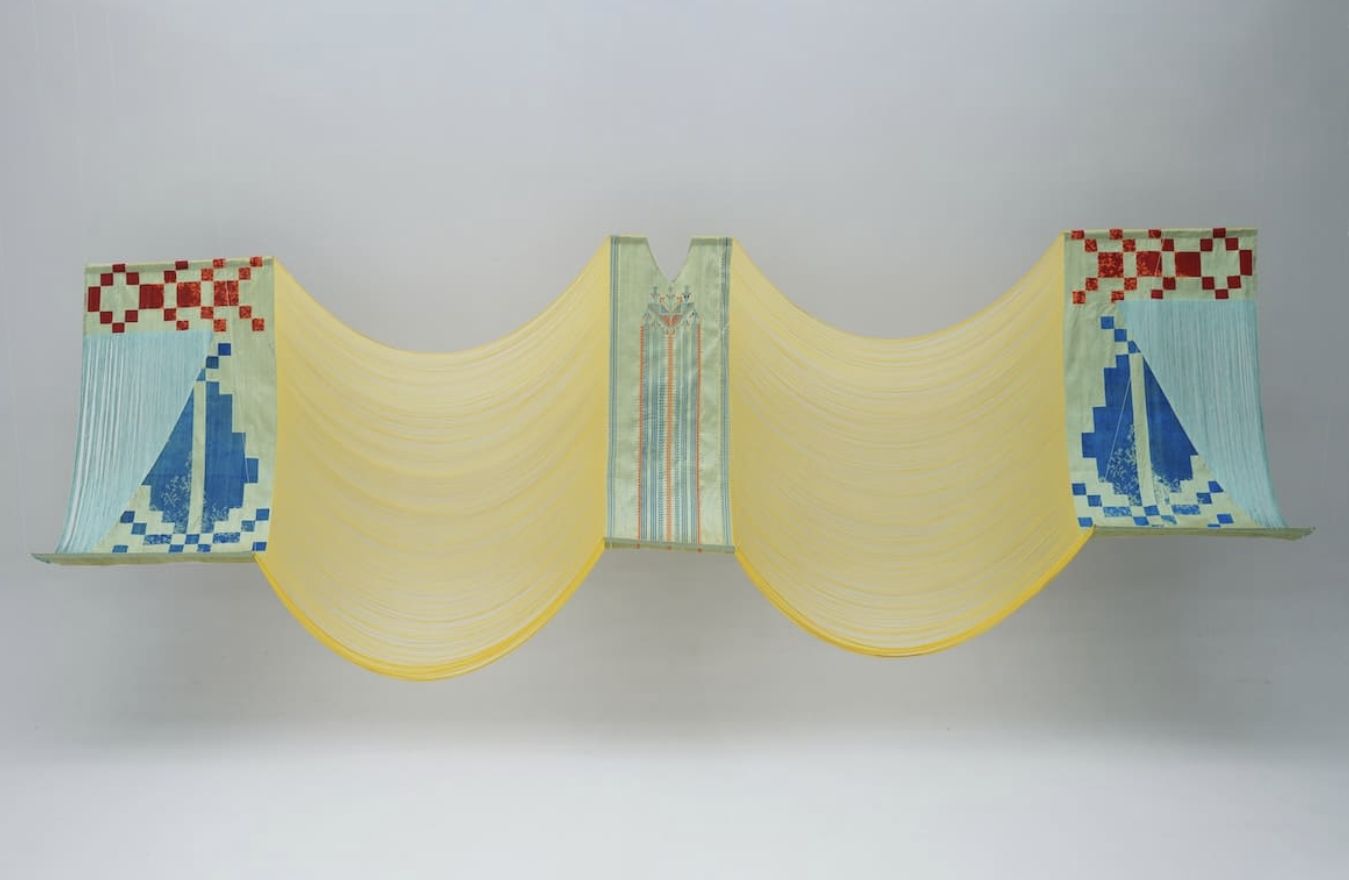
Areen Hassan, Her Hands, Her Land يداها، أرضها, 2026. Silkscreen printing, unraveling, and embroidery on silk. Photo courtesy of Areen Hassan.
EP: What are some of your favourite aspects of Palestinian culture that you want people who aren’t Palestinian or people who are unfamiliar with the culture to know about, or to appreciate more?
AH: One of the things I always want people to understand about Palestinian culture is that it is not defined by a single narrative or reduced moment; it is something deeply lived, daily, and collective. What I love most is this sense of togetherness that runs through everything. It exists in how people cook, eat, and share food; how gatherings are never individual but always communal; how dabke is danced in a circle, carried by rhythm and presence rather than performance. Even work in the fields, especially during olive harvest season, becomes a shared act, people coming together not only to gather olives, but to share time, stories, and care for the land. There is also something very specific in the relationship between culture and everyday life. Nothing is strictly separated into “special” or “ordinary.” A simple breakfast under olive trees, for example, can carry so much meaning because it is shaped by place, memory, and collective presence. And I think Palestinian embroidery carries this in a very powerful way, too. It is not just craft, it is language, memory, and identity encoded in thread. It holds generations of knowledge, especially from women, and continues to evolve while staying rooted in history. For me, what I hope people who are not familiar with Palestinian culture can see is this richness of everyday life, this way of being together, of sharing, of holding onto memory through practice. It is a culture of continuity, where meaning is carried forward through people, gestures, and time.
EP: I ask this in the most simple of terms, as it is impossible for me to understand what the current war on Palestine must be like for Palestinians, but if I may ask, how has this time period affected your artwork?
AH: The first months were very difficult to process. I think I was in a state of disconnection from everything; I wasn’t able to work at all, and it felt almost like a nightmare that was impossible to fully grasp. During that period, like many Palestinians, I was constantly following the news, 24 hours a day, and holding a deep sense of fear and helplessness, while also praying for people and trying to stay emotionally present in some way. After that, something shifted. I became more connected to my culture in a deeper way, and this naturally started to shape my artistic practice differently. My work became less about abstraction and more about presence, about returning to cultural memory, to material language, and to what I can carry forward through making. Right now, I feel a strong responsibility to show my culture through my work, to hold it, and to keep it present in a way that feels honest and grounded.
EP: You have exhibited your work many times now. What do you want your audience to receive upon seeing your work?
AH: What I hope audiences receive when they see my work is a sense of connection to my culture and to the land it comes from. My work is deeply tied to the idea of land, not only as a physical place, but as memory, continuity, and presence. The threads in my work often come from an act of unravelling, which is almost a reverse process of making. It is about taking something apart in order to understand its structure again. The fabric becomes fragmented, yet it remains held together; it retains its own strength even in its brokenness. “Broken, yet still strong; incomplete, yet still beautiful” This tension between fragility and resilience is very important to me. The work may appear delicate, but it holds itself. In many ways, it reflects Palestinian culture: something that carries both vulnerability and an enduring power, rooted in the land and in collective memory. More than anything, I want people to see that power, to feel the presence of a culture that is deeply connected to land, to making, and to survival, even in its most fragile forms.
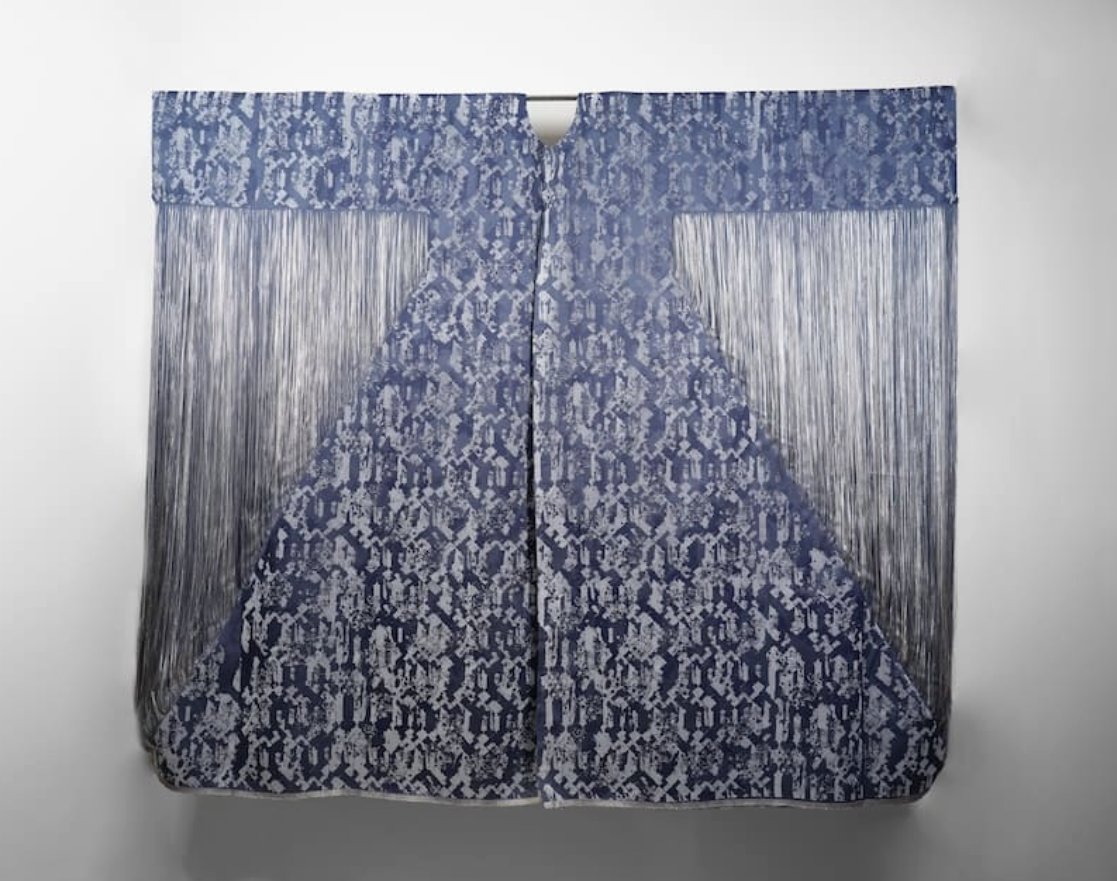
Areen Hassan, The Woven Self, 2023. Silkscreen printing and unraveling. Photo courtesy of Areen Hassan.
EP: What do you like most about your artwork?
AH: What I like most is its ability to hold memory and contradiction at the same time—fragility and strength, presence and absence. It allows me to translate cultural memory into material form.
EP: Outside of textile work, what other media do you work with or enjoy working with?
AH: As an artist, I like to experiment with other mediums, not necessarily to move away from textiles, but to expand how I think and work with them. Engaging with different materials and processes allows me to learn through making and to open new ways of approaching texture, structure, and composition.
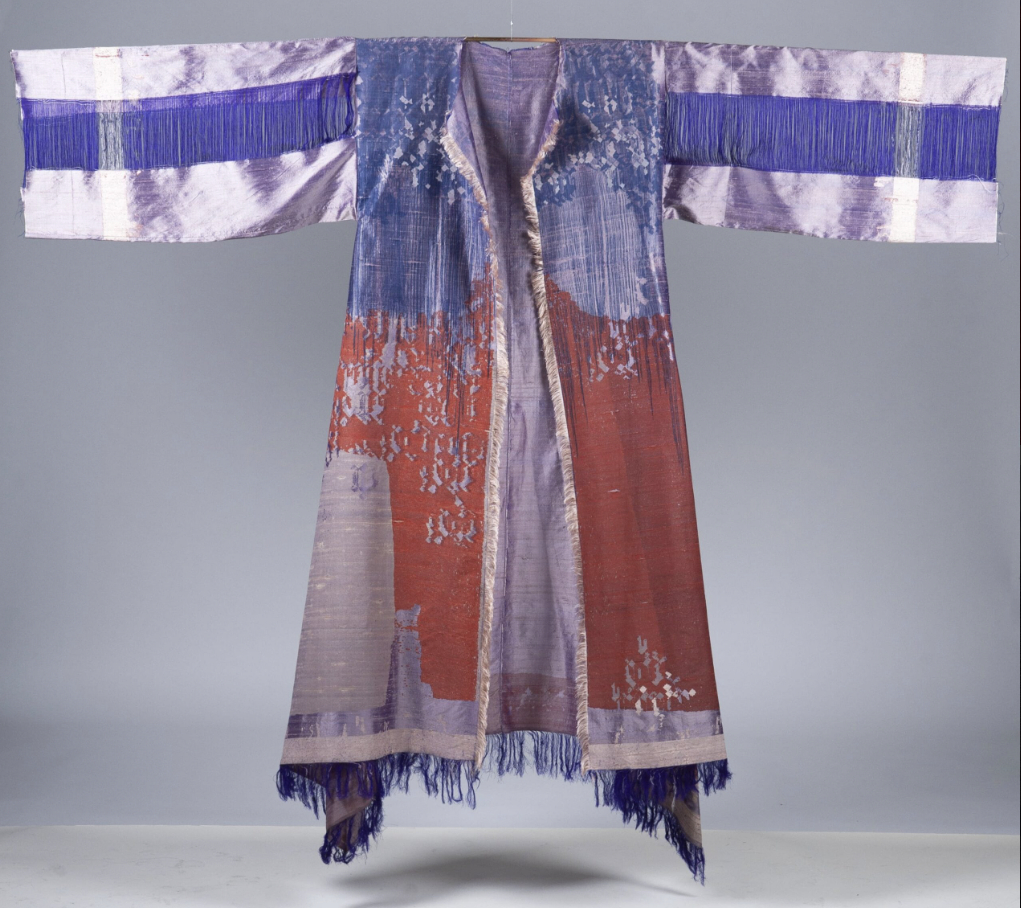
Areen Hassan, Paradise, 2018. Silkscreen printing and unraveling on silk fabric. Photo courtesy of Areen Hassan.
EP: Who are some artists who have influenced your work?
AH: Olga de Amaral has been very important for me, as I mentioned before, especially in how she expands textile into a conceptual and spatial language. From Mark Rothko, I learned how powerful colour can be, not as representation, but as emotion and atmosphere, and how it can hold presence on its own. William Morris influenced me in a different way, particularly in how he approached pattern and composition. I learned from him how to think about layout, and how to translate and bring elements from the natural, outdoor world into interior, constructed spaces through pattern and design.
EP: If you had to choose one work that describes you as an artist today?
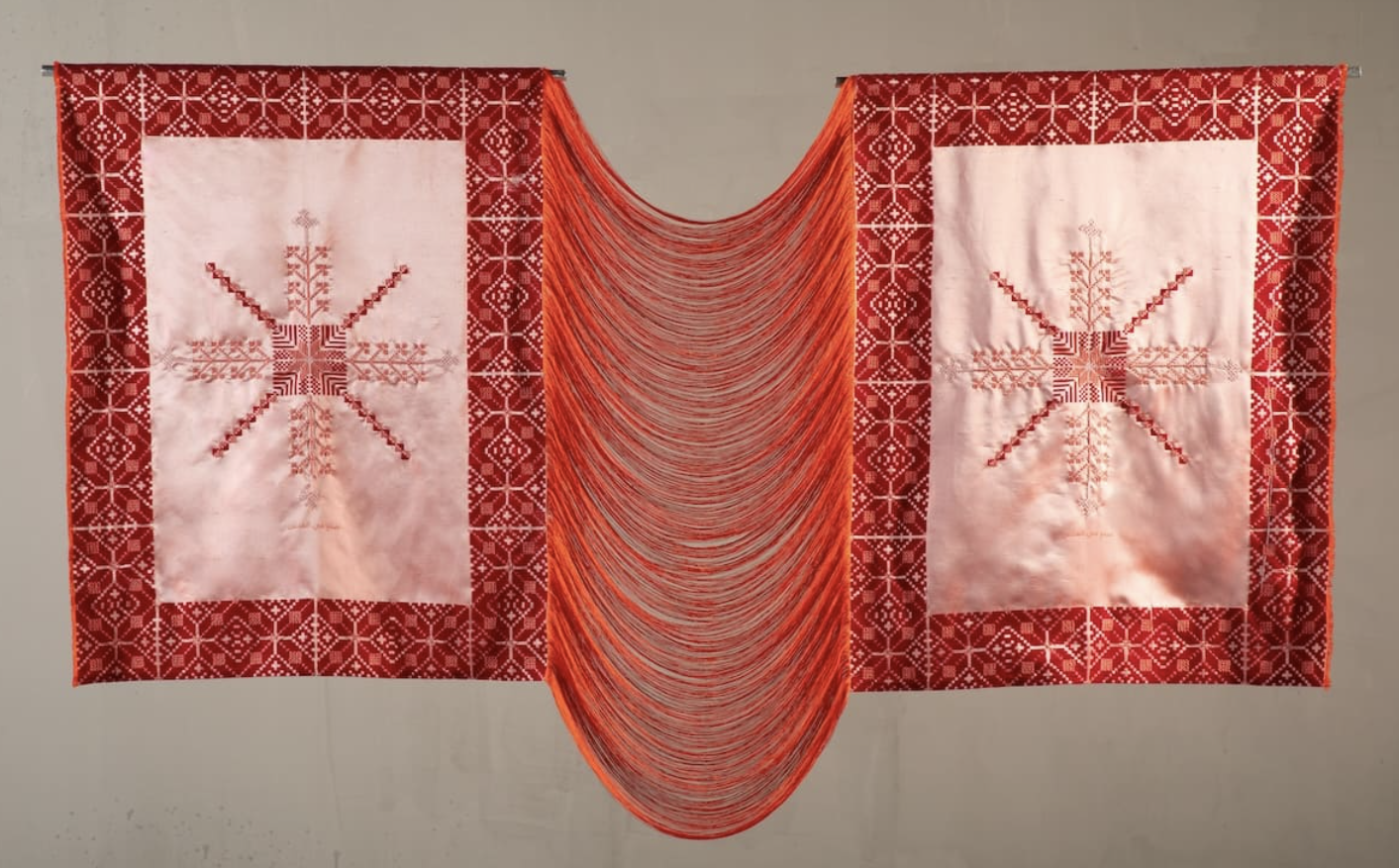
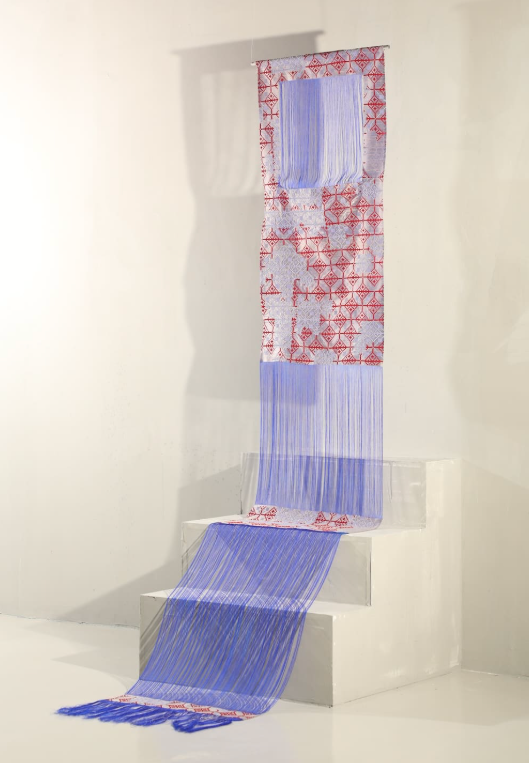
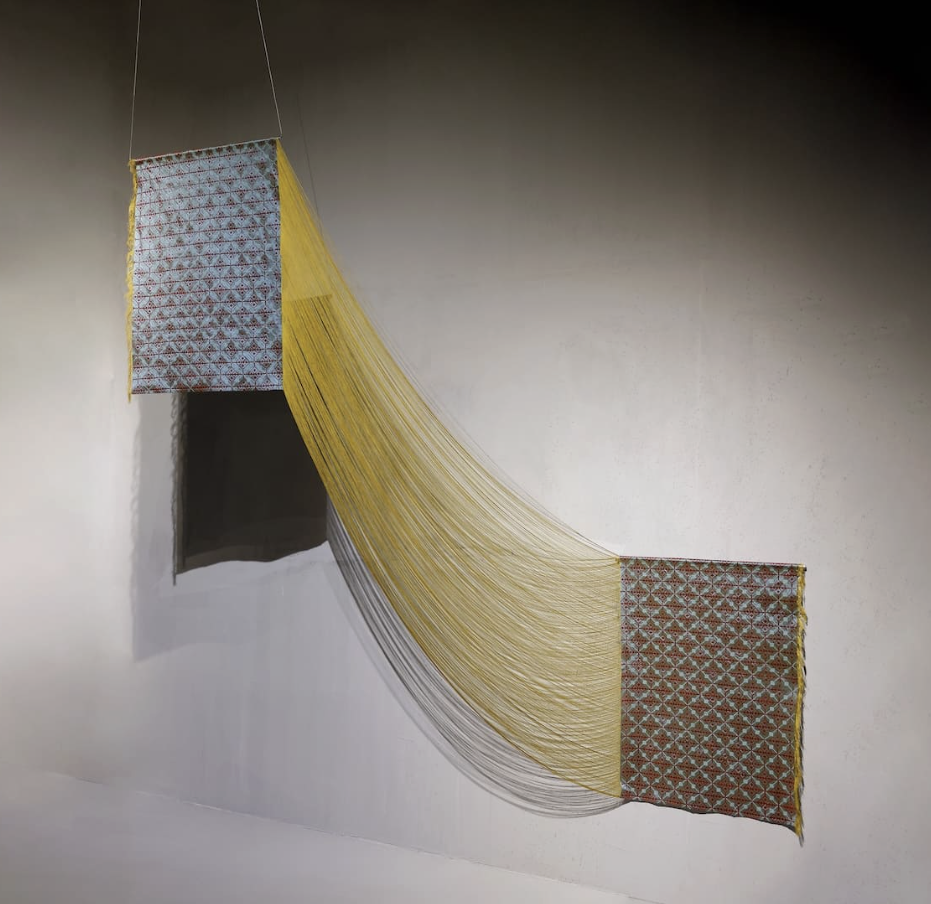
AH: It would be ‘weaving the land back’: a series of three pieces that weave Palestinian heritage into a contemporary narrative by reimagining traditional motifs. These designs take historical symbols and transform them into modern expressions, symbolising both the continuity and transformation of a people’s struggle and identity. Each piece unfolds into the next, creating a narrative where the past meets the present, and where tradition is not just preserved but reimagined. The series draws inspiration from the sacred land of Jerusalem القدس†, incorporating motifs that are deeply rooted in Palestinian identity ; symbols of resilience, resistance, and belonging. The foundation of each piece is a delicate balance of craft: the cross-stitch motif, iconic in Palestinian embroidery, merges with the technique of silkscreen printing, while the unravelling of threads becomes a metaphor for deconstructing and rediscovering the essence of Palestinian history. Through this unravelling process, the fabric is stripped back to its core, echoing a return to roots and the soul of the land itself. Each unravel serves as a reflection of the Palestinian people—broken, yet whole; fragmented, yet beautiful. The series tells a story of survival, dignity, and hope. In ‘Motif of Memory نقش†الذاكرة†’, the Berry Tree motif شجرة†حب†, stands tall, framed by the intricate Tile Branch عرق†البلاط†, creating a visual repetition. This repetition mirrors the unyielding resistance of the Palestinian people, while the threads unravel in the middle, tracing the arduous journey of the people through the trauma of Nakba 1948. The frame repeated endlessly symbolises the borders imposed on them, yet also the strength found within those boundaries. The unravelled threads represent a pathway of survival, showing how even in fragmentation, the people persist. ‘Rooted Across تجذّر†عن†البُعد†’ intensifies this narrative, where the Tile Branch spreads across the fabric like a barrier—both physical and metaphorical. Yet this barrier is filled with rootedness, resistance, and hope. The longer gaps in the threads signify the growing distance between the people and their land, but also the enduring connection. The unravelling here becomes more pronounced, symbolising the struggle to hold onto what remains while confronting loss. As with all borders, it divides, but the essence of the people seeps through, unchanged. The final piece, ‘The Long Weave خيوط†لا†تنتهي†’ marks a journey, both literal and spiritual. The design begins with unravelled threads, which flow into a repeating printed-embroidery frame, symbolising movement from displacement to inner growth. Transit is not just a passage; it is a transformation. The frame, repeated like the borders before it, now becomes a testament to endurance. The longer threads and the recurring patterns represent a journey that transcends time،†a migration from suffering to strength, from exile to reclamation. In this series, the threads do not merely weave stories; they unravel them, revealing that beneath every tear and gap lies the unbreakable spirit of a people deeply intertwined with their land. Through this art, the past is not only remembered but becomes a part of the present, guiding the way forward. The Palestinian people, like the unravelling fabric, are incomplete yet whole, shattered yet full of beauty and power. Moreover, the embroidery layers woven into this series were created by Palestinian refugee women living in South Lebanon, members of the Inaash Association. Their hands carry the profound legacy of displacement and resilience, infusing the work with an authentic and living connection to the narrative. This collaboration embodies the core themes of the series—return, endurance, and the unyielding spirit of a people whose cultural identity persists and flourishes beyond borders. Through their craft, the artwork becomes not only a reflection but also a continuation of Palestinian heritage and strength, bridging past and present with threads of hope and survival.
EP: Which work helped you grow the most as a person?
AH: All of my work has helped me grow as a person. Each piece I create is a full experiment for me, and through every work I learn something new. I approach each project as a process of exploration, pushing myself to go as far as possible within the concept and the material. In that sense, growth is not tied to one specific work, but to the ongoing practice itself—each piece becomes part of a continuous process of learning, refining, and understanding my language more deeply.
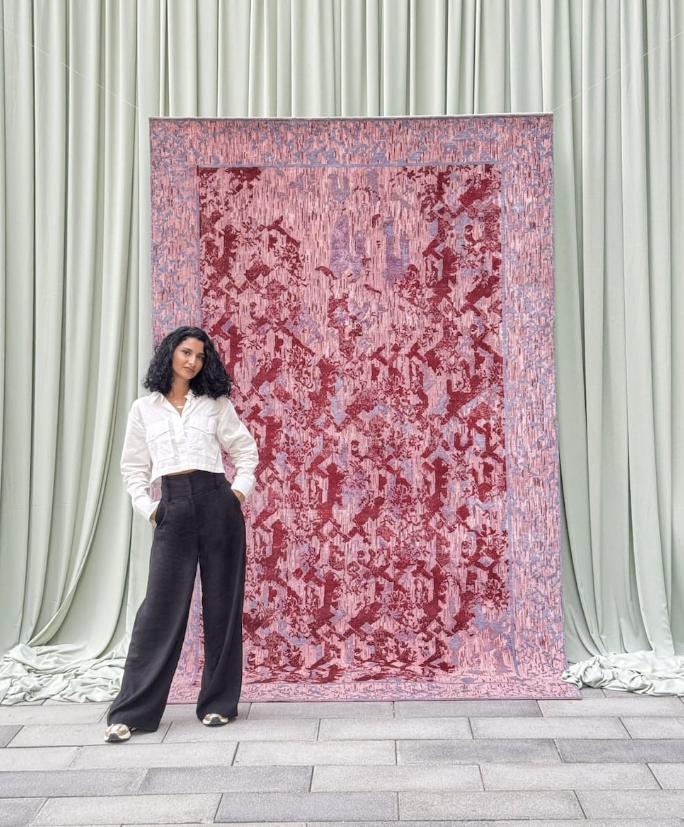
Areen Hassan, Reverie Woven, 2025. Hand-knotted carpet. Photo courtesy of Areen Hassan.
EP: Who are your favourite Palestinian artists?
AH: One of my favourite Palestinian artists is Sliman Mansour. It is not only because I am drawn to his paintings, but also because of his lived experience and what his work carries. He was born before the Nakba of 1948, and as a Palestinian, he has lived through all the historical and ongoing trauma that has shaped Palestinian life. This experience is deeply embedded in his practice. His work reflects pain, struggle, and loss, but at the same time, it carries a strong sense of endurance and presence. There is a quiet power in how his work holds both trauma and survival together, and how it continues to insist on the visibility of Palestinian life and identity.
EP: What is your favourite colour?
AH: Since I was a child, my favourite colour has always been red. As I grew older, I realised that this attachment was not random; it is deeply connected to Palestinian embroidery, where red is one of the most dominant and symbolic colours. In my work as well, red is always present in some form. It carries memory, identity, and cultural resonance for me, and it continues to return naturally within my visual language.
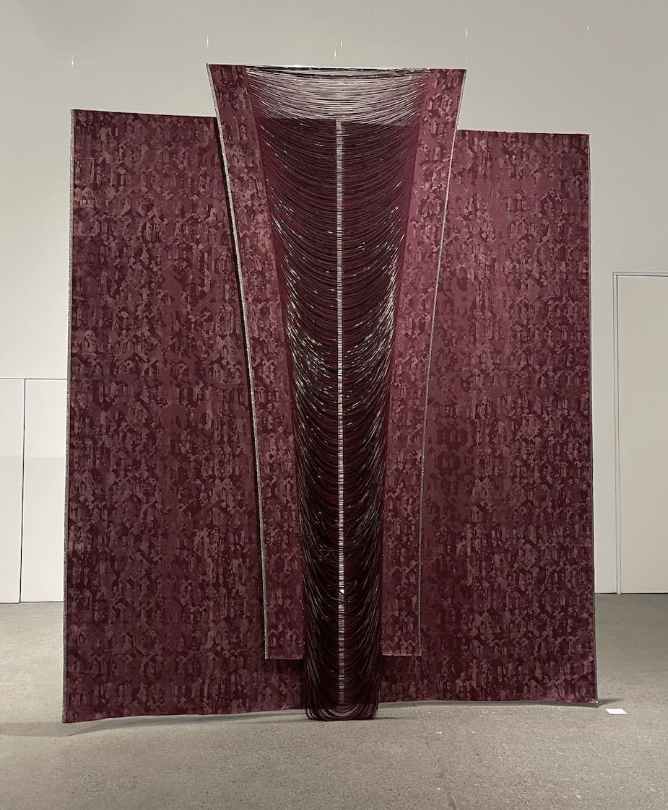
Areen Hassan, Revelation, 2024. Silkscreen printing and unraveling. Photo courtesy of Areen Hassan.
EP: What is your favourite fabric to work with?
AH: I am drawn to natural fabrics, especially silk and woven textiles. Silk interests me for its sensitivity and fluidity, the way it responds to touch and movement. Woven fabrics, on the other hand, carry a structural logic that I connect to conceptually; they hold the idea of construction, interlacing, and time within their surface.
EP: When do you find is the most inspiring time of day?
AH: I am a person who is very sensitive to light and sun, and I find that the time of day has a strong impact on how I work. I am especially inspired by natural light because when I work with textiles, the way the material interacts with light completely changes its presence and perception. For me, light is not just a condition; it becomes part of the work itself, revealing texture, depth, and movement in different ways throughout the day.
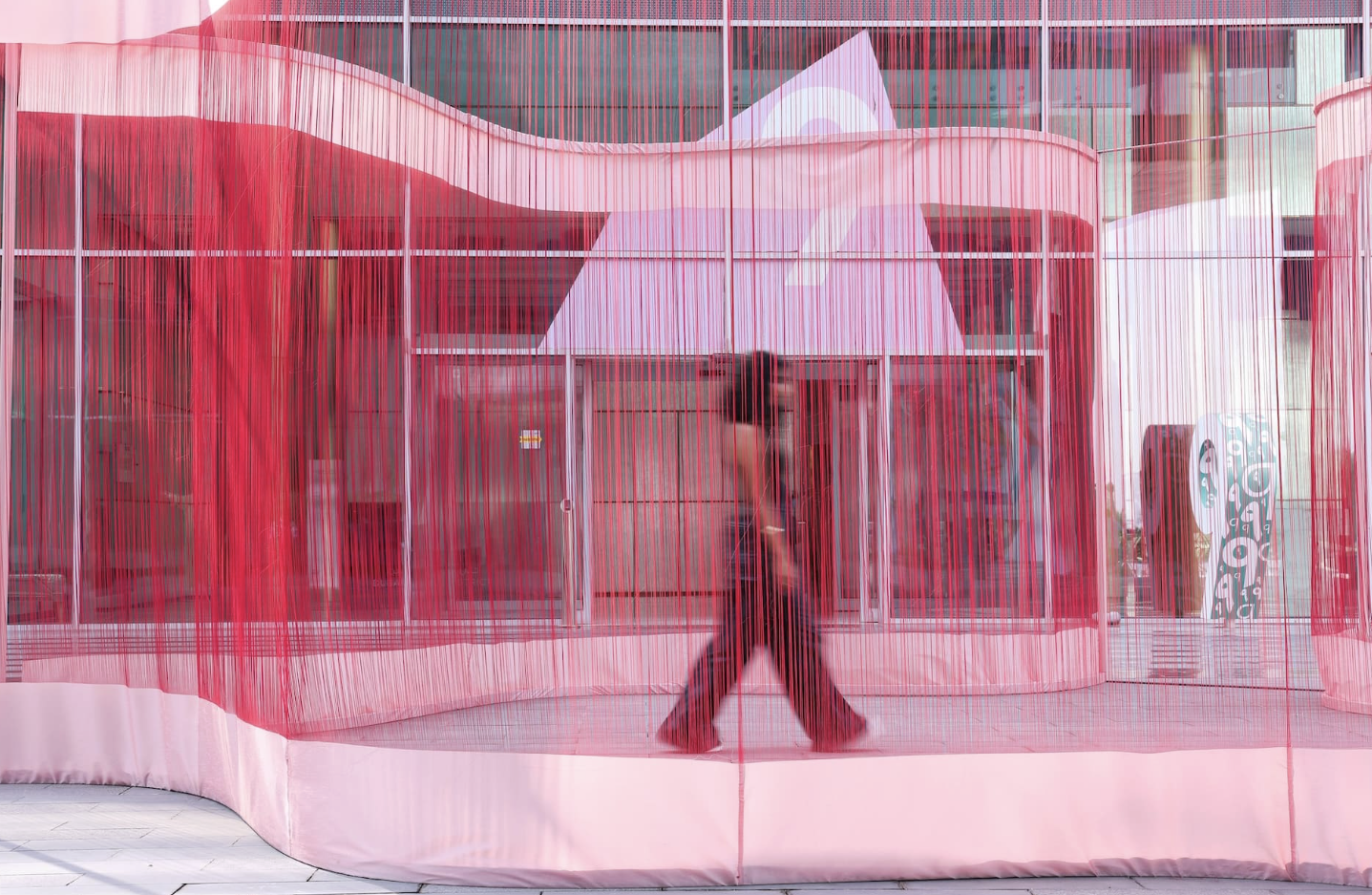
Areen Hassan, Flowing Threads, 2023. Photo courtesy of Areen Hassan.
EP: What are your first steps when starting a project?
AH: The first step for me when starting a project is always the concept. I begin with research and developing the idea, trying to understand the conceptual foundation before anything else. From there, the material and visual direction start to emerge gradually. The process is very much led by thinking and reflection first, and then it translates into form through experimentation with textiles and materials.
You can find more on Areen Hassan on her website and her Instagram.
Many thanks to Areen Hassan on behalf of MADE IN BED.
Eliza Palmer
Editor and Social Media Manager, MADE IN BED
Disclaimer: The views, thoughts, and opinions expressed in MADE IN BED are solely those of the individual authors and not those of MADE IN BED magazine or of Sotheby’s Institute of Art.