Eliza Palmer in Conversation with Maaike Takens
In this interview, I speak with up-and-coming Dutch artist Maaike Takens. Takens’ career began as an adult, using art as a means to escape into a different space, where all that existed is herself and her art. As Taken’s career establishes an international reputation, we discuss her influences, doubts, her personal strengths, and much more.
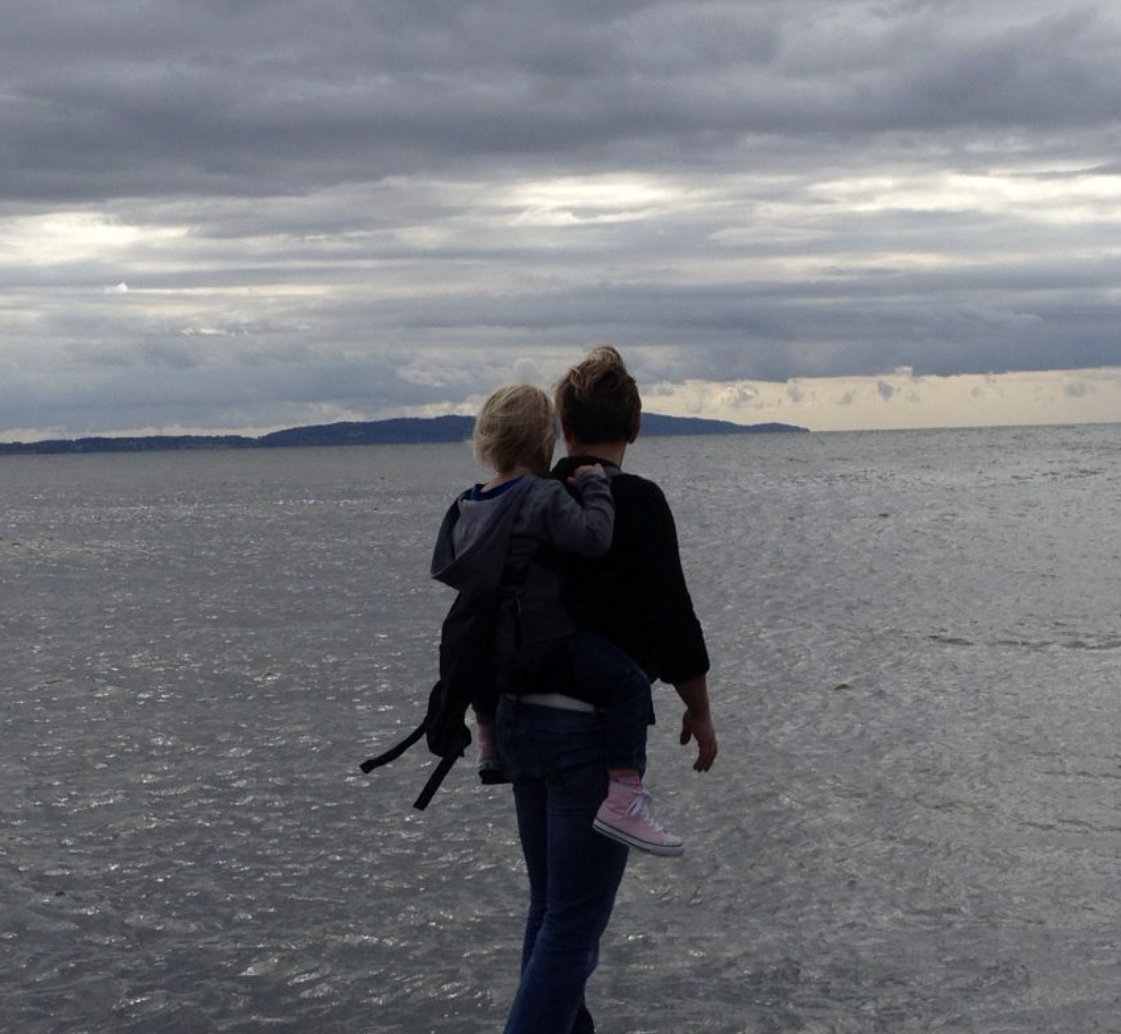
Maaike Takens. Photo courtesy: Maaike Takens
Eliza Palmer: When/How did you begin your art practice?
Maaike Takens: I don’t think I’ve ever been without it. From a very young age, I’ve always been creating. This has continued throughout my life, although it has shown itself in different forms depending on where I was and what my focus was at the time. For example, when my children were very young, the only thing I could really do or ‘have time’ for was cooking because we all needed to eat. So I would make elaborate meals or bake bread. Going to the shop to get ingredients would be an activity. Or I would make the children toys or clothes. I started making art for art’s sake in earnest after I quit my last job (in the arts), I think around 2020/2021.
EP: What is it about art that you enjoy the most?
MT: Disappearing. I disappear into my thoughts and disappear into a world of possibilities where every decision is as good or bad as the next one, and nothing is really wrong, and nothing is really right and still everything makes sense. Another thing I like is that when I paint specific people, I feel like I get to spend time with them. I really enjoy that.
EP: What is the most challenging part about creating art?
MT: I don’t think that I find creating in itself challenging. What I do find challenging is the process of thinking about where to go. Because things are only ever expanding and diverging, and at every point, you can go hundreds of directions. Decisions are most often a ‘jump’, and then I let the work take me places. I think the challenging bit is the bit before the jump, where I am still hanging about on the diving board, deciding if the jump’s too high or the water too cold, and shall I go down the stairs again.
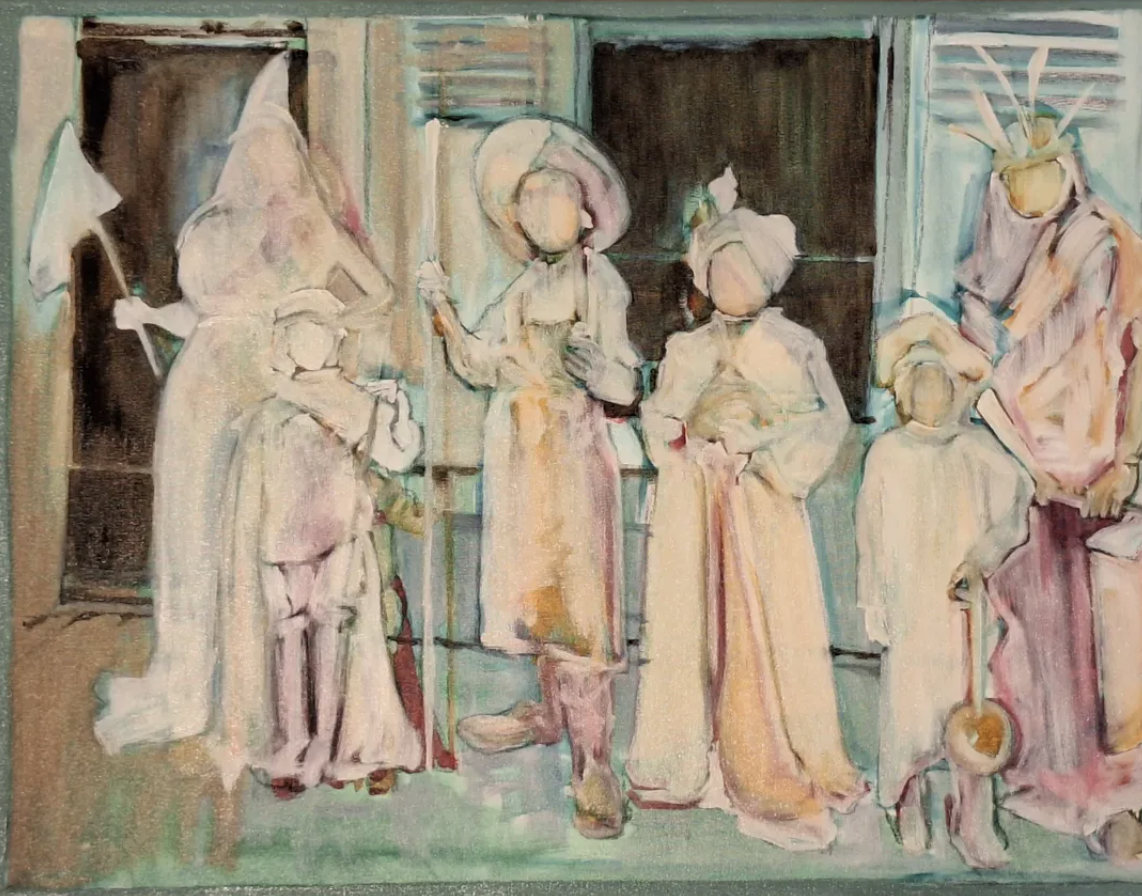
Maaike Takens, Maskerad - 1912, 80x60cm, 2025. Photo courtesy: the artist
EP: You often paint figures in candid moments of their life —what is the attraction to these moments that you then immortalise in your art?
MT: You know how in dreams you meet people and they don’t look like themselves at all, but you still know exactly who they are? Or like you are in a space and you know where it is without there being any points of reference? I think that’s sort of how I pick things to paint. It sounds a bit woolly, but I know it if I see it that and if something speaks to me. I think it must be something like a reminder to myself that we as people are in a way insignificant, but we have significant moments and do things that are significant to watch or see or feel, and that speak to us.
EP: What childhood influences / experiences do you remember that led you to be interested in art?
MT: Not sure, it’s probably a mix of being taken to the museum, having art in the home, I really find it hard to discern what sets off an interest. I think my main interest was then, as it is now, that I primarily love making things, being busy with, well, stuff, fiddling about.
EP: So far, what is your personal favourite piece of art you have created and why?
MT: I think a recent work that I made from a found frame that I covered in old newspaper and paper shopping bags, and then painted on. I think it’s a work where I’ve combined a few things and have come into myself.
EP: So far, what is your personal least favourite piece of art you have created and why?
MT: I once made a painting of trees with the sun shining through and used bits of wood and pebbles, and I wanted it to be sculptural and abstract, but the result was an utterly kitsch image of the sun. I still have it, I will use it again one day.
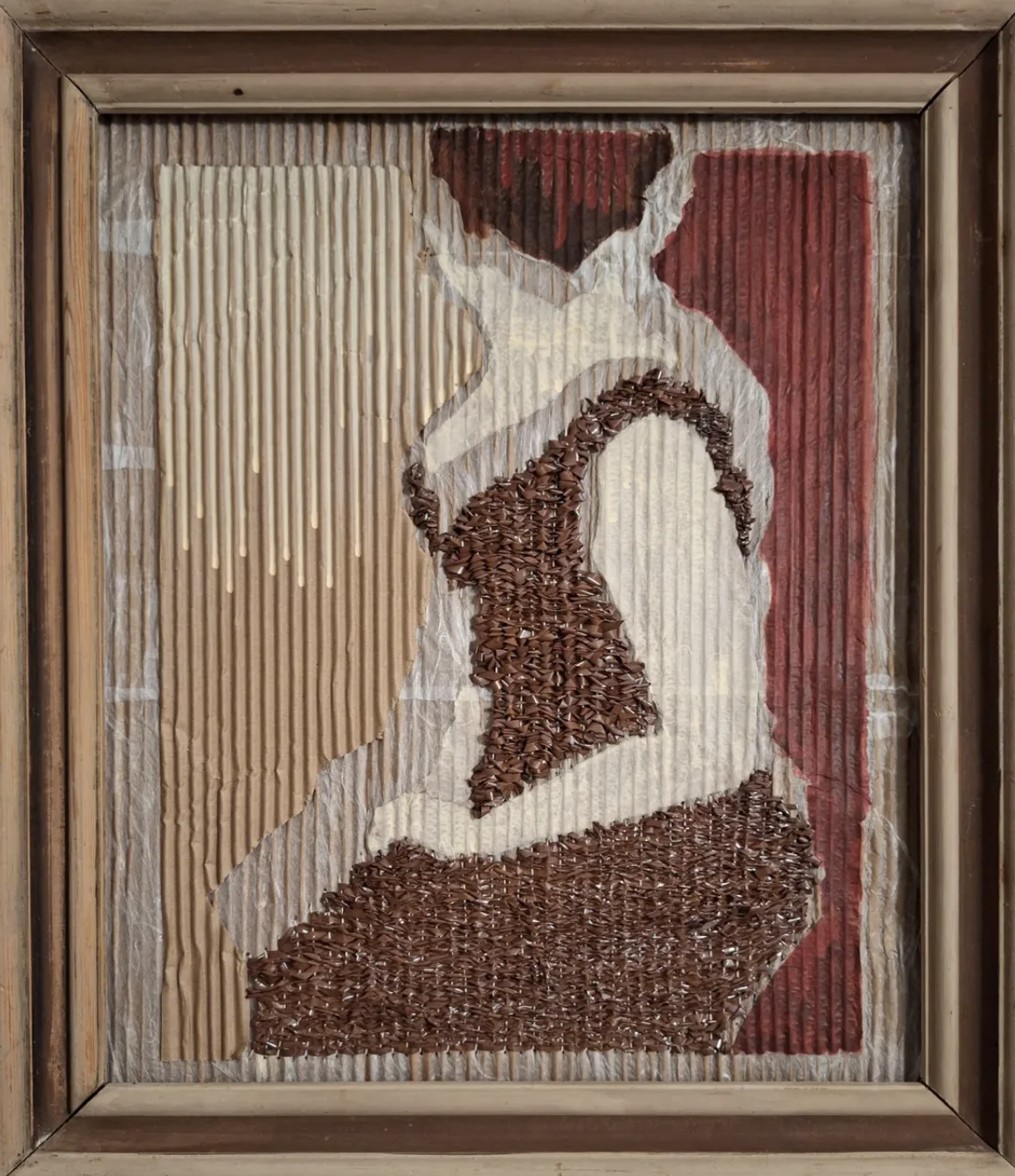
Maaike Takens, Gypsy Kings, 45×60cm, 2025. Photo courtesy: the artist
EP: You experiment often with different kinds of materials in your practice, often using bits of card and board and used paper as a canvas, using materials you already have rather than purchasing a clean canvas, per se. What is your reason for using the bases that you often use rather than sourcing canvases made specifically for painting?
MT: It may sound ‘the wrong way around’ but what I really feel is that when I’m in an art shop and see rolls of canvas or ready stretched canvas, I think “what a waste”. I almost even feel that with a bit of A4 printer paper. Maybe it’s just me, but I have so much stuff lying about, bits of paper, bits of cardboard, old clothes, food packaging, you name it, and I always think “let’s first use what I have”, and in essence, there’s never an end to what I have. It’s not necessarily steered by an idea of being conscious of waste per se, but I do think that’s sort of what I have—an ingrained thought process or behaviour where I am constantly aware of the fact that everything can be used, or used again. In hindsight, constructed thinking could allow one to argue that a material that has been used before or that has had any sort of use before already has a bit of a story to tell, which then becomes part of the work that it’s used for.
EP: Do you have a particular message you want to get out through your pieces?
MT: Hmmm, not sure. I don’t think that I set out to tell something. I think it’s more like I’m ‘just’ showing my mind’s eye or my point of view or the inside of my head. I am interested in the relation between artwork and viewer, though. I think a viewer, any viewer, adds a ‘layer’ to the work. I find it most interesting that if you hang 20 artworks in a room and you send 20 people into that room that they will all have an instant liking to a particular work, and very often everyone likes something completely different from the next person. Also, very often when you talk with people about a specific work, they all have something different they see or feel in the work. Viewers of my work often tell me things that I had not thought about at all and sometimes I can relate to it and sometimes I don’t. And either is equally exciting.
EP: You often use darker, muted, cool tones in your pieces. Is this the hue through which your memory replays these moments?
MT: I’ve heard this before and I am unsure if this is a conscious decision. I do wake up sometimes with colour combinations in my head, or I do sometimes feel the need to try and recreate a colour or a form that I have in my mind. Also, if I write something down that I thought about, I know exactly what colour I am talking about without there being a picture or another visual reference. Just now I’m thinking of a sort of yellowish white, like peroxided hair, combined with a tone of bright pink that is still also muted because the colour is not strong but ‘fuzzy’. And I want to combine that image with something green or greyish green. Why I have this in my head? Not a clue. Maybe you are right, and are these colours something that is played in my memory.
EP: What is a part of your practice you feel most confident in?
MT: I can do everything that I want and learn every skill that I set my mind to. I feel very confident of that.
EP: What is the part of your practice you feel least confident in?
MT: Selling and bringing my work out into the world.
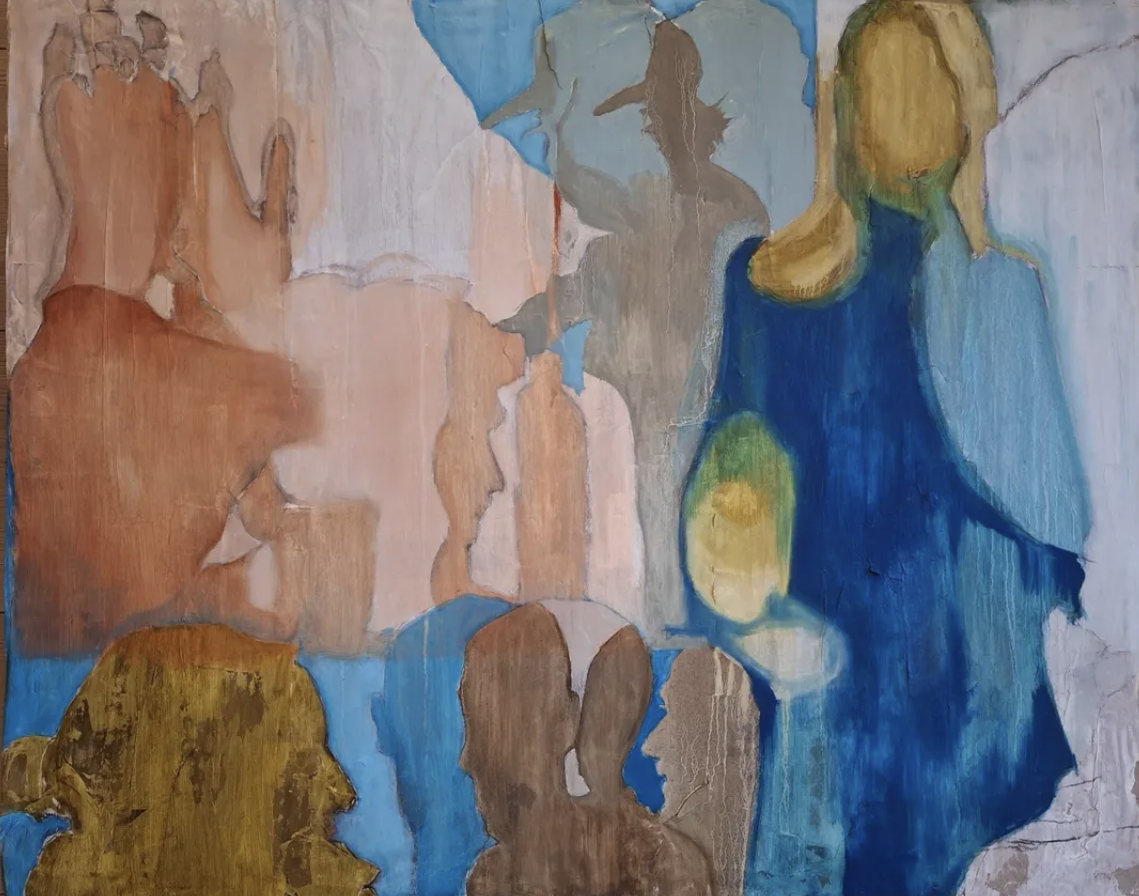
Maaike Takens, wip, 80×60cm, 2025. Photo courtesy: the artist
EP: If you have one, who is your current favourite artist?
MT: Think this is the same question as the one further down. However, I am going to answer this question as if it were “Which artist do you admire?” because that is something else. I can admire artists who have a completely different practice than I have, while I would say that for the “my favourite artist” question, I tend to look at painters. Anyways, I admire artists that are able to collaborate with others or with groups of people and in this way create something that is bigger than the sum of its parts, and that takes away the sense of the ego. There’s a different sort of thinking going on that I want to keep reminding myself of. I think the best example is Jeremy Deller. He sets things in motion in my brain and in the world that I find extremely exciting. I admire that.
EP: If you have one, which art movement is your favourite and why?
MT: Maybe I should say abstract expressionism and surrealism. Because, for me, art that is created within those movements is extremely difficult to recreate. It has to be genuine, and if it isn’t, it has a completely fake and plastic feel to it. When it speaks, it speaks, but it is an extremely difficult language to understand. For me.
EP: What time of the day do you feel most creative?
MT: During the day, while making. And during the night, while thinking and dreaming.
EP: What do you feel is the most important pearl of wisdom every artist should know?
MT: If you’ve made something once, you can make it twice. Meaning, don’t be precious about the things you make or, if you feel that you want to keep something in a specific state, keep it and make a duplicate to take further or in another direction
EP: What is your favourite colour?
MT: All of them
EP: Who is your favourite artist right now?
MT: Probably Vanessa Bell. Maybe de Kooning. Always Auerbach
EP: If you could claim one famous piece of art as your own, which would it be?
MT: Very difficult to answer that. But I think I would have to go with a painting by Frank Auerbach, preferably a painting that I’ve never actually seen, ‘Smithfield Meat Market’ that I only know from a reproduction in a book. Don’t know if it still exists. It’s a sort of perfectly coloured, perfectly figurative and at the same time very abstract work. It’s in oil, but it could also be fabric, depending on how you look at it. True to his practice, it’s something completely new that he brought into the world. I could also live with the painting “Melanie and me swimming’ by Michael Andrews
EP: If you could only use pencil or paint for the rest of your career, which would you choose?
MT: Anything, it doesn’t matter
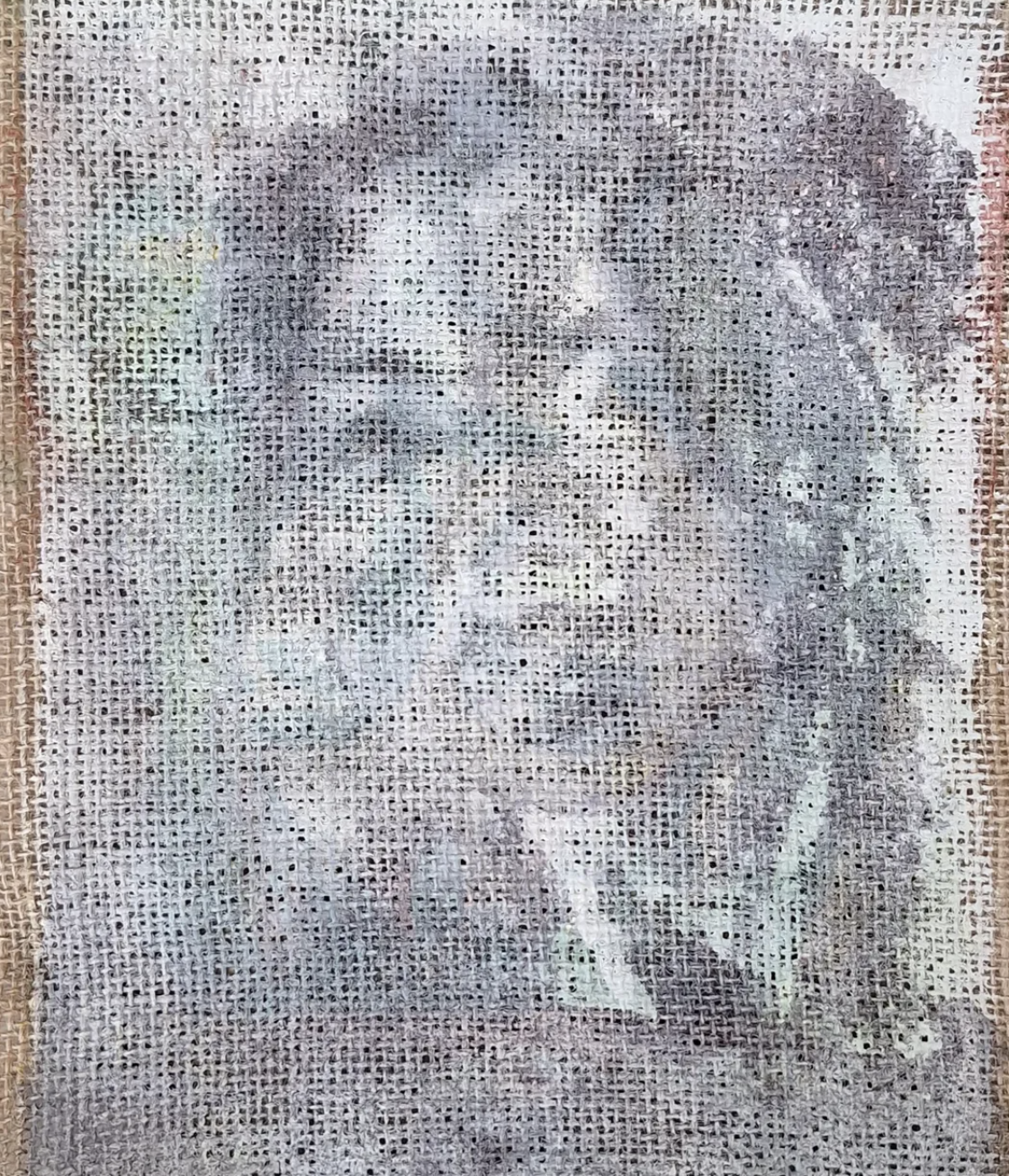
Maaike Takens, Ghost Portrait, 2025. Photo courtesy: the artist
Maaike Takens currently lives in Stockholm, Sweden. Takens with her youngest daughter and husband, and two British Blue cats, Dasher and Otto.
You can find Takens at @maaike_takens
Many thanks to Maaike Takens on behalf of MADE IN BED.
Eliza Palmer
Social Media Manager, MADE IN BED
Disclaimer: The views, thoughts, and opinions expressed in MADE IN BED are solely those of the individual authors and not those of MADE IN BED magazine or of Sotheby’s Institute of Art.