Alexis Kleeman in Conversation with Yeside Linney
Yeside Linney is a Nigerian self-taught artist based in Surrey. She moved to the UK at age four and was raised by guardians to receive an education, which she stated is important to her West African Heritage values. Yeside showed artistic talent as a child but chose to focus on her academic future to please her family, although her art teacher at school wanted to hone her skills. Yeside later attended Cambridge, then pursued a career in teaching English, where art ironically became her bridge to helping students understand academic concepts, and it has kept her young at heart. Yeside has earned considerable recognition for her paintings inspired by her Nigerian heritage and the National Trust landscape that surrounds her home, including a double award in the Women In Art Prize 2022, shortlisted twice for the International ArtGemini Prize and the IngDiscerning Prize 2024, and she was recently invited to judge for the New Emergence Prize.
AK: Could you tell us about how art helped you reconnect to your heritage and identity? In your artist's statement, you describe using art to explore cultural, geographical, and psychological aspects of yourself and your heritage, as well as recapturing what is lost.
Please tell us more about this.
YL: Art gave me a language; it's like returning to parts of myself that were denied and silenced in my youth because I wasn't allowed to speak my own language; I had to focus on learning English, and art became another medium where I could express myself and rebuild my relationship with my Nigerian heritage and mesh it with my European upbringing, the idea of global identity and how people and language evolve in unconscious ways. There is language, there is identity, and there is something about them that doesn't have to be spoken to create a relationship and sense of belonging.
AK: Please tell us about how you explore the threshold and state of transition, the space of in-betweenness, and existing between and across boundaries that you express in your art?
YL: It's a site of crossing, between the English and Nigerian cultures. One of my young artist friends introduced me to an American author called W.E. Du Bois, who talks about double Consciousness. This idea is that if you're somebody, usually a person in the diaspora, you're embracing two cultures, and it's how you navigate the in-between that can cause generative tension in your sense of self. Some of it is inherited, and some of it is constructed; so the threshold is the core of my practice, not metaphor. It's biographical because it is about what I've come from, where I'm going, and the tension of that cultural reality; and the paintings reflect that. There's an unstable space where identities, histories, and the landscape overlap, and the artwork reflects that because it is always in a state of flux.
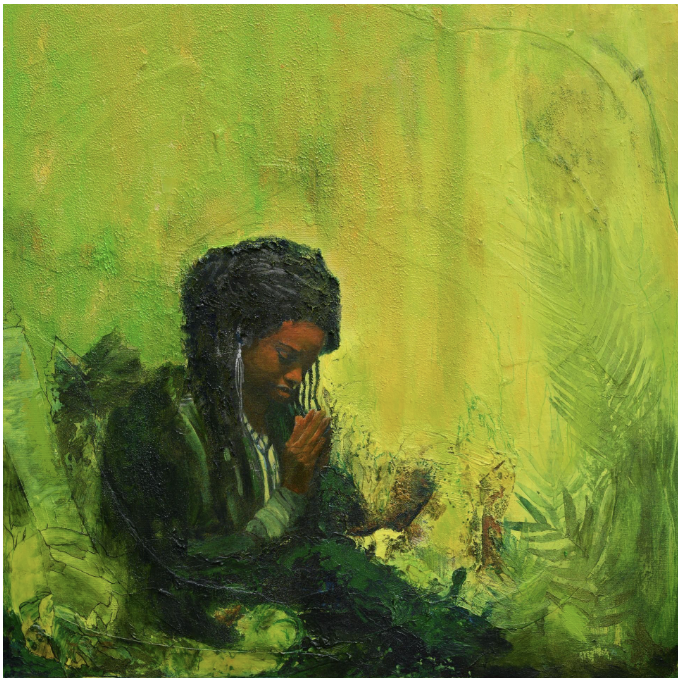
A Sense of Self. Image provided by the artist.
AK: Could you tell us about the contrast between the exploration of the natural world and the dystopian elements you use to represent the dislocation that permeates your sense of being?
YL: It articulates the dislocation that shapes my own identity. As I mentioned, the tensions between my lived experience and being Nigerian-born. I'm very lucky where I live; it's beautiful, but it feels grounding. It allows me to think, and it's quite emotional as well, because you get lost in that space and reconnect with nature. I did a series of paintings where I didn't have the proverbial ‘green, pleasant land’. I used vibrant colours that you would associate with the African continent. It captured the idea that nature almost becomes a vessel for dysphoric memory. It's almost like capturing what's lost. Later, I did a circular piece that had a fiery landscape, carrying a subtext of looking at nature, reflecting my own experiences and worries about topics like climate change.
AK: You recently had an exhibition, Under the Same Sky, Wilderness Art Collective, in Bristol and at the PaintSpaces Gallery. Please tell us about the exhibition, the pieces you exhibited and where and when you plan to exhibit next.
YL: I was invited to participate in the Wilderness Art Collective a couple of years ago, but unfortunately, I couldn’t exhibit then due to personal circumstances. But I was thrilled to participate in their travelling exhibition earlier this year and contributed four pieces. In January, we visited Chile for my birthday. I had to get up at four o'clock in the morning to see the geothermal patterns on the desert ground, and that inspired my work in the exhibition because it's all about the different ways we look at landscape and nature and reclamation. The piece I submitted revealed forms that resonated with the motifs that I've used in other works. I mean, it's all under the same sky. There's a sort of recurring tadpole shape; it subconsciously became a way of reconnecting with that overlooked cultural knowledge. It opens dialogue between the landscape, ancestry, memory, and my ongoing exploration of looking at the duality of self.
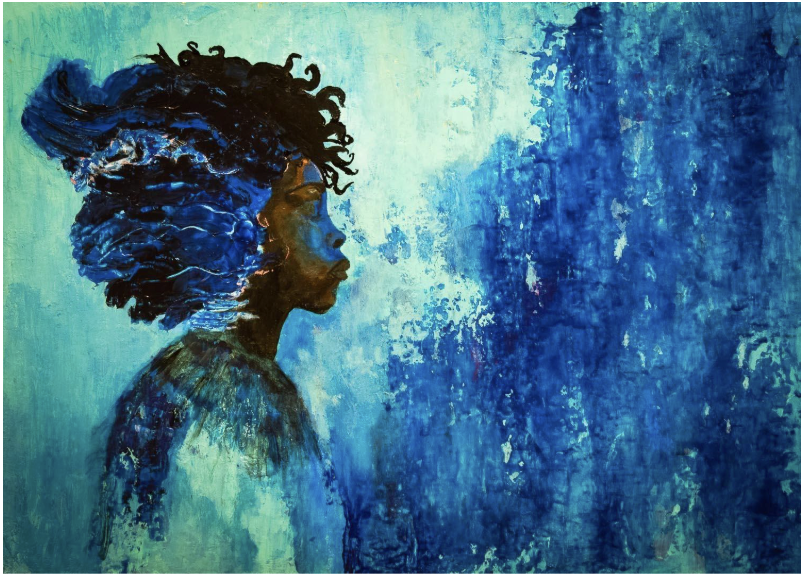
Yemaya. Image provided by the artist.
AK: You have a rich and colourful portfolio, yet each painting tells its own story and speaks for itself, even if it is in the same colour scheme as another painting. Please tell us about how you convey different emotions through the compositions and colours, yet each retains its individual narrative?
YL: The colour in my paintings is constant, but the narrative is not. That is part of my emotional response to the world I inhabit or have lived in and will live in: the emotional narrative of the world is the variable. I like my paintings to be beautiful; but there's more to it. Colour becomes the conduit for layering in many of the works and introduces that sort of nuanced control of rhythm, curiosity, and it becomes part of the storytelling as well. My paintings invite a conversation and describe where I feel safe and create a sense of mental well-being.
AK: Could you tell us more about how you use your National Trust surroundings to underpin conversations about your Nigerian heritage and identity?
YL: Increasingly, figures appear in landscapes because of this tension between societal perceptions that associate Black people with green spaces. The Devil’s Punchbowl is a lovely place, about 10 minutes' walk from where I live, and quite often you get Black walking groups coming down from London. I people-watch and see them interacting with the public space, observe the visual discomfort that you can see on some people's faces as they try to fit in. All that links to conversations about identity, particularly in the diaspora. The way in which I have worn my hair over time is another example of my identity in terms of how I've chosen to wear my hair to be accepted. Particularly for Black females, our hair is a litmus paper of social perception and acceptance. I'd say overall, it’s an ongoing challenge because we are subconsciously trying to fit ourselves into a box, even if we won't admit it. I think the sense of self in my paintings is what I aspire to be: safe in my own space.
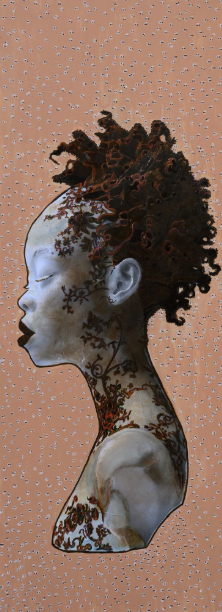
Precious. Image provided by the artist.
AK: I believe your painting, Black Madonna and Child, was on exhibition earlier this year at the Casildart gallery in the Empowerher exhibition. Please tell us about the experience, and if it makes a difference as an artist of colour to work with a gallery focused on representation, especially in an exhibition focused on giving recognition to women artists?
YL: The piece, Black Madonna and Child, was geared towards International Women's Day,. Sukai Ecclestone, owner of Casildart gallery, runs this exhibition once a year. I've been selected each year since it started. For this exhibition, she invited women of any background to represent their various backgrounds and womanhood as a whole; she was keen to put Black Madonna and Child in a focal place. It's redefining people's perspective on what a Madonna and child could be like. The black Madonnas was quite fashionable at one stage in the 17th century, I think, but they were effectively figures that were weathered by age and ended up looking quite bronze or black, but they weren't actually designed like. I liked the idea of reframing that perspective. For this work, my own mother was a reference, using the only photograph I have of her, which I carried on my lap on the aeroplane in 1956 when I first came to the UK. I adjusted her Yoruba headgear, a gele, because it is normally really big so in terms of composition, I thought it would be best to reduce it to balance the artwork. I often write words on the substrate before painting. Because I was separated from my mother at a young age, the words: “You never taught me how to live without you” lie there. The work also acts as a meditational tenderness and protection, and that sacredness of Black motherhood.
Yeside’s portfolio and updates can be found at https://www.yeside.com. Yeside continues to exhibit internationally and will be featured at the following upcoming events. October 9th, 34, An Evening with Yeside Linney, featuring a collection of art specially created for the space: Chinakwe, Market Row, Brixton SW9 8LD. Artwork will be available for purchase from that week. 10 - 25th October, 2026. Rogue Women, Rogue Studios, Manchester: A group show curated by Eleanor Clayton, Head of Collections and Exhibitions at The Hepworth, Wakefield. 23- 31st October, 2026. Framed in Black: 53, Havant Road, London, E17 3 J E. A group exhibition in Lemon Seed Project’s home gallery, inviting visitors to experience art in a lived-in domestic setting, creating an intimate way to discover and collect work outside the usual gallery model.
Alexis Kleeman
Interviews Co-Editor, MADE IN BED Magazine