Alexis Kleeman in Conversation with Yula Kim
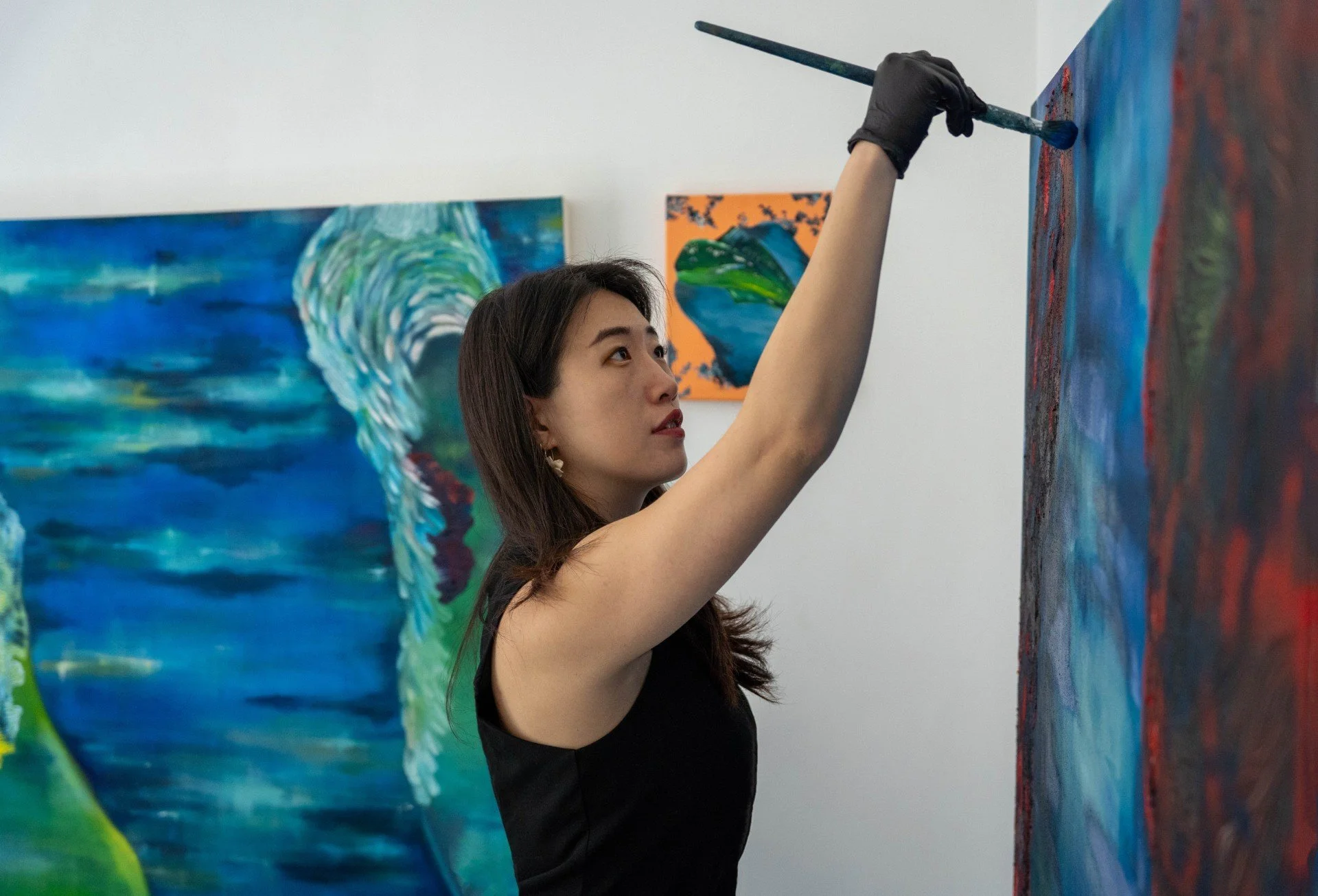
Artist Painting Scene. Photograph by Jim Mangles.
Yula Kim is a South Korean-born, London-based artist whose life and practice have been shaped by experiences across the world - Hawai‘i, China, Uganda, and the United Kingdom. Through her practice, Yula explores the idea of “certainty”, a feeling of presence shaped by migration, movement, memory, and the desire to exist beyond socially imposed definitions within contemporary life. In her work, she creates a visual language that reflects her search for certainty beyond the boundaries of her conservative upbringing. Hawai‘i has remained a significant source of inspiration throughout her practice, and she has visited the island on several occasions. Its distinctive bird species, vibrant coral reefs, active volcanoes, and unique ecosystems continue to inform her visual language and artistic research. Her work has been presented through projects and exhibitions with cultural institutions including Tate Modern Late and Coronation Concert in 2023, the Science Museum’s Communicating Time and Culture Project and UCL’s the Crafting Sustainabilities Collective in 2024 and Kingston Museum’s group exhibition in 2024-2025. Yula holds an MA in Contemporary Art Practice from the Royal College of Art and an MA in Museums and Galleries in Education from University College London. She previously completed a BA in Fine Art at Goldsmiths, University of London. Her research has explored avian taxidermy, preservation, and the role of natural history collections within museum display and artistic context.
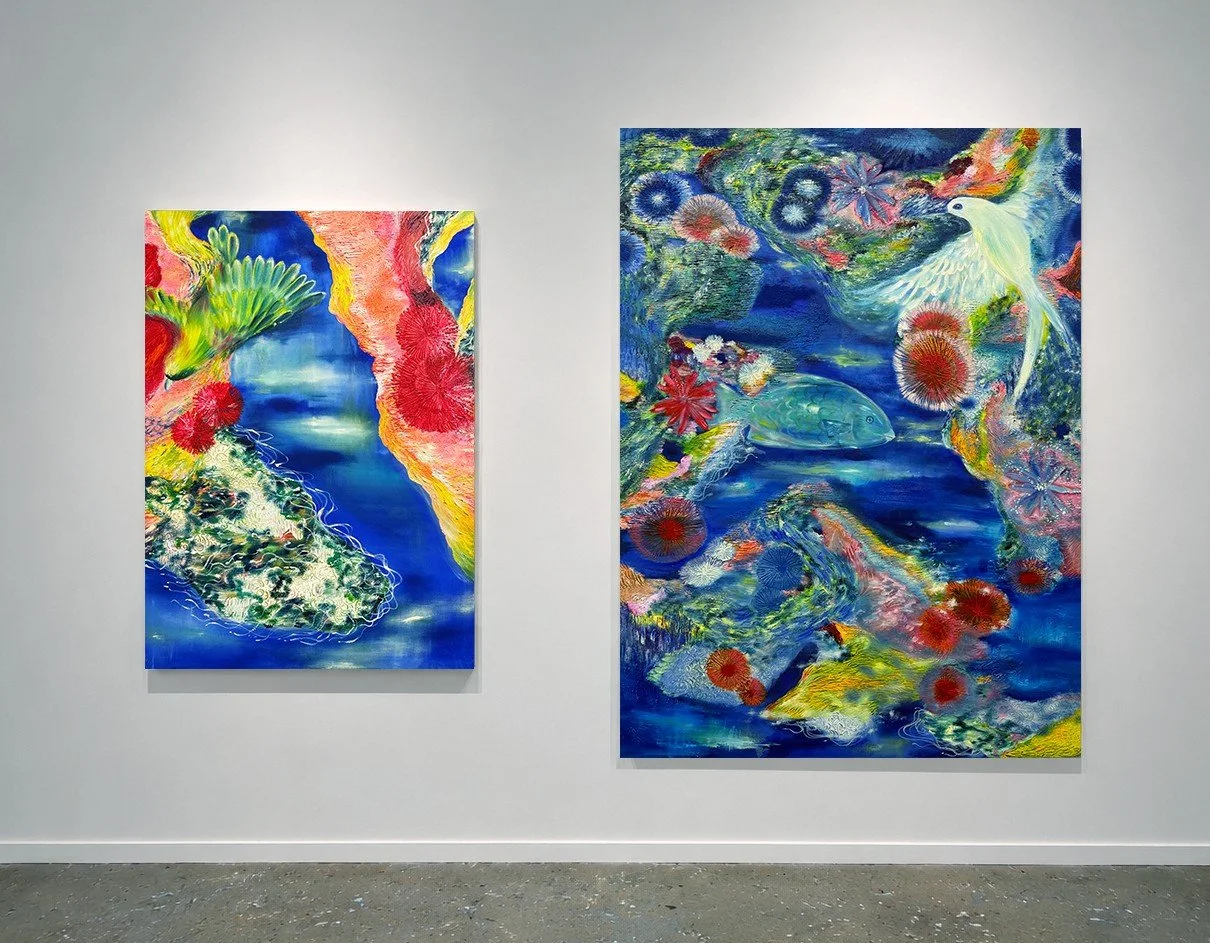
Installation of artworks. Image provided by the artist.
AK: Your artist statement talks about living across Asia, Polynesia, Africa, and Europe within a religiously conservative framework, and how your work reflects an ongoing negotiation between external expectations and an inner sense of self. Can you tell us what you mean by this statement?
YK: I am searching for what certainty means to me and how I can exist as a unique individual in the world. This is because I am a Third Culture Individual; I was raised in places that differed from my parents' cultural background, including South Korean, American, and British culture. This caused me to develop an awareness of multiple cultural perspectives from an early age. It helped me develop a unique perspective on the world. Living across many diverse cultures and environments has influenced my practice, encouraging me to adopt a more exploratory perspective. These experiences continually provide new sources of inspiration and help me define my own sense of certainty, while expressing my presence in relation to both others and the natural world.
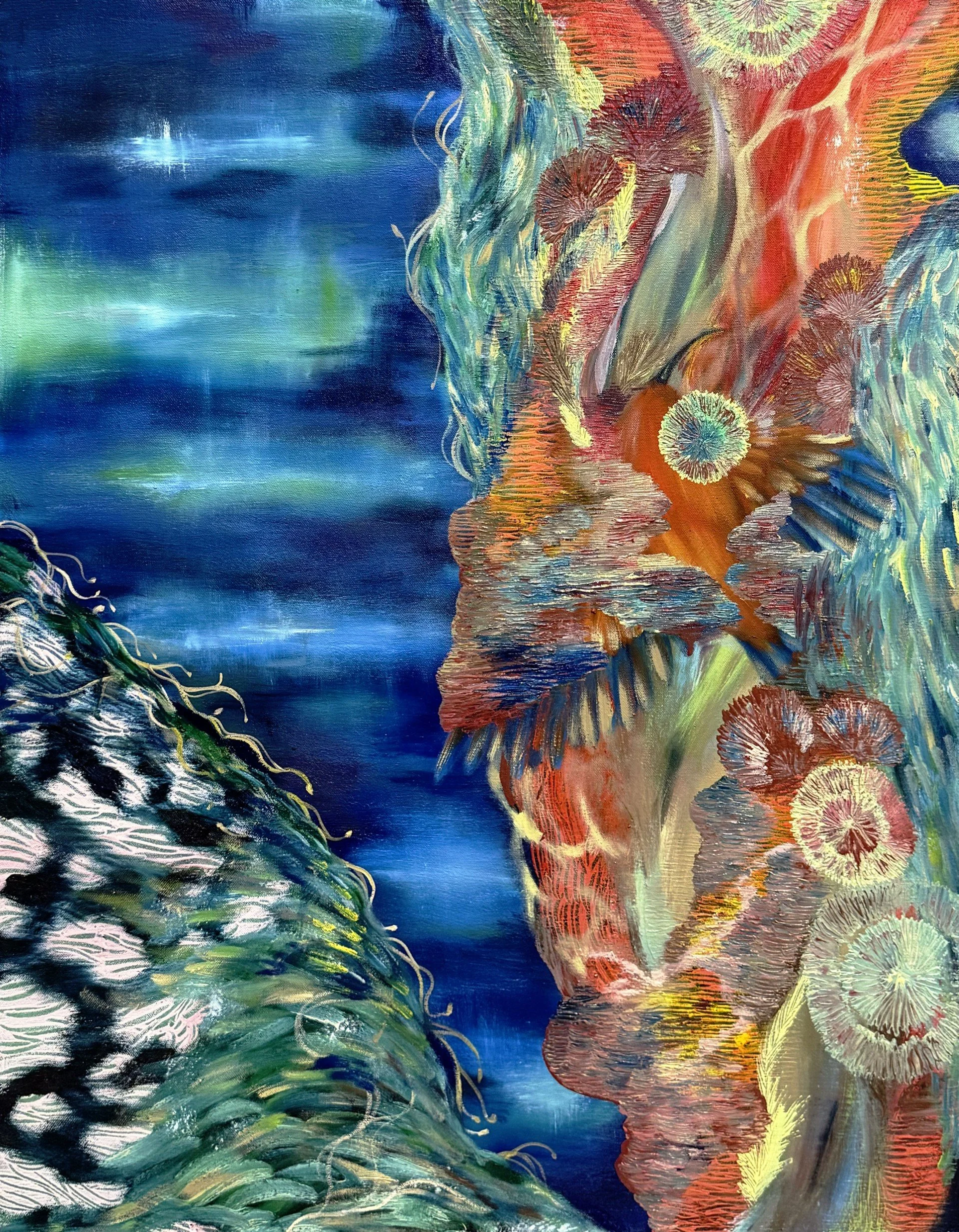
Holding Blue, Mauna Loa (2026), Yula Kim. Image provided by the artist.
AK: Your artistic practice has an emphasis on line making and creating a balance between the imaginative and the familiar. Can you tell us about the artistic process and inspiration behind your unique compositions?
YK: I use colourful lines of differing thickness in my work to produce the illusion of vibration and movement. I like texture in my work; it feels more expressive, which is the reason I work in oil and natural pigments, as it creates a texture that is not possible with acrylic or watercolour. I really like the physical process of painting, putting down paint, scraping into it, and using unusual methods of mixing pigments to create unique textures and lines. I use them to tell a visual story, creating the feeling that the viewer is present within the scene, where colours and objects merge into something new.
AK: Your work is often reminiscent of a tropical scene in either colour or form. Is this a result of your travels and exposure to tropical places as sources of inspiration?
YK: I like to stay in one area to create art and travel abroad to collect new ideas, experiences, and beautiful sources of inspiration. I then weave these influences into my work, sharing these feelings I have gained with audiences around the world, including London. Travel allows me to create scenes that reflect my experiences of finding certainty and connection with nature.
For example, I first felt a strong sense of belonging in nature during my gap year in Hawai‘i in 2017, a feeling that returned during my visit in 2025. The experience made me feel truly alive. It inspired me to share the feeling of being immersed in nature, surrounded by beautiful birds, colourful corals, the blue ocean, lava stones, and the quiet presence of small local towns. For me, these experiences suggest a universal connection between people and nature, creating a sense of certainty through the presence of active, living environments. This connection continues to inspire me and is something I seek to express through my work.
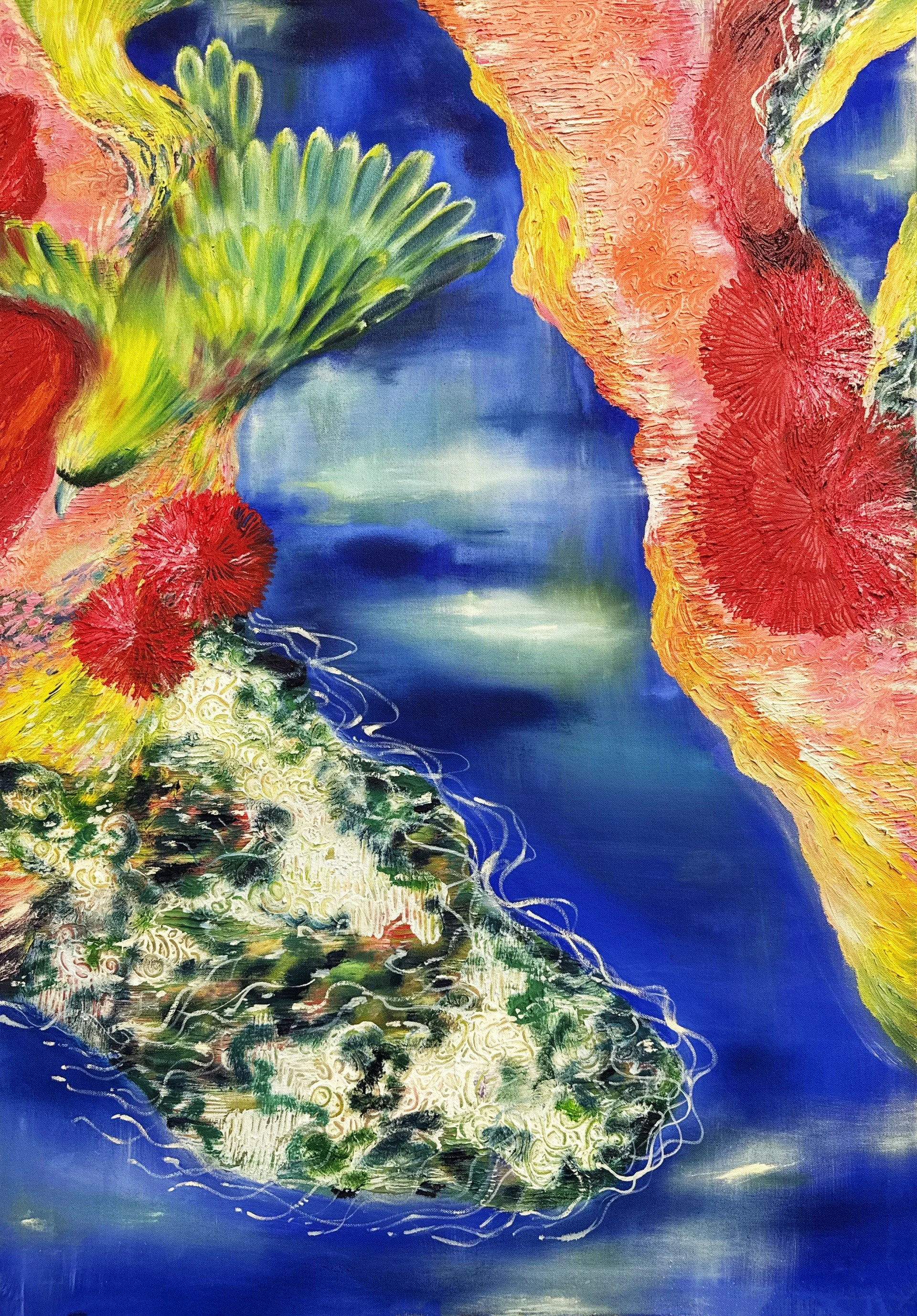
The Sea Still Glows (2026), Yula Kim. Image provided by the artist.
AK: There is a strong sense of exploration and self-discovery in your work. Does this come from a place of searching for yourself, either in identity or artistic practice, or perhaps like many artists chasing the next piece of inspiration?
I am interested in understanding what ‘certainty’ means for me and how I can define myself as a unique individual. Many of us are initially shaped by certain roles and expectations, whether through gender, religion, society, or culture. While these frameworks can provide a sense of belonging, I believe it is important to look beyond them and discover who we are on our own terms. I am fascinated by the different styles people choose to live, and I deeply respect those who remain curious about perspectives beyond their own.
Although I appreciate and learn from the diversity of human experience, I do not want to adopt someone else’s life as my own. Instead, I am interested in understanding what resonates with me and what does not. Perhaps that is where the sense of searching in my work comes from. I want to remain open to different experiences and ways of living, while still developing my own values and sense of certainty. For me, self-discovery is not about finding a fixed identity, but about continuously defining myself through experience, reflection, and choice.

No. A (2023), Yula Kim. Image provided by the artist.
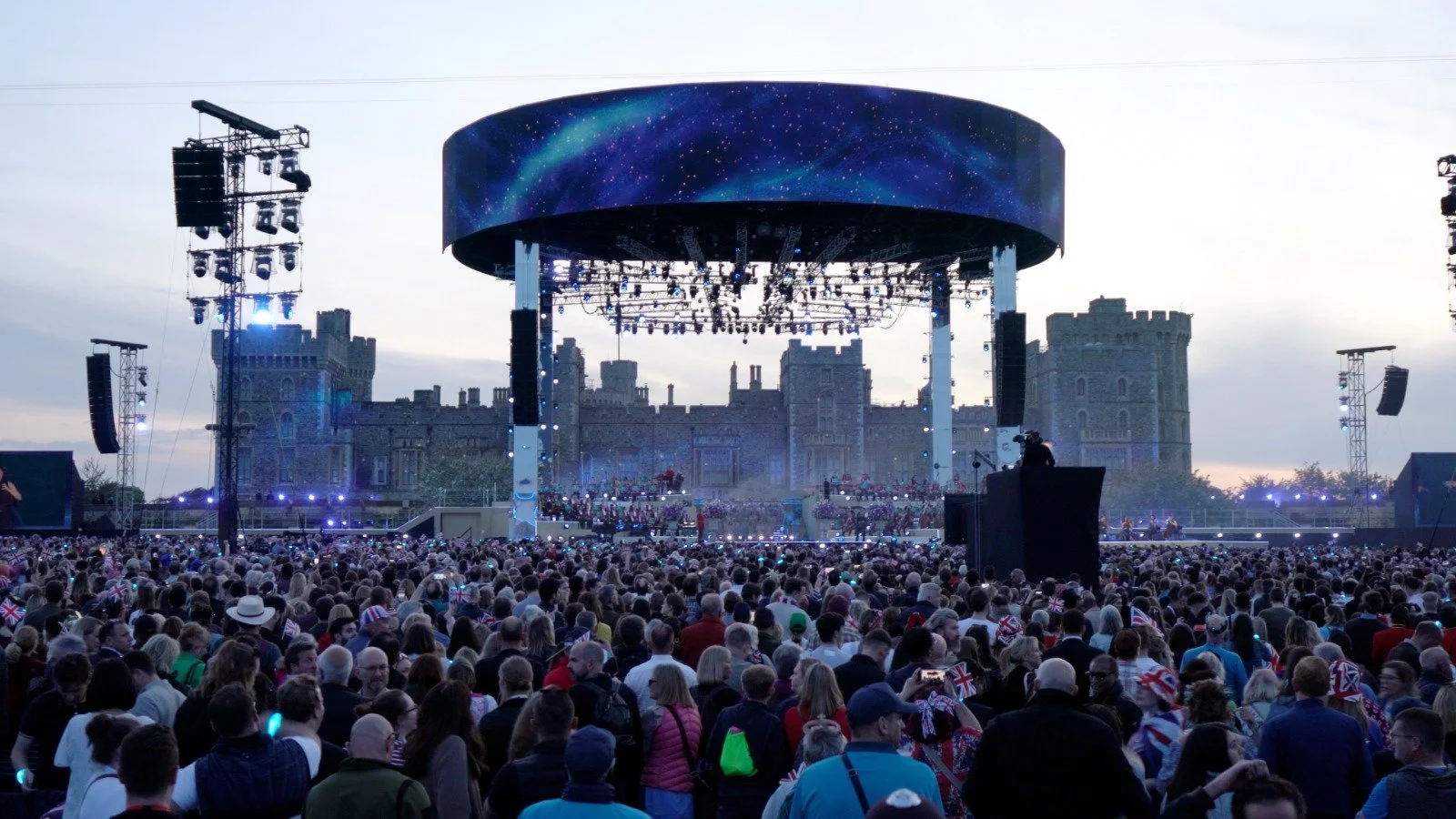
No.A (2023), Yula Kim. Coronation Concert, Windsor Castle, May 2023. Image provided by the artist.
AK: I understand one of your paintings was selected to commemorate the coronation of King Charles III and was exhibited at Windsor Castle during the Coronation Concert. This is a huge honour. Could you tell us about the piece and the emotional aspects of creating it, as well as it being selected for a once-in-a-lifetime opportunity like this?
It was such a rare opportunity. My work was selected through a process involving the Palace curators, the BBC, and the Royal College of Art. The work they selected was titled “No. A”, as it was the first image I created for the project. The title originated from its original filename, "A”. It is composed of deep navy, soft purple, and pink tones interwoven with flowing, galaxy-like lines. The work is a visual narration of love and unity, reflected in the way colours blend and interact to create a harmonious composition of smooth, vibrant tones, flowing lines, and varied forms.
This work was inspired by my time in Hawaii during my gap year and my visit to Kilauea and the summit of Mauna Kea; it was so cold, but beautiful. I felt connected with nature, and these experiences brought me tears of joy, and that connection was what I wanted to capture with this painting.
AK: Can you speak to your philosophy on nature, reflecting a desire to hold onto a sense of certainty within the shifting conditions of contemporary life, and how this view impacts your artistic practice?
YK: I believe nature is one of the most innocent places. I particularly like the birds and botanical elements since they are living, breathing, clean air, and they can tell us about changes in our living environment. These creatures create biodiversity in our contemporary environment, whether in the busy urban area or in the quiet countryside. I find inspiration in the places I have lived, travelled, and studied, as well as in the birds and other natural elements that I have encountered during these experiences. I am particularly interested in regions such as Polynesia, which continue to influence my artistic research and practice. I love British birds and other regional species, but I am also fascinated by birds from the Pacific Islands. These environments provide a rich source of inspiration because they reveal the close relationship between birds and flowers. Many of these birds play an important ecological role by pollinating plants, much like bees, and in doing so, they help sustain and enrich the wider ecosystem. I am drawn to these subjects because they remind me that every element of nature has its own role and presence within the world. Through observing these relationships, I can reflect on ideas of interconnectedness, biodiversity, and the sense of certainty that living organisms bring to our shared environment.
I really like the different qualities of various birds, as well as other parts of nature, and I want to find out more about them to explore the certainty of their presence, aura, and moment. I believe these elements are related to contemporary life. Humanity has become more diverse, and each of us has something different to say. I really appreciate the different perspectives, beliefs, and opinions that come from different individuals. I believe birds, and ultimately nature, create a feeling that can make us feel united. This is what inspired me to become an artist, and it continues to influence my work today.
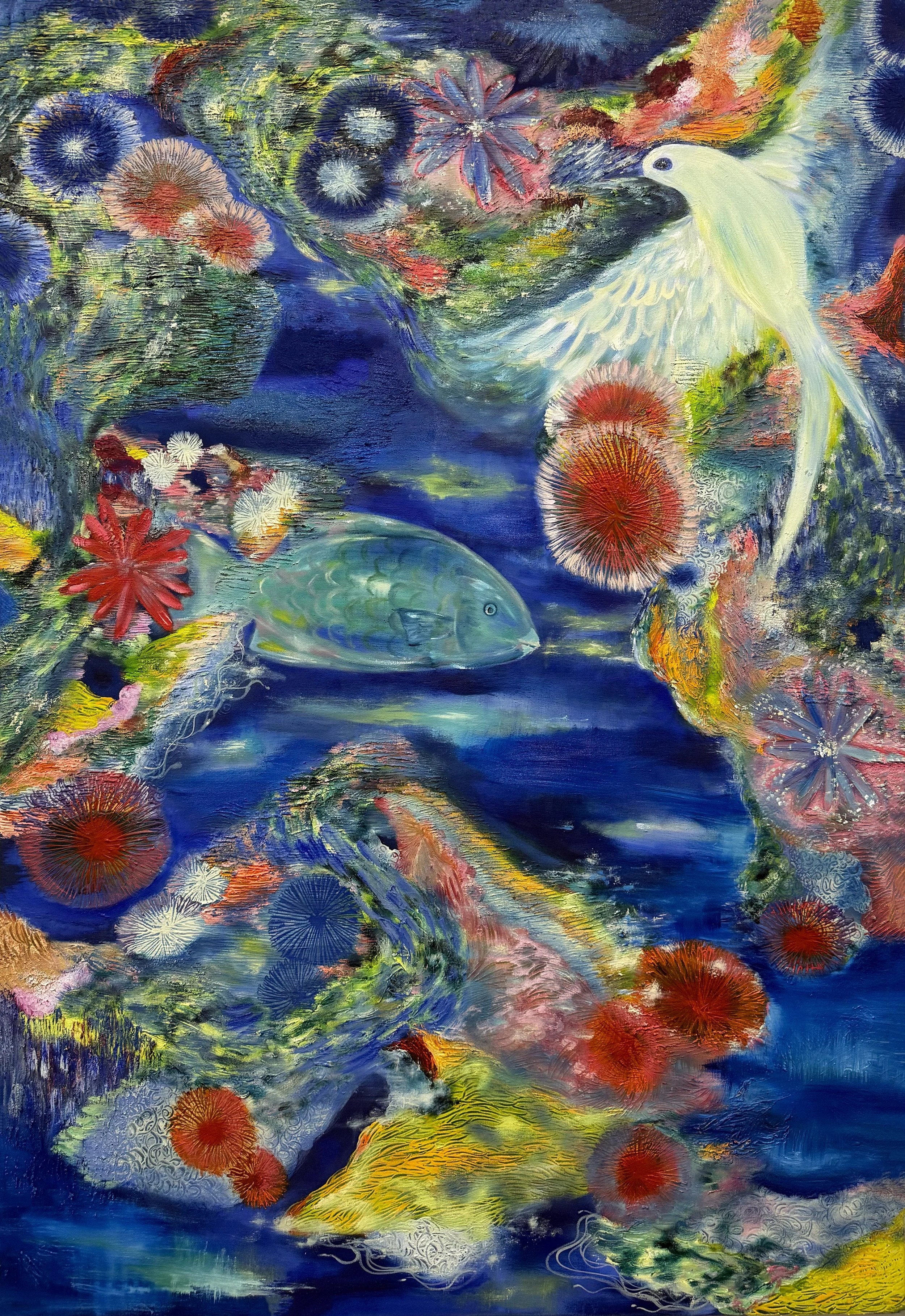
Afterglow, Kona (2026). Yula Kim. Image provided by the artist.
AK: You have several series of paintings; however, your most recent addition, the Kona Glow series, is named after a region on Hawai’i Island. Can you tell us about the inspiration behind it and your time making art in Hawai’i?
YK: The Kona Glow series was inspired by my time in Kona, Hawai‘i, where I spent part of my gap year. Surrounded by the ocean, I became fascinated by the intensity and depth of the blue colours in the Hawaiian landscape. The experience helped me appreciate the elegance and power of nature, and it gave me a sense of connection to something larger than myself. I was particularly inspired by the colours, marine life, and unique bird species found in Hawai‘i. Many of these birds possess distinctive characteristics and play important roles within their ecosystems. In my work, I often use birds as an alter ego through which I reflect on contemporary life, certainty, and belonging. Through the Kona Glow series, I wanted to translate the atmosphere, colour, and emotional experience of Hawai‘i into painting while exploring broader questions about freedom, connection, and our relationship with the natural world.
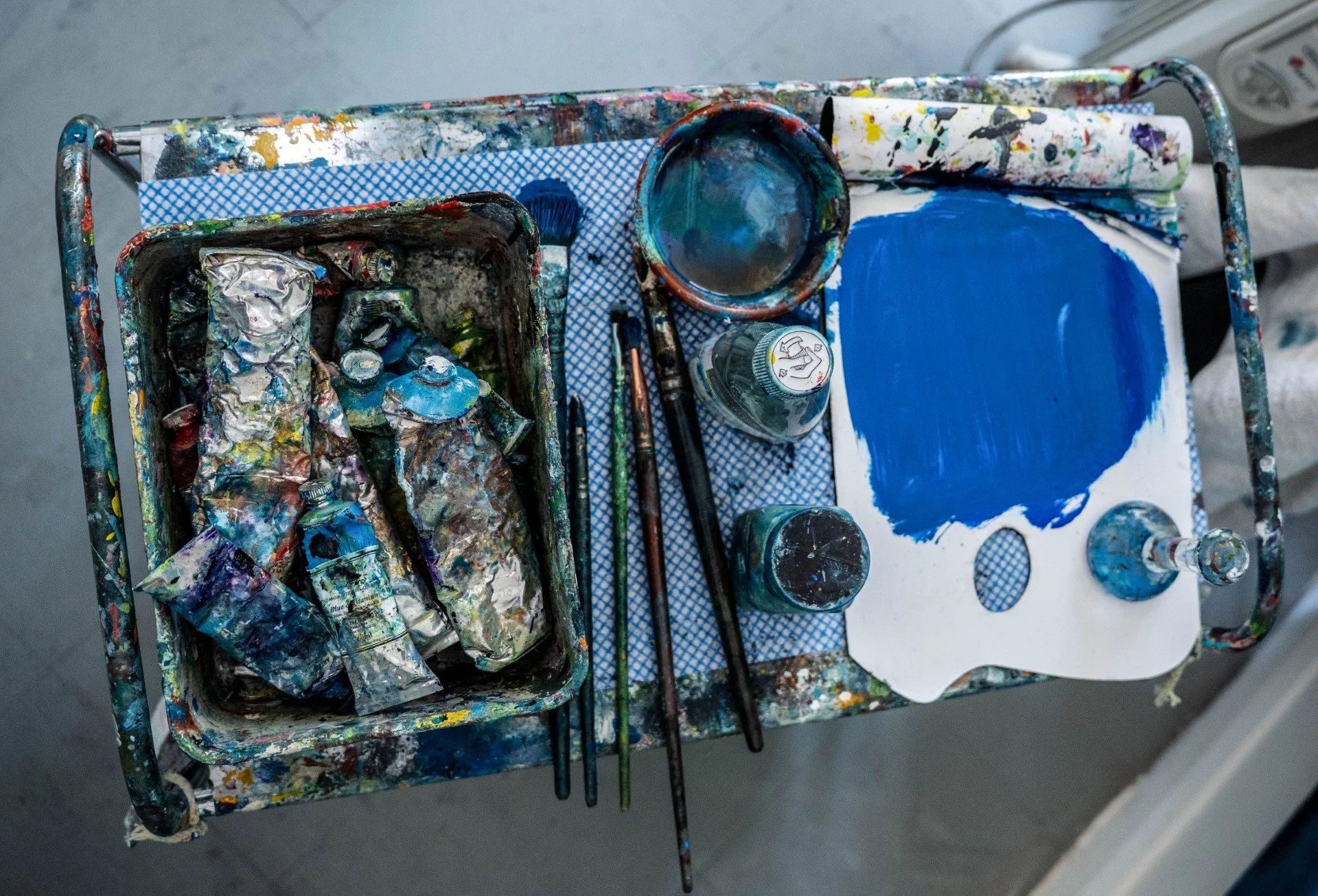
Photo of the artist’s materials. Photograph by Jim Mangles.
AK: Your style has developed and changed significantly over the last four years. Is this due to travel and exposure to other art styles and sources of inspiration, or maturity as an artist?
YK: Four years ago, I was studying in an academic environment, and my paintings were closely tied to my research, functioning almost as a visual diary. At the time, I was interested in communicating what I was learning and sharing aspects of the natural subjects I was studying. Over time, however, I began to move my artistic practice beyond being inspired by my research alone. Alongside my experiences in museums and galleries, I wanted to share my personal encounters with nature and the world around me. I became increasingly interested in using painting not only as a tool for investigation, but also as a way of expressing my own experiences and perspectives. That is why my artistic practice has changed so much over the last four years. As I have grown and evolved as a person, my work has grown with me.
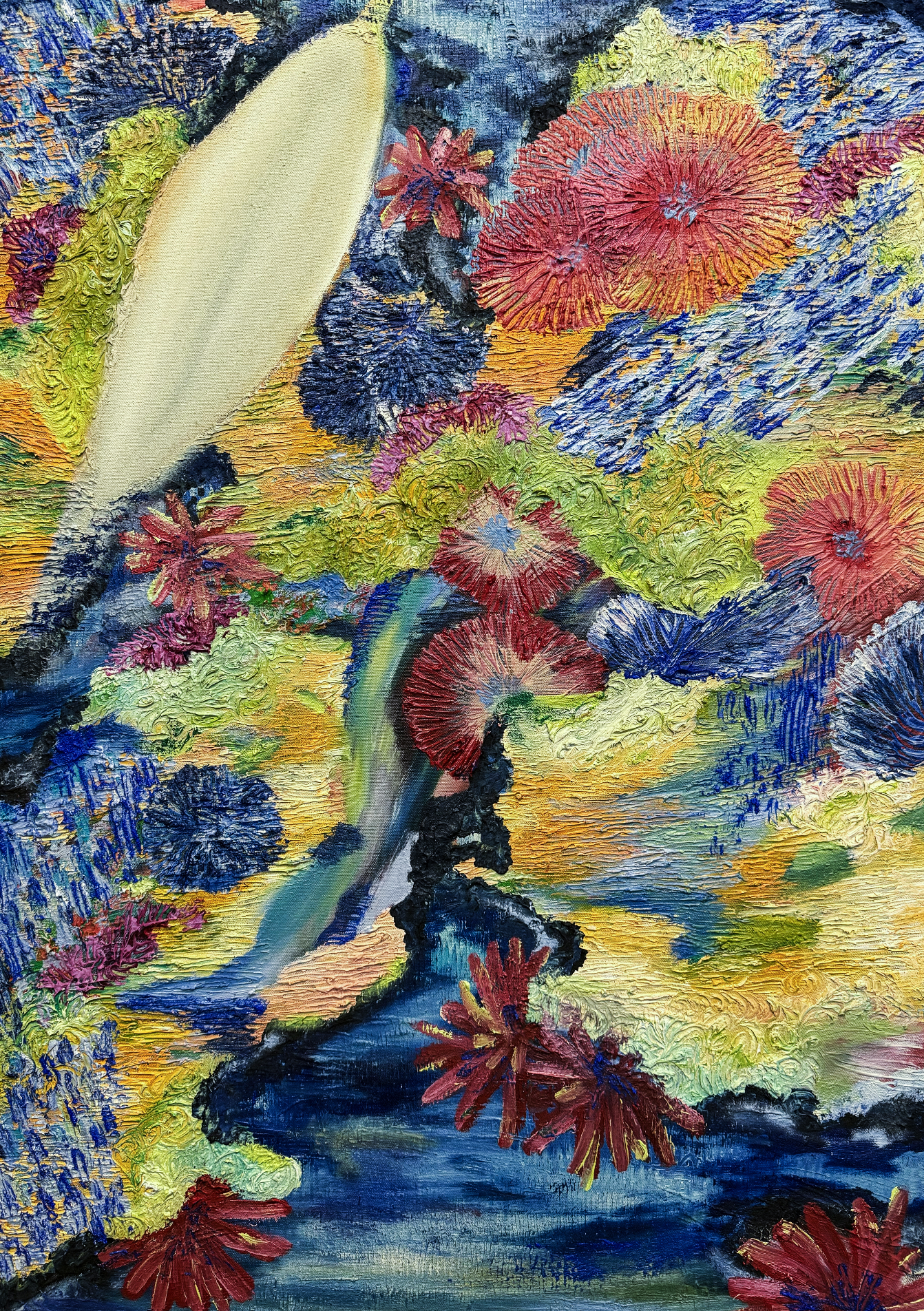
Pelagic Kealakekua (2026), Yula Kim. Image provided by the artist.
AK: You have participated in several international projects and exhibitions, including Auckland Art Week, The Big Screen Plaza New York, Tate Modern, and more. What is next for your career?
YK: Through my work and projects, I hope to share my artistic perspective on how we connect and merge with nature, and how we seek to define a sense of certainty in an ever-changing contemporary world through the continuous act of creation. I would love to develop more institutional collaborations and exhibition opportunities in the future. I am also currently looking for a gallery to work with and to build a long-term relationship with. There are so many possibilities ahead, and I am excited to explore new creative projects both in London and beyond. At the moment, I am actively reaching out to galleries, artist collectives, and cultural organisations that align with my practice, and I look forward to seeing where those conversations may lead. I believe this is one of the most rewarding aspects of being an artist: the opportunity to engage with different creative communities and contexts. Through this, you encounter people with diverse experiences, educational backgrounds, and perspectives. I find it incredibly valuable to exchange ideas, collaborate, and build meaningful relationships with others. These encounters not only enrich my understanding of the world but also continually shape and expand my artistic practice.
Yula continues to explore birds and natural elements as a way of reflecting on the idea of ‘certainty’ in contemporary life. Through her paintings, she examines how individuals navigate identity, belonging, and change within an increasingly complex world. Further information and contact details of the artist can be found at yulastudio.com. Yula hopes to work in collaboration with galleries and other artists as the next step in her career and will continue to exhibit globally.