
Artist Highlight—Art Basel Miami 2025: Roméo Mivekannin
At Art Basel Miami 2025, Roméo Mivekannin cultivated a bright light amid a constellation of Black artists with the Southern Guild. For their first presentation at Basel Miami, this booth showcased superb talent among the powerful and surging Black Diaspora, namely Zanele Muholi, Ayotunde Ojo, and Manyaku Mashilo. Roméo Mivekannin was a personal favourite from our survey at the Miami fair. His work recreates Western art history on his own terms by recasting major roles into ones played by himself. These works give a sense of theatre, using dramatised light and almost rehearsed yet faithful expressions. He frequently uses a free hanging canvas—unconfined by frames—and goes through a process of soaking the canvas in herbal admixtures, stemming from the rich cultural roots of Benin. By using scenes drawn from his predecessors, Roméo at the same time validates and demarcates himself from the surrounding figures.
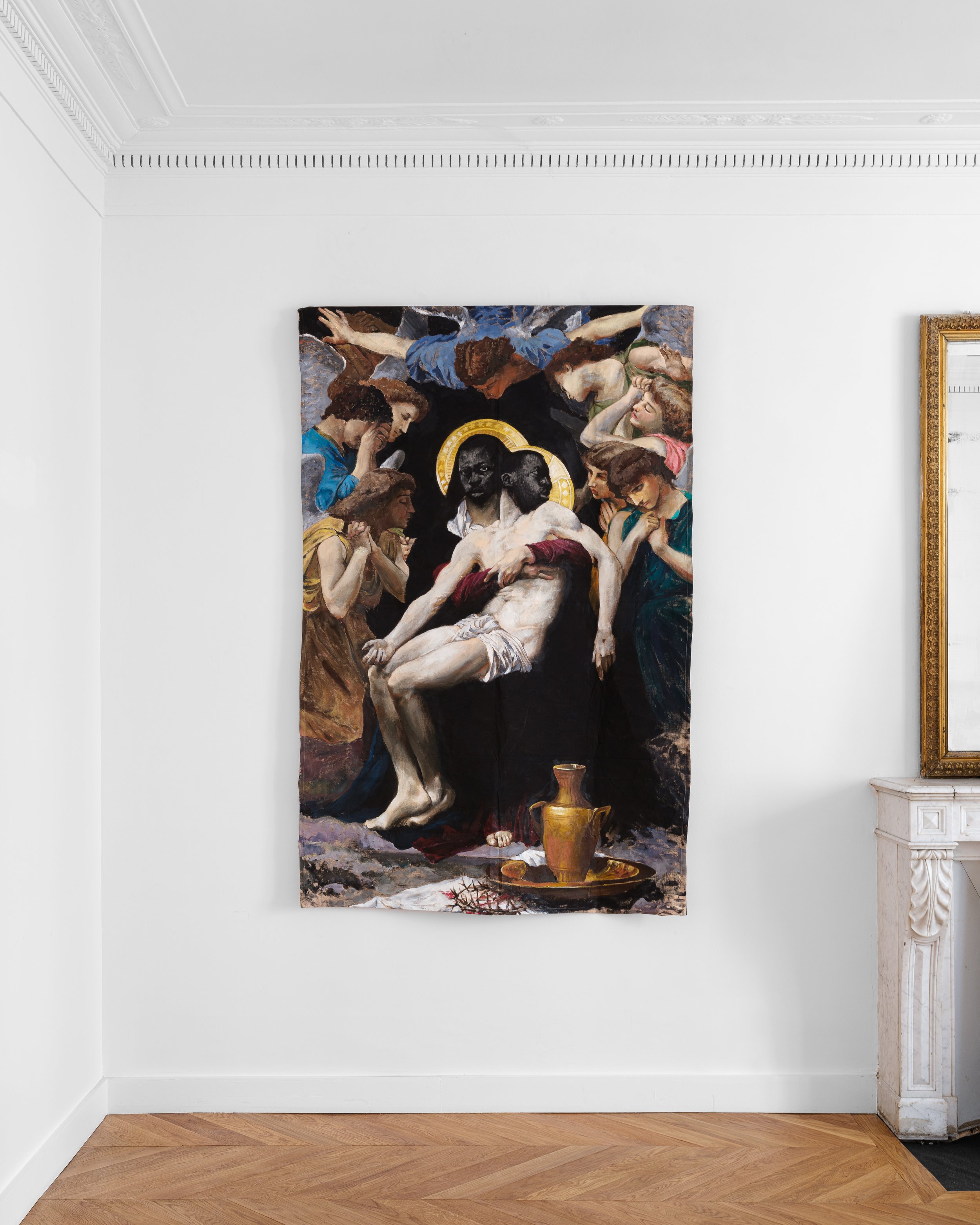
Roméo Mivekannin, Pièta, after Bouguereau (1876), 2023. Image courtesy: The Artist and Galerie Cecile Fakhoury
Just like Roméo’s thematic design, scenes of Jesus’ life can also be perceived in the realm of theatrics, how perpetual renditions of the Passion of Christ are dramatised and immortalised through art. In Pièta, after Bouguereau, Roméo inserts his self-portrait both as the head of Mary and the deceased Jesus, juxtaposing ‘Europeanised’ bodies with the face of a French-Beninese Black man. The two figures wear golden nimbuses as divine crowns, framed by the surrounding Euro-like angelic ‘actors’ expressing various emotions. The dark tones of Roméo-Mary's garment are rendered incognito with the empty space of the dark background, like they are spiritually suspended in divine blackness. This is the dramatic apogee, the moment a son dies in the arms of his mother.
Jesus’ defunct arm falls directly above a handled bronze urn that sits at the edge of the ‘stage’, possibly pointing to the Holy Pair’s Eastern origins that European painters tend to eschew. Pots in Christian art can represent the fragility of human structures; in this sense, Roméo’s Christ points to the structures of entrapment fortified by a White Christ. This scene is not bound by the naturalism of reality, emphasised by the artist’s exposure of the ground layer on the far right. Roméo dives into a deep bag of techniques laid out by his predecessors.
By way of the title, this is a painting after William-Adolph Bouguereau—an exceptional choice by Roméo considering Bouguereau’s Pièta also enacts inter-gender positions for Mary. Bouguereau created his Pièta after the passing of his own son, George, who died in his arms. His Mary hides her feminine qualities beneath her veil, solely emphasising pure human emotion—a common characteristic of Romanticism. Roméo instead uses the emotions of a Black identity that suffered for centuries attempts at erasing their history. This painting is rooted in Neoclassical Romanticism that is repositioned within the problems of the contemporary, evident with this reversed racial narrative. While the original Pièta from Bouguereau may be accepted as a ‘real’ and ‘non-idealized’ Jesus, Roméo asks the viewers to rethink how we come to terms with ‘real’ history in a Western context through the lens of this contemporary epoch.
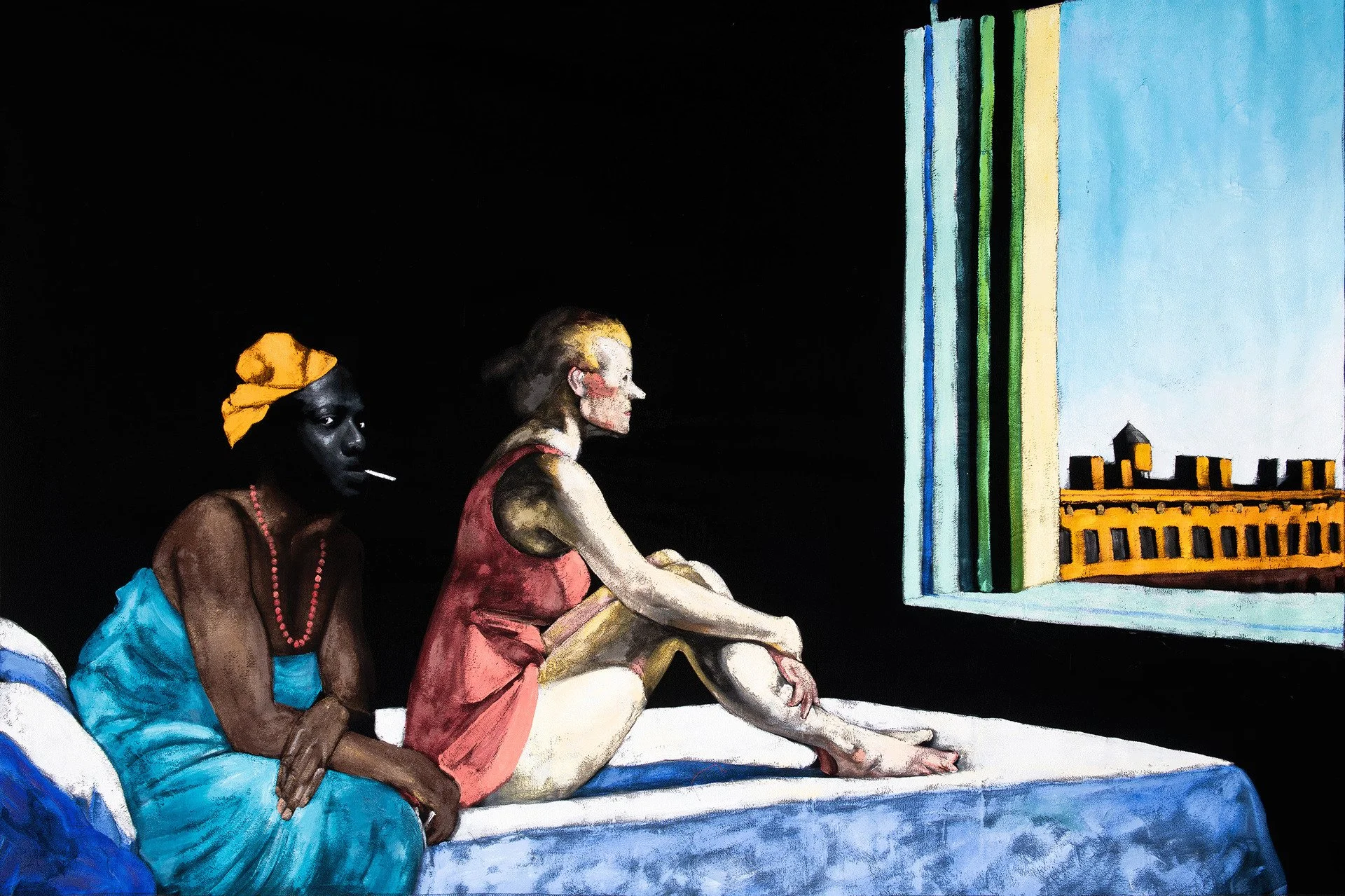
Roméo Mivekannin, Morning Sun (1952), after Eward Hopper, 2025. Image courtesy: The Artist and Southern Guild
Roméo does not stay entirely true to Eward Hopper’s Morning Sun. The primary technique Roméo uses to reinvent this scene is colour: the inclusion of melanated colour, but also a high-tuned saturation of colour. Painting on black velvet, he creates a room so black it seems absent from space. Underlying themes for Hopper are urban loneliness and isolation; Romeo seems to take a further step towards loneliness by eliminating the walls of this bedroom. The two figures are no longer in a room but positioned in front of a black backdrop, contributing to this stage-like energy from Mivekannin’s oeuvre.
We still get this sense of stillness transferred from Hopper; figures are static and angles are straight, horizontal and vertical--not even in the rise of smoke from the cigarette. There are compelling concepts of loneliness and isolation from the woman starring out the window, as a vessel for introspection, but we do not receive the warmth of light from the morning sun. The lack of warmth from these unlocalized colours creates a cold sense of loneliness and a more pastiche idea of picture.
The White woman is centred and takes up more space on the bed, but because of her lack of individuality the focus is very much on Roméo’s character who is connected to the viewer through a gaze. The bright light of the outside source illuminates the White woman and the bed but seems to miss Roméo’s character. Could this mean Black is overshadowed by White, or should our interpretation not be so ‘black and white’? The melanated figure does not need light to shine; culture and beauty do the illumination. Mivekannin represents symbols of identity and cultural expression through Afro-centric garments: the blue dress wrapped beneath the shoulders, paired with a red beaded necklace and orange head wrap—or gele—hints towards the appearance of a woman. Once again, the artist plays with inter-gender roles as he represents Black men and women—Black identity in its entirety.
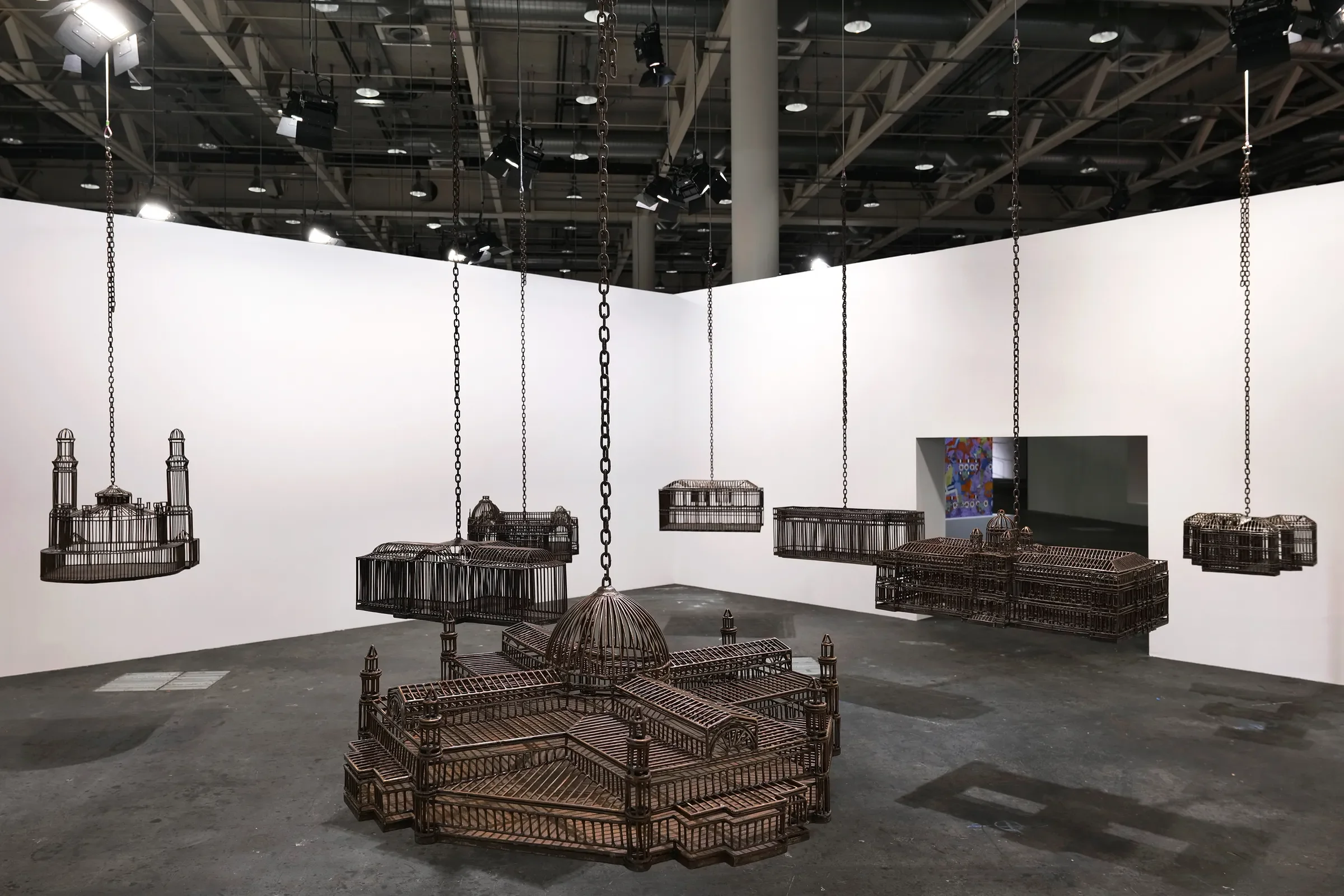
Roméo Mivekannin, Atlas, 2025. Image courtesy: The Artist and Galerie Cécile Fakhoury
The French-Beninese artist continues to address the reality of our history, sparking tough conversations, and uplifting the marginalized to the forefront of visual art. Roméo’s rising momentum is hard to ignore right now. His first institutional solo exhibition, “Les gens ne disent presque rien,” at Kunsthalle Gießen marked a significant milestone.
At the same time, Southern Guild has been strategically amplifying their visibility. Their booth’s recognition among the top 10 presentations at Art Basel Miami 2025 (as noted by Artsy) reflects not just strong curation but great representation and investment in the many artists on their roster.
Southern guild’s recent move into New York’s Tribeca—at 75 Leonard Street—is also worth paying attention to. Their presence in Tribeca, among other blue chip galleries, signals a deliberate expansion of African diasporic voices. If they continue on this trajectory, it’s very likely we’ll see new work from Roméo Mivekannin that builds on this institutional momentum—potentially even sharper in its engagement with art history and colonial archives.
Nicolas Berkel
Guest Writer, MADE IN BED
Disclaimer: The views, thoughts, and opinions expressed in MADE IN BED are solely those of the individual authors and not those of MADE IN BED magazine or of Sotheby’s Institute of Art.