Lisson Street: Sean Scully—The Nature of Art
Recently named the ‘greatest living abstract painter’ by Jonathan Jones for The Guardian, The Nature of Art presents Scully’s 2005 series of photographs from the island of Aran alongside two large-scale paintings and a huge salon-style array of drawings, watercolours, photos and written works on paper. It is a selection that charts the landscape theme throughout his career.
Born in Dublin in 1945 and raised in South London, Scully attended evening classes at the Central School of Art before enrolling at Croydon College of Art in the mid-1960s. He later completed his BA at Newcastle University and, after receiving the Frank Knox Fellowship to Harvard in 1972, moved to New York in 1975. Scully’s work has consistently negotiated between the reduced vocabulary of American abstraction and the emotional and metaphorical traditions of European painting. While his large-scale canvases of vertical and horizontal bands are instantly recognisable, they have always carried something more than formal logic. Landscape, memory and architecture remain embedded within them.
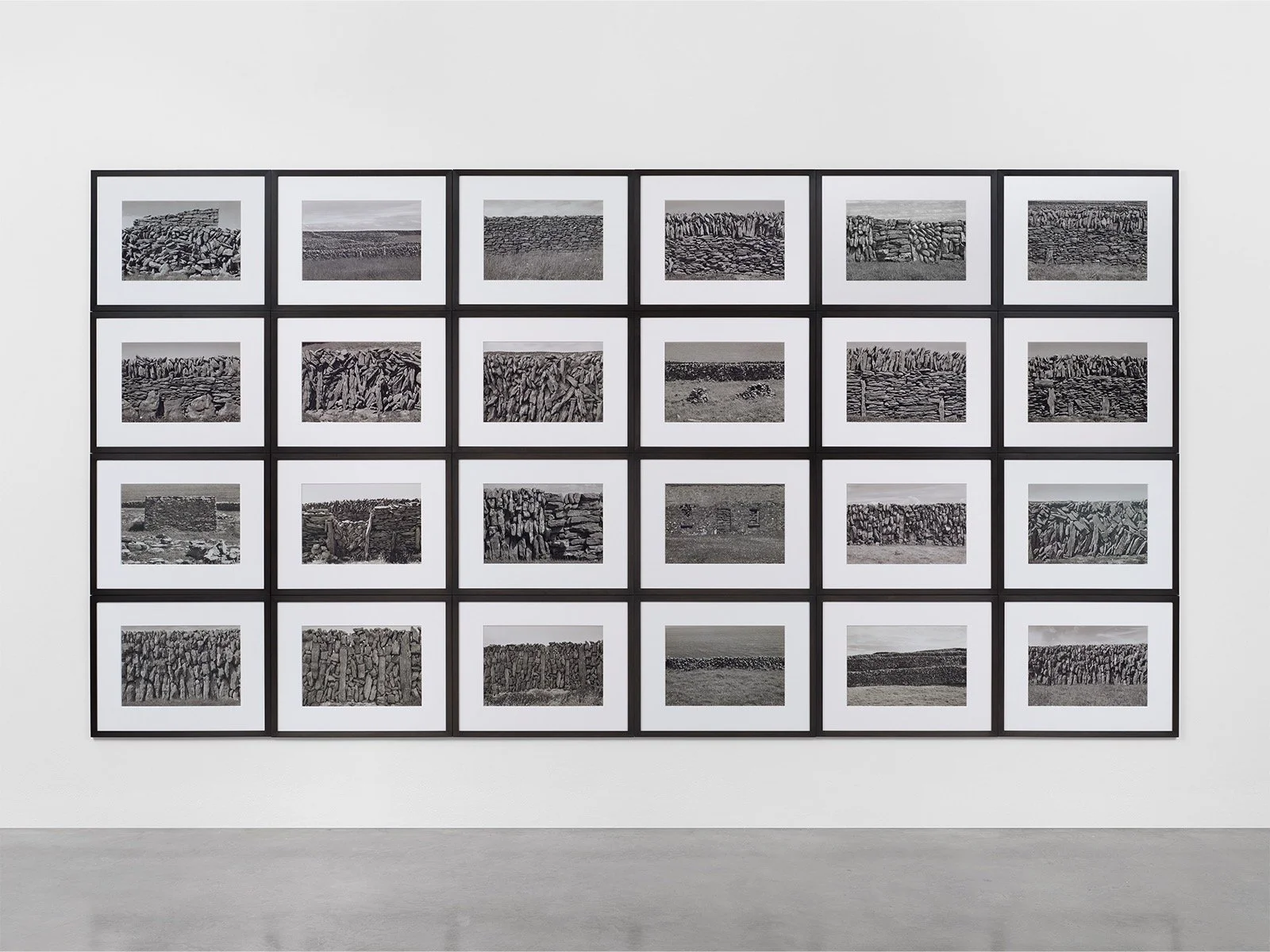
Exhibition view of ‘Lisson Street: Sean Scully – The Nature of Art’. Image courtesy of Lisson Gallery
At 67 Lisson Street, the exhibition unfolds through a specially curated salon-style wall hung in rough chronological order from left to right. It begins with a small pencil drawing of a houseplant from 1965, made while Scully was still a student; the work is observational, attentive to organic form. Yet within a year, the shift is palpable. A set of vibrant oil pastels and gouaches from 1965–66 begins to blur horizon lines, rainbows and figures in a field. The natural world is not abandoned; it is absorbed into a newly abstracted language.

Exhibition view of ‘Lisson Street: Sean Scully – The Nature of Art’. Image courtesy of Lisson Gallery
This early leap from close botanical study to abstraction establishes the premise of the exhibition. Landscape is not a phase in Scully’s career: three watercolours from 1984 depicting a countryside view, rustic houses and a balcony vista mark a moment of return to recognisable imagery. However, even here the structural logic of bands and blocks is emerging; the horizon is already becoming a stripe.
As the salon wall progresses, works on paper move towards fully abstracted compositions: lined surfaces, tessellating blocks and cubic fragmentation. Charcoal drawings move into undergrowth and layers of earth, suggesting depth and density without directly describing it. Elsewhere, abstract forms share the page with plants and organic forms, reinforcing a cycle in which the work emerges from nature and gradually returns to it. The inclusion of handwritten pages is telling: in them, Scully speaks of his admiration for Monet’s Giverny and notes that green only entered his painterly vocabulary after 2016, following a long hiatus. Colour, here, carries a biography on its own.

Exhibition view of ‘Lisson Street: Sean Scully – The Nature of Art’. Image courtesy of Lisson Gallery
Next are images of Moroccan walls and Sienese doors, revealing the structural affinities between Scully’s painted works and the built environment. The 2005 Aran series of 24 black-and-white photographs, taken on the island off the west coast of Ireland, is exhibited nearby, and two large-scale paintings complete the presentation. A classic five-banded Landline stretches across the gallery with weight and deliberation. Its horizontal strands feel geological, as though sedimented over time.
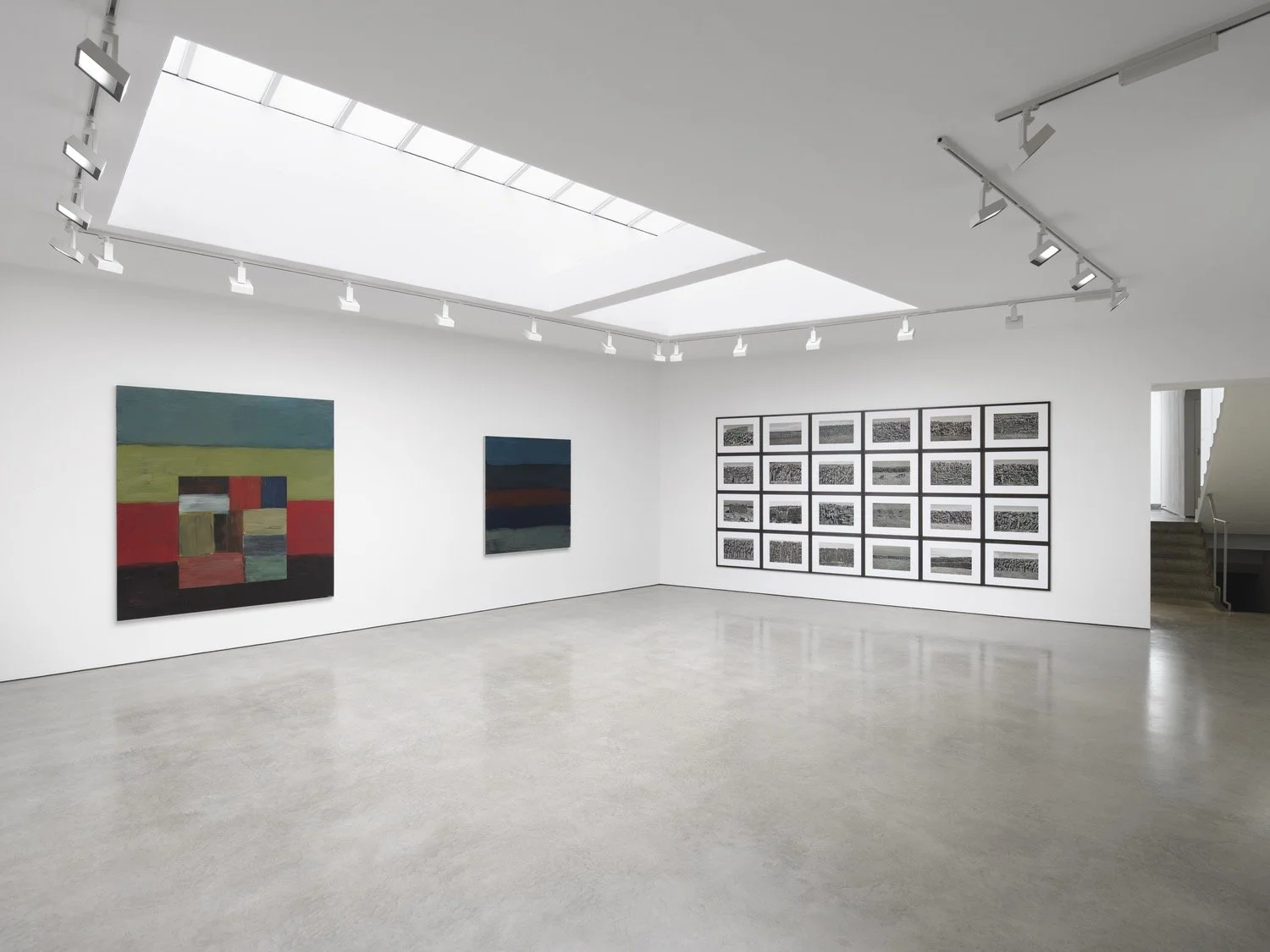
Exhibition view of ‘Lisson Street: Sean Scully – The Nature of Art’. Image courtesy of Lisson Gallery
Scully’s career has often been framed as a shift away from the cool detachment of Minimalism towards an emotional abstraction. His work synthesises influences ranging from Rothko and Pollock, to Matisse and Mondrian, as well as references to classical Greek architecture. However, The Nature of Art resists grand statements. The prominence of drawings, watercolours, photographs and written works on paper reveals an artist in dialogue with his environment rather than removed from it. Even in his most abstract works, they remain tethered to the physical world; the forms echo horizons, stacked forms recall stone walls, and blocks suggest architecture. The geometry is never neutral. It carries memory of Ireland’s coast, of Moroccan streets, of the countryside glimpsed from a balcony.
By tracing landscape across drawing, photography and painting, the exhibition reveals abstraction as something grounded rather than remote. In doing so, it affirms Scully’s position not simply as a master of geometry, but as an artist for whom the natural world remains a constant, shaping presence.
The Nature of Art Sean Scully is on show at Lisson Gallery, 67 Lisson Street, until the 9th of May 2026.
Amelia Holdsworth
Reviews Co-Editor, MADE IN BED
Disclaimer: The views, thoughts, and opinions expressed in MADE IN BED are solely those of the individual authors and not those of MADE IN BED magazine or of Sotheby’s Institute of Art.