Elisa Consentino in Conversation with Louise Pragnell
From coronation portraits at the Grand Ducal Palace in Luxembourg to a pandemic-era sitting over Zoom for an NHS hero, Louise Pragnell has spent nearly two decades painting subjects in classical oils. This year, she was selected for the Herbert Smith Freehills Kramer Portrait Award for the third time, with a portrait of former British-Ghanaian basketball player Pops Mensah-Bonsu. We visited her studio in south-west London on a gloomy September morning to talk about the painting, her process, and the people she's hoping to get on canvas next.
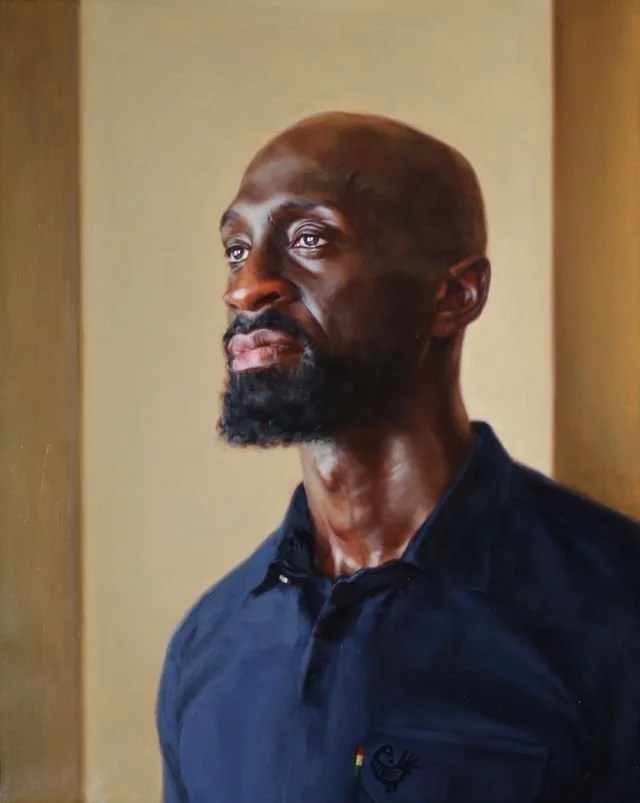
Louise Pragnell, Pops, 2026. Photo courtesy: the artist
Elisa Consentino: This is the third time that your work has been selected for the National Portrait Gallery Award, after 2011 and 2012. What does it mean to be back at the National Portrait Gallery with this piece? And how has the experience changed for you between then and now?
Louise Pragnell: Well, it's amazing to be back. It's been 14 years. It's really wonderful because it's an international exhibition and artists are selected from all over the world. There are artists representing 18 different countries in the final 50. It's become a lot more international than it was when I exhibited in it before. One of the artists set up a chat group with all of us and even before the exhibition started we were sharing photos of our studios and different techniques and paints and so on. It's been a lot more interactive, which is wonderful. As an artist, you're always learning. There's always techniques that you don't know about or certain materials and what works for different people and how different people work. Also, people from different countries have had very different training and being from different cultures they also have different perspectives. So that has been a key difference. But getting that email saying that I was in, it was the same feeling.
EC: Your portrait of British Ghanaian former basketball player Pops Mensah-Bonsu, titled Pops, was selected for this year's award. I understand that the painting grew out of a trip to Ghana, where you met him in Accra during the Omenaa Foundation anniversary celebrations. What drew you to him as a subject? And how did the idea for the portrait first come about?
LP: When I first went to Ghana, I didn't know that this was going to come out of that trip at all. I was there for an arts festival, so we were looking around studios and galleries and I'd met him several times during the week. I found out he'd grown up in London, and I'm a Londoner too. He's got this incredible athletic presence but he's also a very nice, easy to talk to guy. Towards the end of the week there was the Omenaa Foundation anniversary at the Kids Haven Centre, which is an orphanage and support centre for children, and it was an intensely hot day. It had been a real sensory overload the whole week, looking at all this artists' work and studios and just being in Ghana. The day at the centre was really heartbreaking, but also very inspiring to see how they were helping these children and the work the charity does. Pops is very famous there and these kids would run towards him. There were a couple of boys, one in particular, who just didn't want to let go of him. He's brilliant working with children, he loves it. He feels an enormous sense of responsibility to help them, having had this huge success himself and wanting to come back to his family roots and get involved in the community. There's a real softness to him that I found quite inspiring. At one point I saw him holding a little boy's hand against a bright yellow wall, and I just knew there was a painting there. And so I just asked him if he would sit for a portrait.
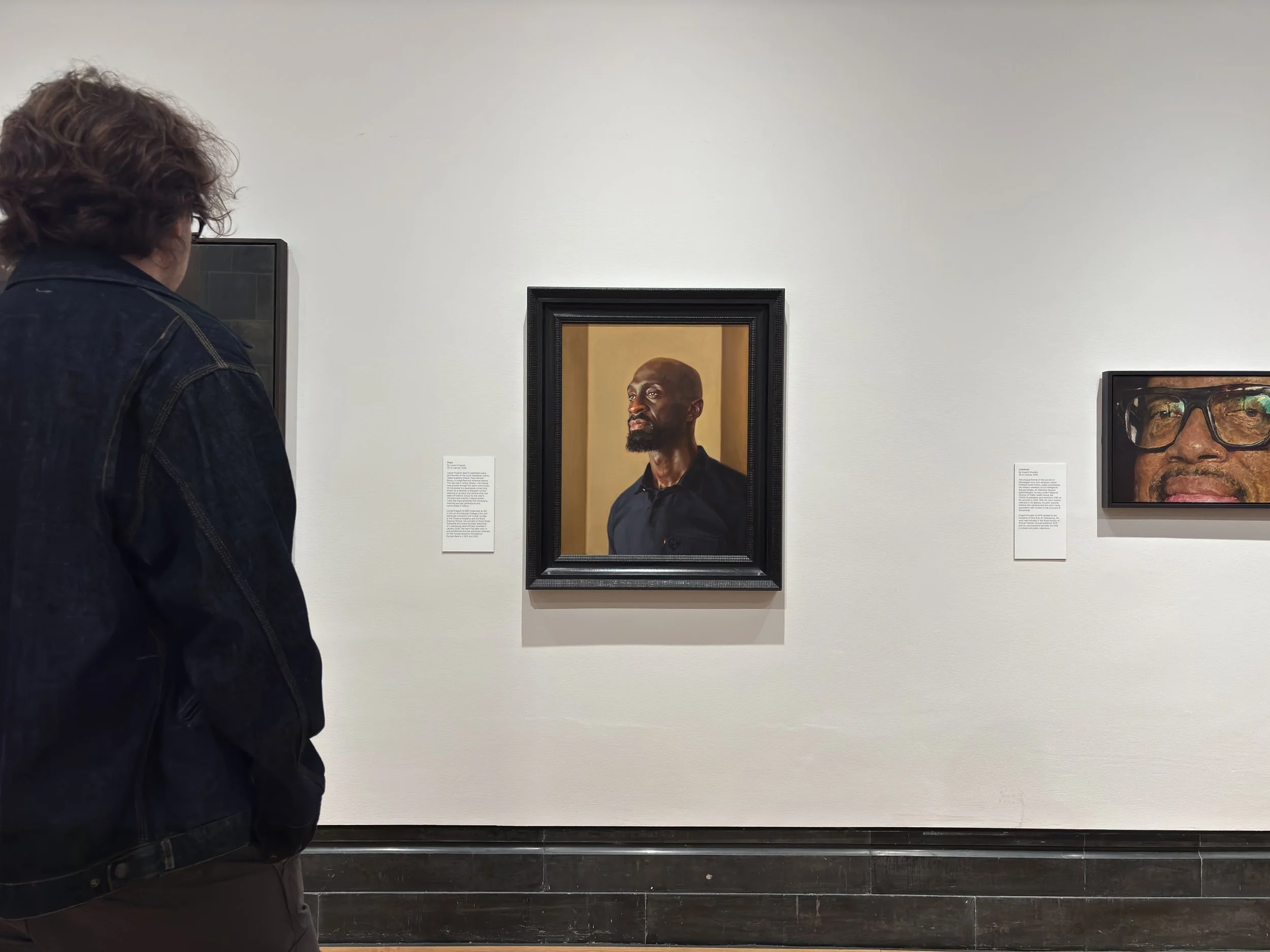
Pops at the National Portrait Gallery for the Herbert Smith Freehills Kramer Award exhibition. Photo courtesy: the author
EC: Why did you choose to submit his portrait for the competition out of everything you've been painting over the years?
LP: With the competition, the work must have been painted within the last 18 months. I work a lot with commissions, so I don't have a huge amount of stock. As often as I can, like with Pops, if someone really inspires me I’ll ask them if they could sit for me. And then I kept getting this advert from the National Portrait Gallery and I was like, oh, yeah, maybe I should have a go. It's been a while.
EC: You submitted your portraits in 2011 and 2012, and as you said, there was this huge gap. Why?
Well, life. Children, I've got two daughters. And I'm divorced. It was difficult when the children were small and I was single mothering to really throw yourself into work. But there was a real gear change when my youngest daughter's school started finishing later as they do homework at school. That was around 2022, just after COVID. I think COVID played a part as well. I hated the separation from people and the worry and the stress and the homeschooling. Then there was a real fuel in my artistic tank, after that combination of the children being a bit more independent and COVID making the world feel so empty.
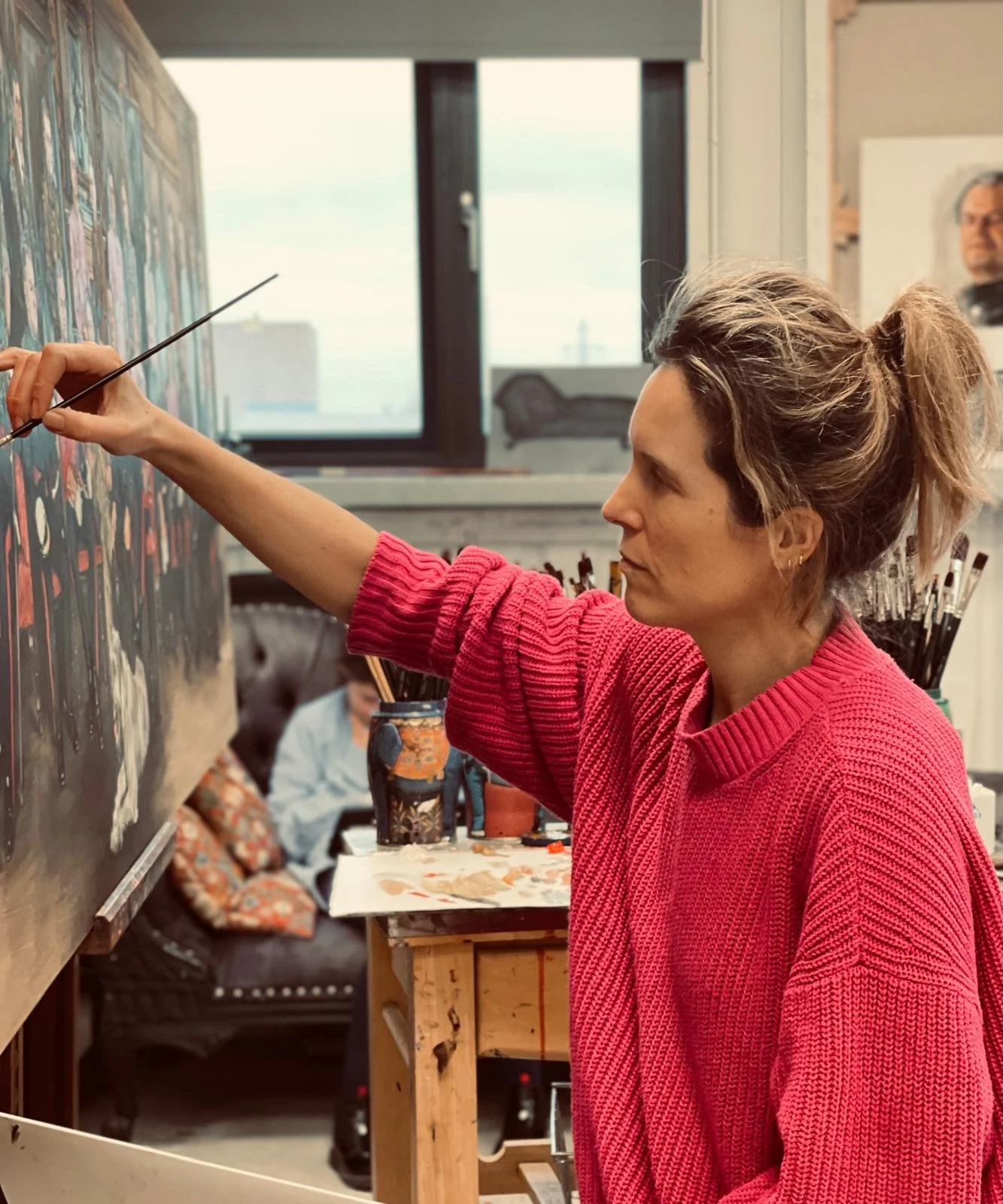
Louise Pragnell at work. Photo courtesy: the artist
EC: I was thinking about Virginia Woolf's A Room of One's Own and the idea of women having to have their own space to work. How do your practice and motherhood balance out?
LP: Well, thank God for school. I'm a very sociable person. I love people. That's why I paint portraits. I find people endlessly fascinating. The sittings are very exciting, they're really interesting. But then there's also a great relief to come here and literally close the door on the world. Often with a lot of my work, the bigger military things or with the drapery or the medals, there's a lot of work where I don't have the person sitting in front of me. And I really love it. I feel very lucky to be able to just shut myself in here, turn on Radio 4, which is crucial to my sanity, because it also lets me know what time of day it is, and just get quite lost in the work. But then after seven hours, I'm desperate to see people. I'm very sociable, but also really need my own space.
EC: On Pops's shirt in the portrait there’s the colours of the Ghanaian flag and the Sankofa bird, which symbolises the importance of learning from the past to shape the future. What does the icon mean in this specific context? And whose idea was it to include it in the portrait?
LP: Pops and I didn't really talk about how the portrait was going to look. It was actually a wonderful coincidence. At the arts festival I learnt about all these Adinkra symbols, which are very spiritual symbols. There's the wisdom knot, the " By God's grace, all will be well," and these rams' horns which mean bravery. They're everywhere in their art and ceramics. I do quite like a bit of juxtaposition in art. There's such a delicacy with the bird, picking up an egg in its tiny beak. And I thought, he has such a powerful physique, but there is also this real sensitivity to him. Painting a tiny little bird retrieving an egg seemed like a juxtaposition, but also it has such depth of meaning in terms of his story. His parents came from Ghana, he grew up in Tottenham, went to New York, and then came back to Ghana. He didn't actually know that I was including it. But he does have a necklace which is a heart, another version of the Sankofa bird, though I hadn't seen that when we were in Ghana. When I sent him a photo of the finished image, he said he couldn’t believe I included the Sankofa bird. His company is called "Sankofa Seven."
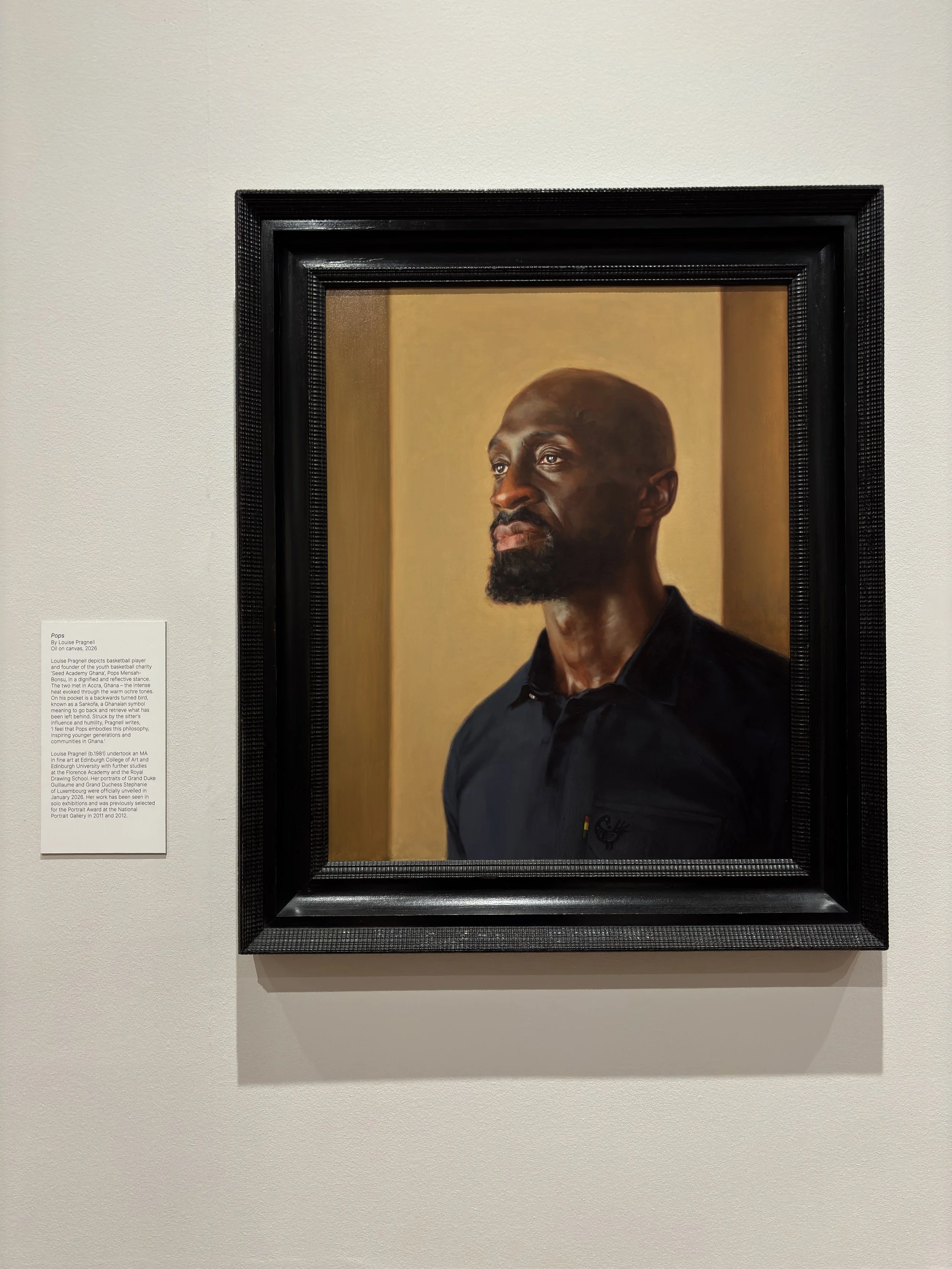
Pops at the National Portrait Gallery for the Herbert Smith Freehills Kramer Award exhibition. Photo courtesy: the author
EC: Watching the portrait, I felt his presence glow from the canvas. What's your process for capturing someone's essence in a portrait? And how do you make sure that each sitter's depiction feels distinct and true to who they are?
LP: I think it's quite instinctive. The key with sittings is that I'm trying to get to know someone quite quickly. You're trying to get a vibe, an understanding of their energy. But also how other people understand them. You've got to bear that in mind and what their legacy might be. It’s really important that people feel relaxed and that they don't think I'm trying to interrogate them or cross boundaries. I really want them to enjoy the process as well. In terms of getting the truth of them, it's also obviously just really subjective. You see different sides of people and I really like that when there’s an ambiguity in portraiture. Because people aren't just one thing, one truth. There's so many different sides. They can be very determined. They can also be very scared. They can have insecurities. They can have a fabulous sense of humour and great energy. And ideally, I'd like to touch on different aspects because people are three-dimensional, multifaceted. We like to pigeonhole people, particularly in the public eye, but that person is made of all sorts of things and experiences and thoughts. Also, sometimes you have expectations about how someone is going to be, and then you change your mind. And that may well come through a bit more in the painting because that's what's interesting to an artist, what often ends up on the canvas.
EC: Do you work only from live sittings or do you also use photography and videos?
LP: The live sittings are really important because they allow time for people to relax. A camera can feel quite intrusive and you can get more from a person if you're there with a paintbrush and a canvas. It's less invasive, less aggressive. But also the colours, and how someone takes up the space, photography really distorts and flattens. You have to be careful using photographs as reference. Obviously, what I really want in my portraits is a feeling of real life. But photographs are useful when you've got to paint 32 officers' medals. They don't have time to sit around while I do that.
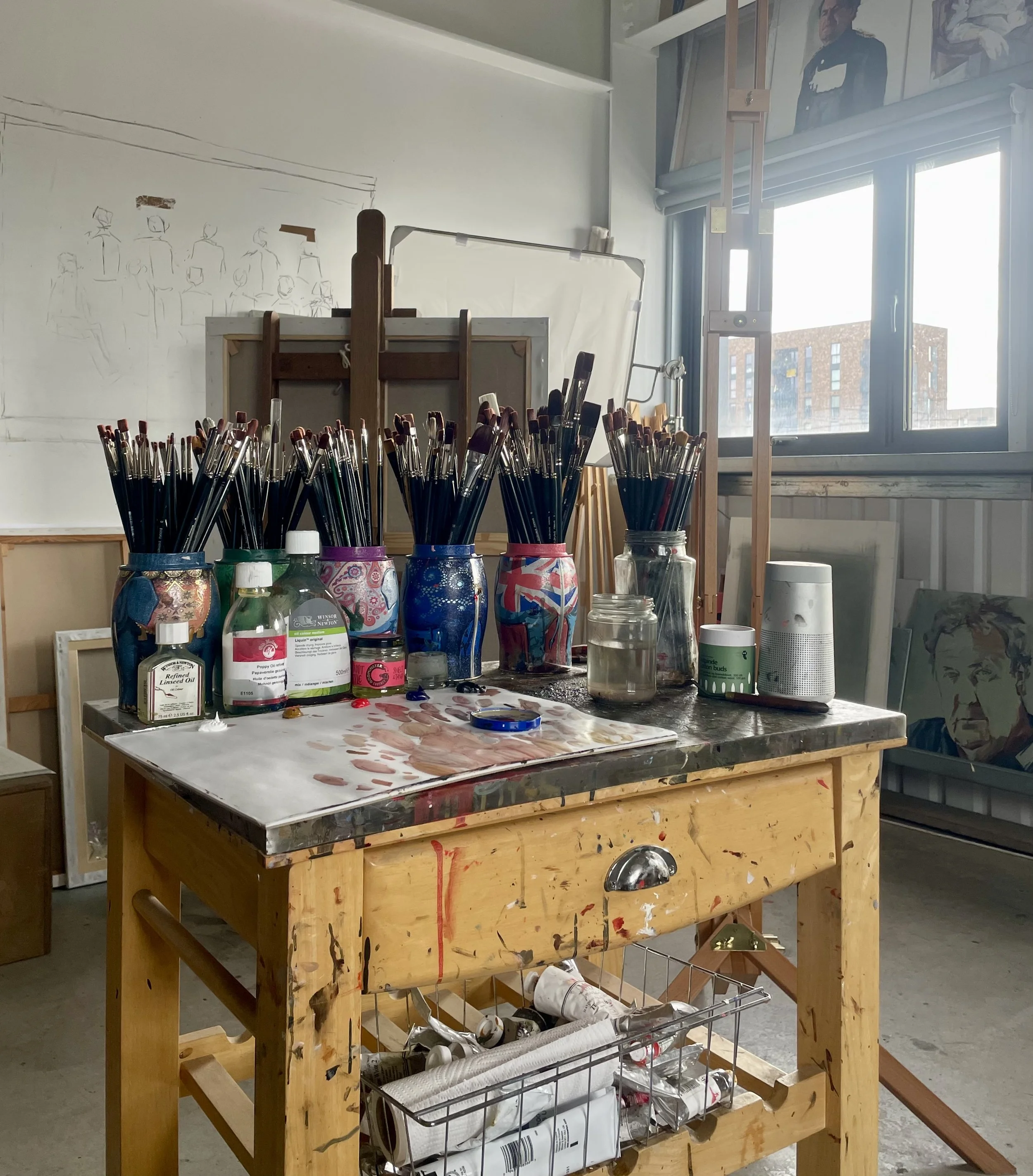
Louise’s studio. Photo courtesy: the author
EC: You work in a very classical technique. Is there a particular period of art history or specific artists that you draw inspiration from?
LP: A period that I love is the Dutch 17th century. I specialised in it for A-level history of art. I also recently went to a Michaelina Wautier exhibition at the Royal Academy. She had this very striking painting which, if I saw a photo of it, I wouldn't have thought, wow. But in real life it has such movement. The Dutch, their use of light. For me, light and shadow in portraiture, I really love using that as a tool for expressing mood and emotion. And also getting that three-dimensional lifelike quality. There's also a Russian artist called Ilya Repin, who is wonderful. Just an amazing portrait artist. You get that real sensitivity, but the paintings are also bold. And I love that juxtaposition: a striking image, but actually there's something quite soft, quite lifelike going on.
EC: What draws you to this classical style of portraiture?
LP: I think I'm a very sentimental person. I love old music. And a bit like Sankofa, you really can learn from the past. The classical techniques, there's a reason why they last and last, and why these paintings are still beautiful. I feel a real respect for it, essentially it's craftsmanship, because there are rules. I break, by the way, a lot of these rules. But in this country, there's such a heritage around craftsmanship and portraiture. And I just love it.
EC: You've painted royalty, military figures, and members of the public alike. What matters most to you when deciding how to paint someone?
LP: Really, it's what's behind the eyes. That's the ultimate importance. With a commissioned portrait, there's a lot of things to bear in mind. Where is the painting going to hang? Particularly with some of these institutions, like when I painted the Luxembourgs, I did their coronation portraits; you have to keep in mind where the paintings are going to hang and how they relate to these beautiful spaces. I want those paintings to be there for hundreds of years, and they have to fit in the atmosphere. Hands are also important; they are very expressive. With the pose, it has to work from an aesthetically pleasing point of view, but it's also about what you're saying about the person. And it's best when people aren't thinking about their hand. As soon as someone thinks about their hand, it looks completely unnatural. So then you have to talk about all sorts of other things, and wait, and then the hand will relax.
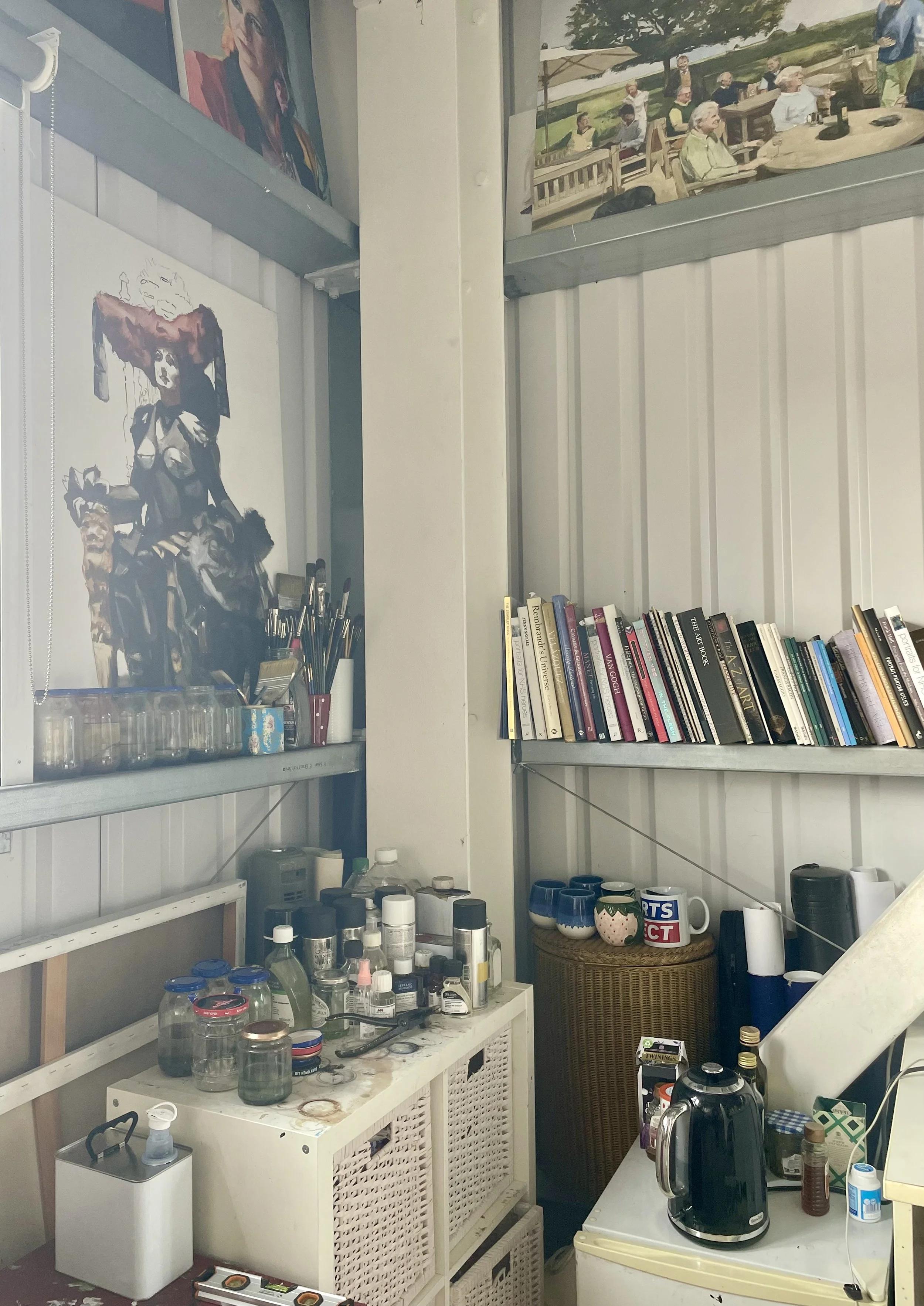
Louise’s studio. Photo courtesy: the author
EC: How do you approach painting a sitter that carries so much public symbolism, like with your royal commissions?
LP: It's such a privilege to be trusted with that kind of commission. I can't lie, it's quite nerve-wracking. With the Princess Royal, she is so busy, so you are very aware of the time and not wanting to ask for extra sittings. But the royals I've been lucky enough to work with have been a lot more human than I expected, and very professional, and used to dealing with people who are nervous. They're very well-practised at that. So actually they make very good sitters.
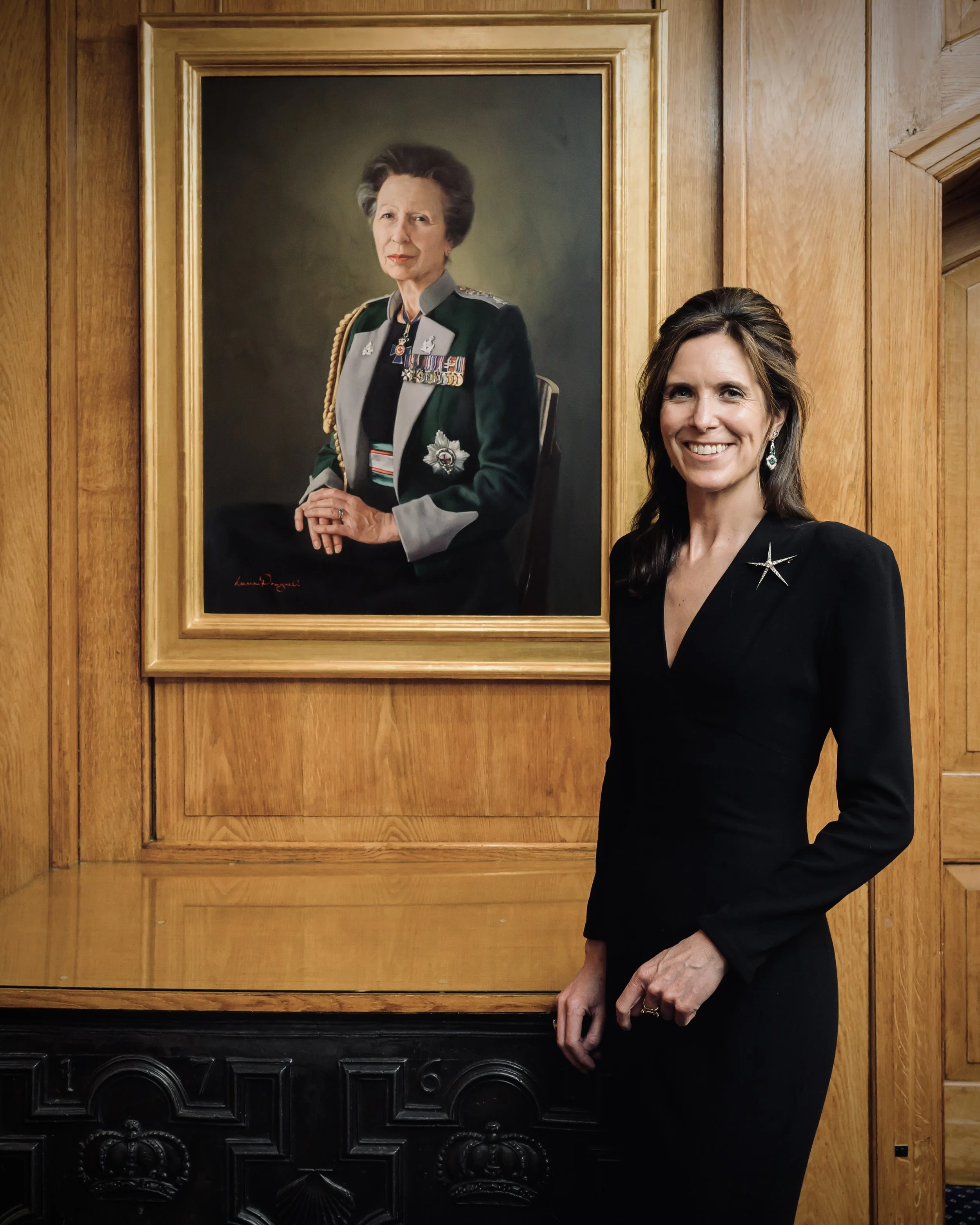
Louise Pragnell with her portrait of HRH Princess Royal portrait. Photo courtesy: the artist
EC: How does the dynamic change when you're working with a group rather than an individual sitter?
LP: It's really intense, really fun, but a completely different process. The subject is the dynamic of the group. You're not zoning in on the psychology of one person. You want the viewer's eyes to dance around the group. With the groups I've painted, there's such a sense of pride, and a kind of excitement that they know this moment in time is being recorded, and they're part of it, and it's going to sit on the wall for a long time. The camera is key for group work, because you can't expect everyone to hold still. Purists might not like that, but otherwise you wouldn't get the group painting, it just wouldn't be possible. It's problem-solving as much as it is creative. If I do that, that person doesn't have a leg. So it's a kind of jigsaw.
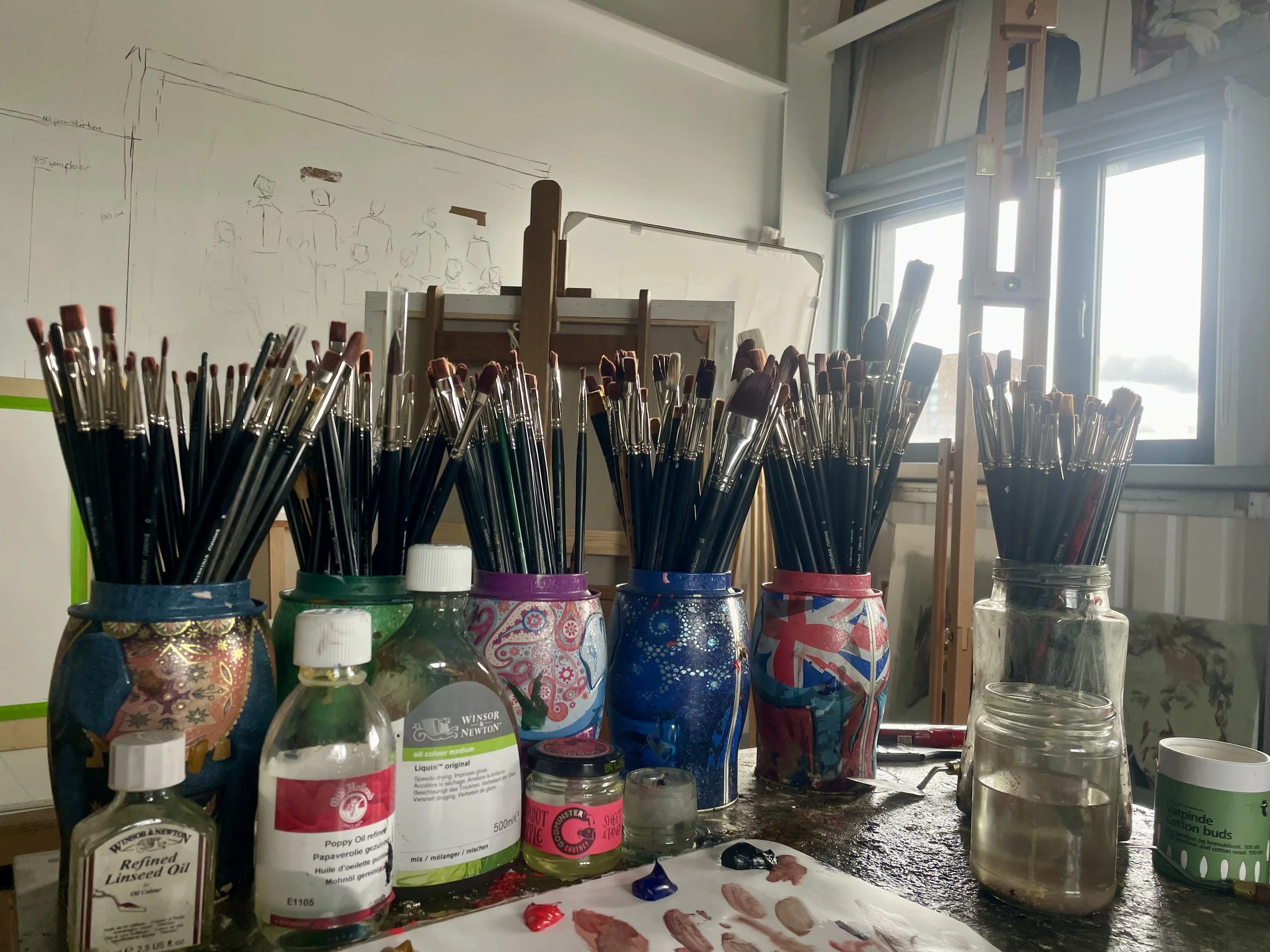
Louise’s studio. Photo courtesy: the author
EC: After more than two decades of work in classical portraiture, who haven't you painted that you'd still like to paint?
LP: There's so many people. It's slow painting, a very deliberate process, and it's kind of sad to think I'm only going to dip my toe in the ocean of possible paintings that are out there. There are people I've painted who I never thought I'd want to paint, and then the opportunity came up, and I really enjoyed getting to know them and hearing their stories. I would like to paint probably more performers. The ceremonial portraits will always hold a special place for me, but it's also quite fun to do something irreverent, maybe slightly ironic. I would love to paint Florence Welch, from Florence and the Machine. She'd be amazing. She's a walking painting, she looks like she could be the subject of a pre-Raphaelite painting. An amazing talent, she actually grew up near here. Also Aryna Sabalenka, the tennis player. I've been lucky enough to go to Wimbledon the last couple of years and she is extraordinary to watch. She's a performer as well as an athlete. There's something very warrior princess about her. What I love about my job is meeting people and learning about different things I don't know about.
Louise Pragnell’s Pops is currently showing at the National Portrait Gallery amongst the 51 portraits selected for final display in the Herbert Smith Freehills Kramer Portrait Award 2026, free to visit until 7 October. You can find more on Louise on her website and her Instagram, and more on the award here.
Elisa Consentino
MADE IN BED Reviews Co-Editor