
Alexis Kleeman in Conversation with Roisin Inglesby, Curator at William Morris Gallery
Roisin Inglesby has a degree in History from Queen’s College, Oxford and an MA in Design History and Material Culture from the Bard Graduate Centre in New York, with a specialisation in historiography. Roisin’s curatorial resume includes the V&A, Tower of London, Teien Museum, Tokyo, and William Morris Gallery. She was also listed in the 2024 Apollo magazine's '40 Under 40', focused on the intersection of craft and art. Roisin is intimately involved in the collaboration between William Morris Gallery and Liberty London, 150 Years of Women in Print. An exhibition focused on the female designers behind the iconic Liberty textiles, alongside the work of May Morris, to showcase the development of women’s professional careers in the textile and design industries.
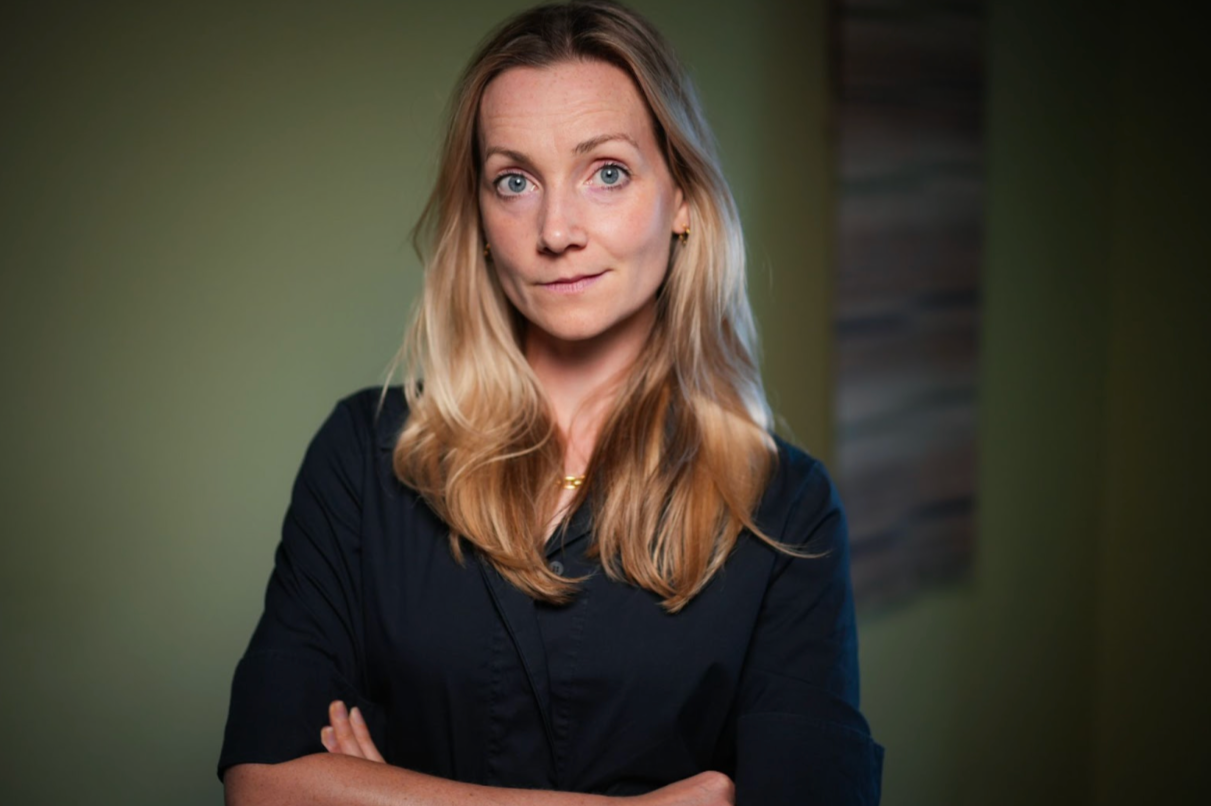
Roisin Inglesby, Curator, William Morris Gallery.
AK: You specialised in historiography and looking at the impact objects and pictures can have on history. Does this material culture focus influence your gallery practice? If so, how?
RI: I originally studied history, and in my third year of undergraduate, I shifted to looking at objects rather than texts to inform my research. In the museum, stories come from the objects, and the objects are the most important thing. Because of this, I start with objects and use them to develop exhibition narratives and tell the stories of not just the object and artist, but also the historical and political framing of the period the object is from. The goal of my historiographic approach is to increase narrative accessibility to the audience through the material culture of objects rather than presenting information in a strictly text-based narrative, which can alienate an audience because it often requires specific knowledge they may not possess.
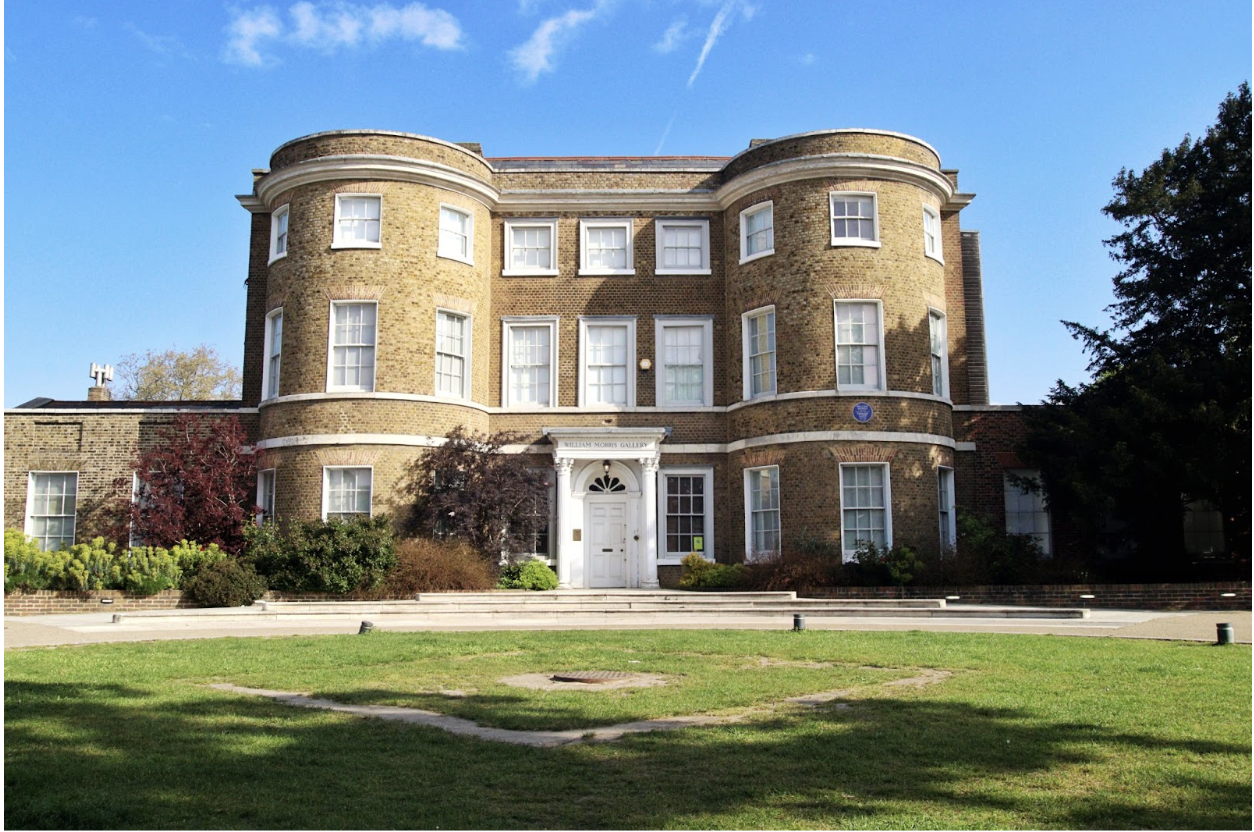
Photo of William Morris Gallery, Credit: Daniele Audino.
AK: I understand that this year is the 75th anniversary of the Gallery and that March is the annual Morris Month celebration. Please tell us about the Gallery's history and Morris Month, and how the Gallery plans to celebrate.
RI: The Gallery was established in 1950, by friends and younger colleagues of Morris as permanent Memorial to him, but of course we are not the only institution dedicated to Morris in London, he lived in a lot of different houses, where the Gallery is now, Red House, now owned by the National Trust, Kelmscott Manor in the Cotswolds, and Kelmscott House in Hammersmith. We have a good relationship across all Morris-related sites and work together to cross-promote and increase accessibility to our resources to visitors inside and outside of London.

Photo of May Morris (1890-1900), (No photographer’s name attributed), ⓒ William Morris Gallery, London Borough of Waltham Forest.
AK: William Morris was often credited for his daughter May’s work, as she was an embroiderer and the Director of the Embroidery Department at her father's enterprise.
Is there anything going on at the Gallery to honour her for Women’s History Month? Or any narrative in the Gallery to juxtapose May’s work with any of the Liberty designs?
RI: Many of Liberty's current designers are inspired by May, and they have a great capsule collection based on May's embroidery work at the moment. In the first room of the Gallery, we generally have an exhibition titled Meet the Man, featuring William Morris. For this exhibition, we have changed it to Meet the Woman. It now features May Morris and other women who worked for Morris&Co. So now when you go to the Gallery, the first person you see is May, not William and that flips the narrative, until recently, most people assumed that everything that Morris & Co. did was designed by William Morris, when in reality May, and other women did a lot of the designing at the firm.
May, as well as being a designer, was also a champion of women's art education; she challenged the idea that women's cultural production should be classified as amateur or domestic work. In the late 19th century, she had ambitions for women’s creative work to be professionally recognised and for them to be paid equally to their male counterparts, which was historically and socially not the case for women in creative industries.
AK: The Gallery currently has an exhibition featuring Women In Print and 150 years of Liberty Textiles. March is also Women’s History Month. Could you tell us about the inspiration behind this exhibition and the Gallery narrative of the historical impact women have had on printmaking and the textile industry?
RI: When we decided to collaborate with Liberty, we had a conversation about which narrative angle to take. In an exhibition this size, there are limitations; it would be impossible to tell the whole history of an organisation, especially one with such a rich history like Liberty. The items on display were chosen to highlight underrepresented people in the historical narrative, particularly women in the creative industries. This historical narrative disparity is interesting because now, roughly 90% of textile designers at Liberty, and probably in the country as a whole, are women.
The central narrative of the exhibition is about this transition from the 1870s, when these industries were male-dominated, to the 2000s, when they became female-dominated, and the role that both Morris & Co. and Liberty played in the development of women's entry into professional creative industries. It's great that it coincides with Women's History Month, but it is important to represent these stories throughout the year. It should not be the exception to talk about women in March; it should be put front and centre throughout exhibition programs year-round.
Every object in this exhibition is designed by and/or made by a woman, and that is a powerful thing. When you go to an exhibition or see a movie or look at a room full of political leaders, if all of them are men, no one really notices. How many times have you watched a movie and did not notice there were no female main characters until 25 minutes in, but if the entire main cast were female, you would notice right away? The same is true with politics; a room full of men making a decision is seen as the status quo, while a room full of women making the same decision challenges social norms.
I really appreciated the Women In Revolt exhibition 2023 at Tate Britain. It featured female artists, and every work in the exhibition was produced by women. It had a powerful effect, because it made you think that if there were an entirely male artist featuring exhibition, no one would think twice about it; it is so socially ingrained, but an entirely female featuring exhibition is still innovative. I wanted to recreate that feeling of walking into a room of women receiving the recognition they deserve.

Wiltshire Berry, designed by D Stoneley for Liberty, 1933, screen-printed Tana Lawn™ cotton, 1970s-1980s. Design, is copyright Liberty Fabric Limited [1933].
AK: Could you speak to the impact of growing political, educational and employment opportunities for women around the time of the First World War and how these shifts in society opened doors for women to enter professional textile design? Do you believe the careers of these women, especially those like Mrs Stonely, whose work goes largely unrecognised, could be given the recognition they deserve now?
RI: The time around the First World War was socially transformative. There is a design studio called the Silver Studio that created many designs, some of which were bought by Liberty in the 20th century. Around 1900, they had a job advert that said: “Ladies need not apply.” However, by the First World War, women were working at the Silver Studio, reflecting the larger changes in society. The war caused a social shift because so many men were away fighting that companies had to employ women, and this completely changed what was socially accepted as women's work.
It was not just in the textile industry that experienced this social shift; around this time, women across all industries began getting more opportunities, partially because of increased educational opportunities for women. For example, at the Glasgow School of Art in Scotland, there's was a group of women including Ann Macbeth and Jessie M King, both of whom are in the exhibition, and this level of art education enabled them to enter the field of professional design. Similarly, at the Silver Studio, there are two fantastic designers, Madeline Lawrence and Winifred Mold who were designing for the Silver Studio around the same time. It was the perfect storm of education and social change that enabled women to get into these design roles. However, that does not mean their experience was the same as men's; just because women were working in professional industries in the early 20th century does not mean they had workplace or social equality.
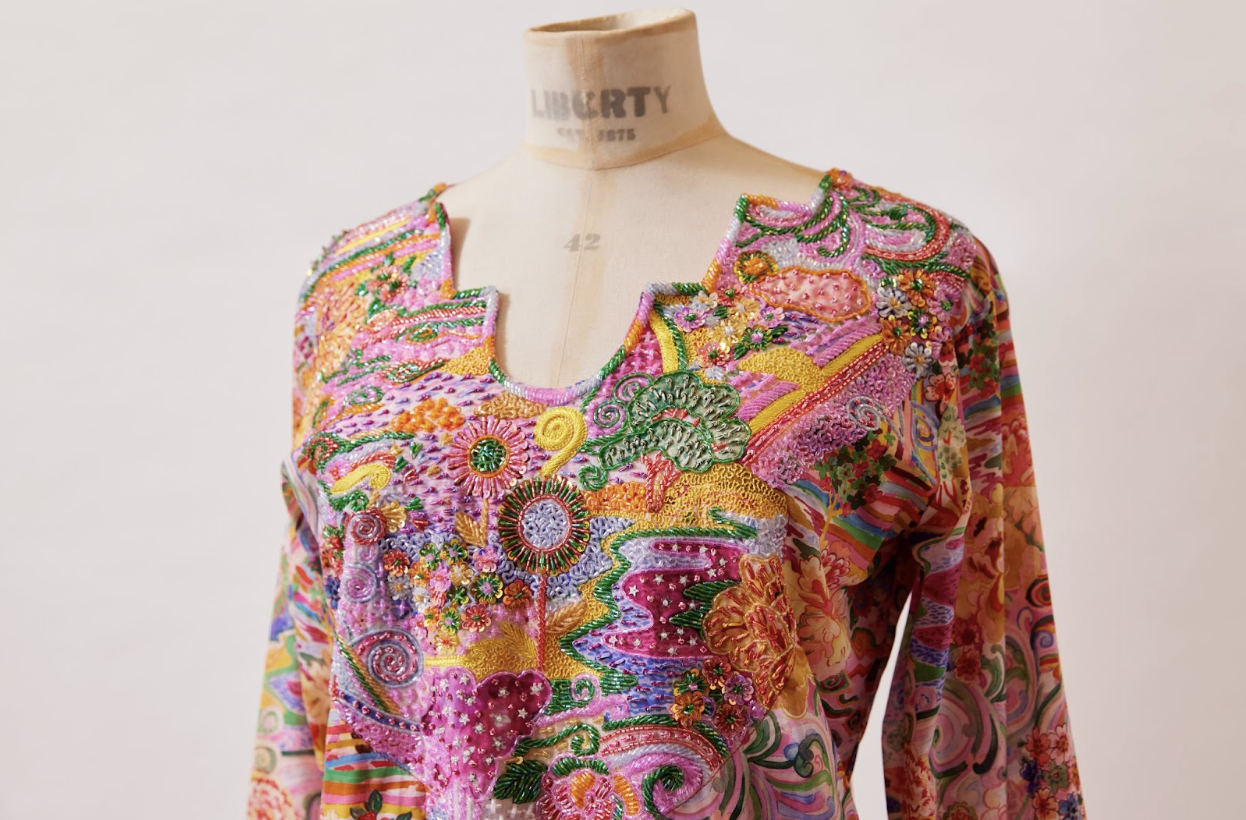
Detail of Jalabiya (Mukhawar), fabric designed by Polly Mason for Liberty, embellished in beadwork by Colourful Line, 2025. Liberty.
AK: Liberty has been an innovative voice in fashion and textile design for 150 years. Do you believe this is because of the innovative work these women have done to push the boundaries of what is considered “acceptable” fashion and women's careers?
RL: There have been many male designers throughout history, but since World War II, it has become a very influential, female-dominated industry. For example, Sarah Campbell and Susan Collier really pushed the boundaries of what was acceptable, especially in terms of colour. Unfortunately, Susan passed a few years ago, but Sarah has been really helpful with the exhibition. She said that Susan's main thing was always pushing, pushing, pushing what colours were acceptable because she was aware that Liberty's competitors were using bright colours, and that Liberty would be seen as old-fashioned if they did not keep up with the competition.
In the 50s, Colleen Farr created the first in-house design team for Liberty. Before that, Liberty had only worked with freelancers, so the first head of design was a woman. Furthermore, Colleen was instrumental in brand diversification, like Young Liberty, a subbrand aimed at younger people. Diversification like this kept Liberty at the forefront of fashion, and designers such as Althea McNish, a Caribbean British textile designer, were crucial in introducing British audiences to different ways of thinking about colour. This way, Liberty maintained its traditional significance; it never felt too old-fashioned or outdated.
AK: Could you tell us about the film included in the exhibition that features archival and contemporary footage as well as interviews with designers Sarah Campbell, Natalie Gibson, Neisha Crosland, and Polly Mason, and how this will offer an insight into the stories of women who have created Liberty fabrics, and give a voice to the designs that continue to shape the industry today?
RI: It was really important to us that the women we are honouring be part of narrating their own lives; unfortunately, many of them are no longer with us. So to commemorate them and their legacy, because who actually thinks about who designs the fabric? We wanted to give the traditionally nameless and faceless women behind these iconic designs the recognition they deserve. To bring these women to life, we commissioned a brilliant filmmaker, Iron and Glass London, to produce a 10-minute film for us, which is available on our YouTube channel. They interviewed women who have worked at Liberty about their experiences and how the company supported their careers. To name a few, Anna Biruma, an archivist, and Alison Lewis, a fabric consultant, as well as some textile designers. Every time I go into the exhibition, people are watching the film, and these women's stories are being heard now.
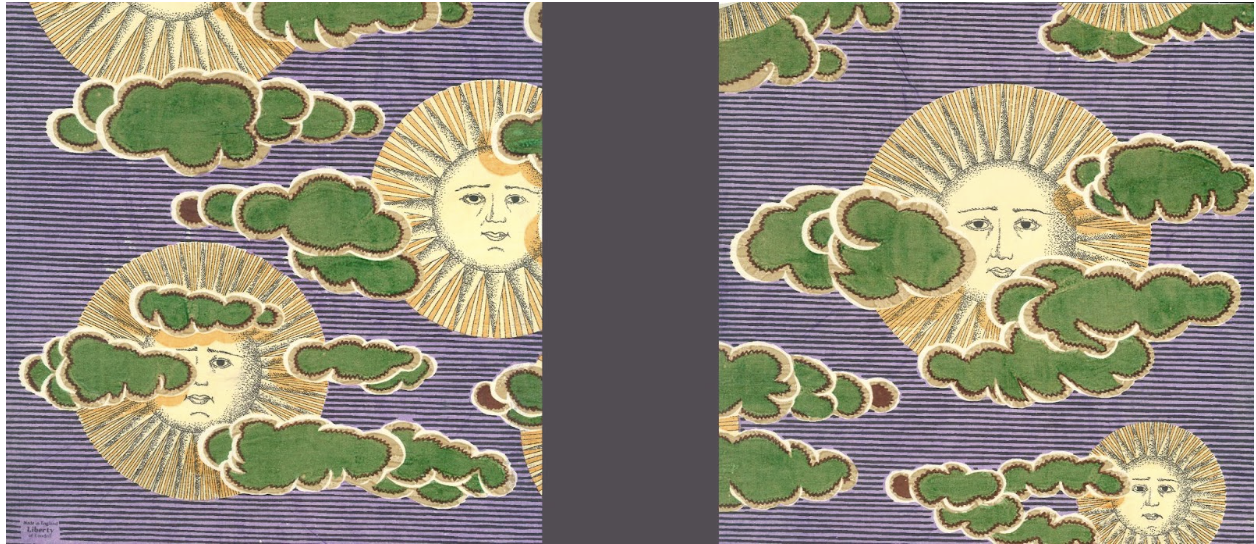
Print impression for Phoebus, by Mitzi Cunliffe for Liberty, screen-printed pigment on paper, 1959. Design is copyright © Liberty Fabric Limited [1959].
AK: Could you tell us about the programs the Gallery is hosting for the Women in Print exhibition, and the question, “What does the future for women textile designers in the UK look like?” Furthermore, how do you believe your institution and its rich history will help shape the future of female textile designers?
RI: We are working with Liberty on the public program and focusing on engagement with local young people and university students who are working with Liberty to use the exhibition as a resource for their own work and to understand not only the history of Liberty but also to think about designing for the future. An important part of Liberty's design work, and something we have highlighted in the exhibition, is the importance of continued hand drawing and physical engagement with design.
These days, there are many digital design tools, and something that sets Liberty apart is that it still emphasises hand-drawing. Obviously, they use digital technology for much of their work, but they always start with a hand-drawn sketch. So, pencil, pen, crayon, ink, watercolour, etc. It shows design students the importance of drawing and using technology as a tool, not a crutch, alongside their creativity, knowledge, and skills. This is what sets Liberty apart from other textile designers, especially with all the AI in the world. No one knows what will happen. However, helping people realise there is still a role for the human hand in design is pivotal at this moment in history.
William Morris Gallery and Roisin continue a legacy of displaying and supporting the history of design, printmaking, and the textile industries, and of providing community resources and programs for public education. The Women In Print: 150 years of Liberty Textiles exhibition will run until June 21st, 2026 and continue to offer community events and opportunities for young people to get involved, with mentorship, training, and tours throughout the exhibition. The Gallery is hosting community talks with the curators of The Women In Print: 150 years of Liberty Textiles exhibition on March 24th, April 21st, and May 19th, free of charge.
Alexis Kleeman
Interviews Co-Editor, MADE IN BED
Disclaimer: The views, thoughts, and opinions expressed in MADE IN BED are solely those of the individual authors and not those of MADE IN BED magazine or of Sotheby’s Institute of Art.