Eliza Palmer in Conversation with Samuel Harrison
We had the opportunity to interview Samuel Harrison, the artist who has already collaborated with some of the world’s biggest brands. Harrison, who has worked with clients including Vogue, Harper’s Bazaar, Instagram, Dyson, and Adobe, tells us how he handles international success and why he came to establish his recognisable black and white aesthetic. Read on as we get to know Harrison and get the lowdown on his expert tips and techniques .
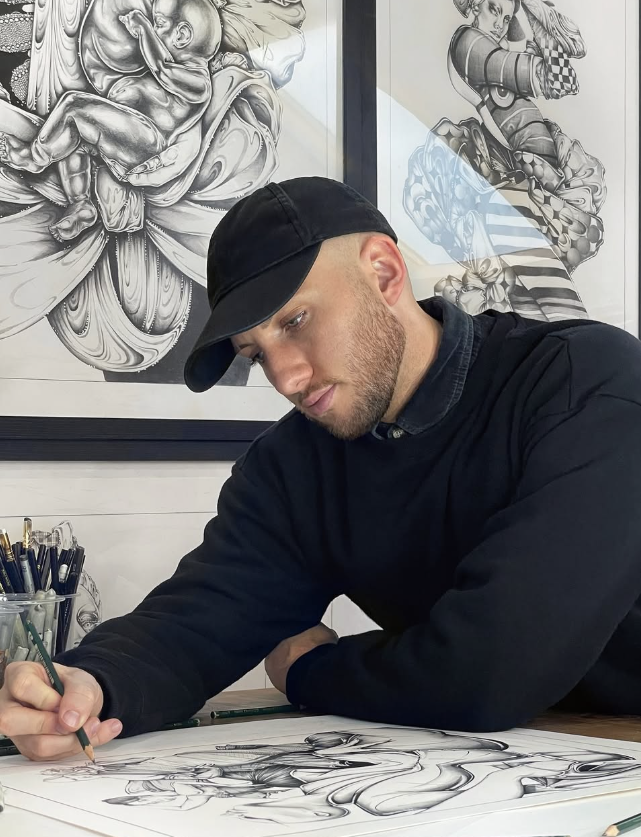
Samuel Harrison in his studio. Photo courtesy: Samuel Harrison.
Eliza Palmer: From where and when did your artistic interest begin?
Samuel Harrison: I don’t really remember a time when I wasn’t ‘the arty one’. I grew up with two brothers doing all the sports they could sign up for, and I was more interested in drawing. There’s photos of me when I was little happily drawing on a big white board that somehow found its way to our house and I’m clearly concentrating hard and taking it very seriously. So it never really felt like a decision, it was just something I’ve always been happy doing.
EP: You studied Fine Art at Central Saint Martins, as well as Chelsea College of Art. What were some of the positive outcomes you received from practicing and learning there?
SH: I think being an art student gave me the freedom to do some growing. I think those extra years studying gave me the space to figure out what kind of work I wanted to create and who that work was for. I first started working professionally as an illustrator as a result of artwork I was making alongside my studies, outside of the curriculum. Studying at CSM and Chelsea gave me access to some of the best libraries in the world, taught me a lot about how to present artwork, and also gave me the confidence to take my work seriously.
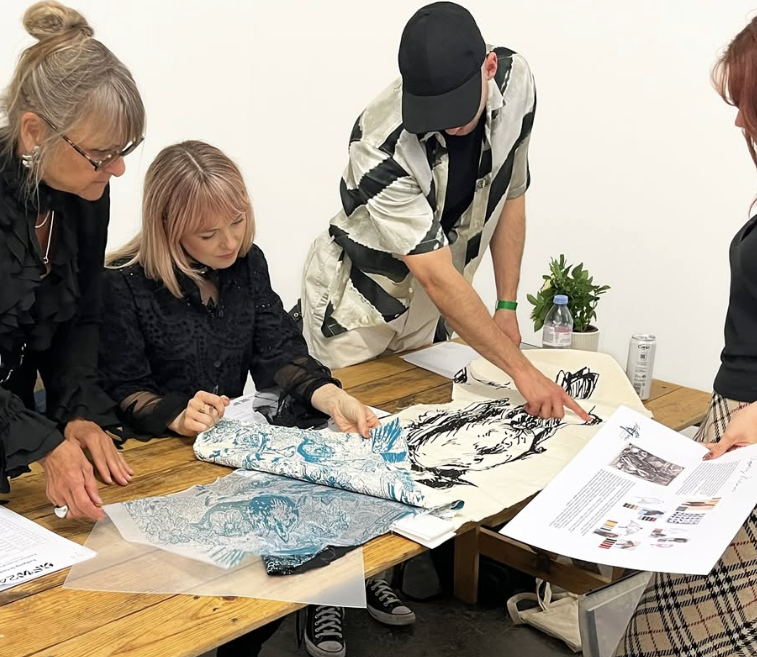
Samuel Harrison, Sue Dray and Elyse Blackshaw as part of the judges panel for Graduate Fashion Week 2024. Photo courtesy: Samuel Harrison
EP: What is your favourite pencil to draw with?
SH: My all time favourite is a Castell 9000 graphite pencil by Faber Castell in the shade 2B.
EP: When you get an idea in your head for a piece, what is the very first thing you do?
SH: The very first thing I do for an idea is sketch. A rough scribble on a small scrap of paper helps visualise whether the image I have in my head works in reality. I tend to start with a lighter shade of pencil and then work into it with darker shades once I’m beginning to finalise shapes in the composition. I also then usually set up my phone on a front camera video and pose up a storm to try and see anatomically how a body might move or the angle a hand might make. I’ll then screenshot the parts of a video I like and use those as reference to adapt my sketch. So my process with initial ideas is a mix between sketches and self made reference images.
EP: What is your favourite part of the body to draw?
SH: Hands. My favourite part of the body to sketch is a very elegant, diva hand. I think a dramatic hand pose really can bring so much attitude to an illustration and elevate a pose to be something much more interesting.
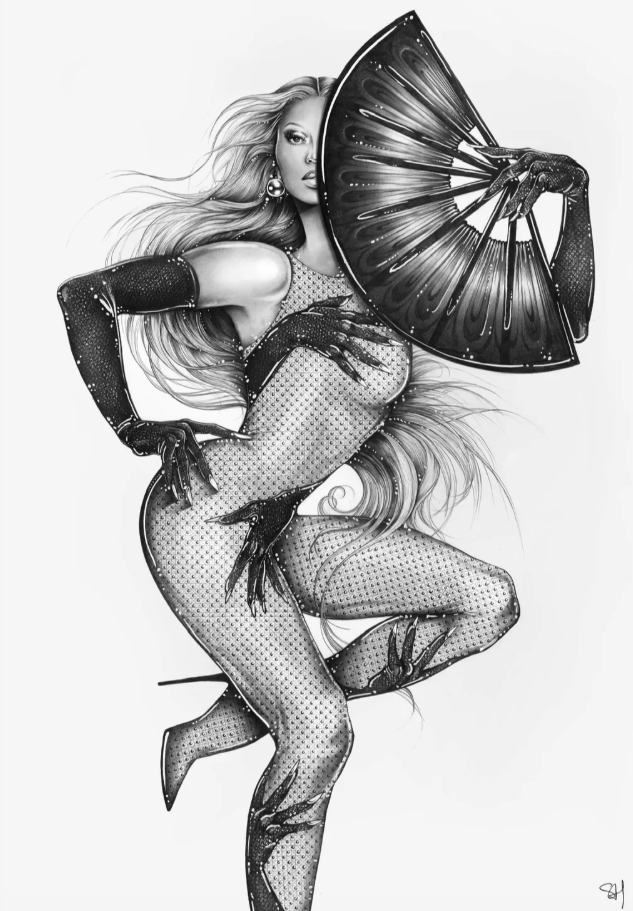
Beyoncé Loewe - Samuel Harrison, 2023. Photo courtesy: Samuel Harrison Art.
EP: What is the part of the body you find most difficult to draw?
SH: Hands. Although they are my favourite, they’re also very difficult. I think for a long time I approached drawing hands as a very rounded feature, in which all 4 fingers and 1 thumb must be visible for it to translate on paper as a hand. I know when I was younger there were a lot of hidden hands in my drawings. However the more I studied hands from reference images (and double checking in the mirror in the middle of a sketch where the thumb goes), the more I realised they’re incredibly angular, the joints in fingers produce very directional straight lines, and its very are you ever see the entire hand flat.
EP: What is your favourite fabric to draw?
SH: For years I would have said I enjoy drawing heavy draped compositions. Silk like fabrics that are knotted/twisted or hung in a way that creates the most volume possible. While that’s still something I love, I’ve also began enjoying the shiny qualities of drawing latex and leather. These deep black materials capture a liquid, metallic kind of feel and lets me play around with shading and highlights in a more heavily contrasted way.
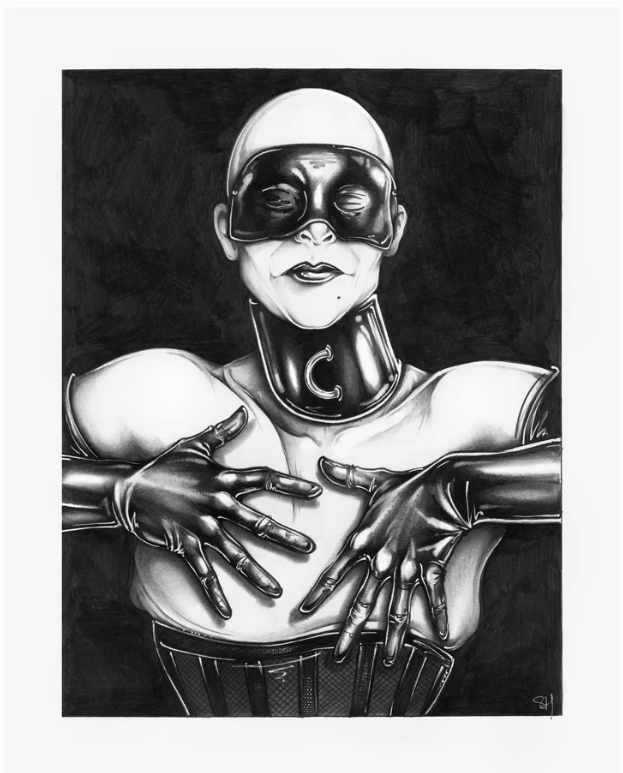
Lola Illustration - Samuel Harrison, 2026. Photo courtesy: Samuel Harrison Art
EP: There is something quite fluid about your work. Some of the curves and the highlights look like molten metal slowly tracing down the side of a hip or down the draping of a sleeve or across the brim of a hat. When it comes to creating these sloping liquid lines, how do you approach them? Is it one single initial swipe of the pencil, or is it a slowly crafted connected line of many smaller strokes?
SH: I think some of these strokes you’re describing stem from a self consciousness of not wanting my work to appear too static. It’s something I worry about when planning a composition and sometimes I don’t think I get it right. I think detailed pencil drawing can easily become a bit too ‘still’, especially because my illustrations take hours and days to complete, I fear it can lose the energy of the initial idea. This is why I try to keep my initial scribble ideas as small sized sketches. I think drawing small allows the hand to capture more movement in your drawings, full of gestural lines and quick mark-making that I find much harder to do when drawing larger or on a large expanse of paper. In my final illustration I therefore try and incorporate those key lines of movement that I loved from the initial sketch back into my work once its scaled up and executed in a more detailed style as a way of showing fluidity.
EP: A lot of your work, the majority in fact, is black and white. Why is this so? What is behind this decision?
SH: It hasn’t always been this way. For a number of years I used watercolour, acrylics and even some collage as a way to add colour to my graphite pencil illustrations, however it never really felt right for me. I always kept the colour part towards the end of the process, and most of the time always liked the drawing before I did so. For some reason I believed in order for my work to be ‘finished’, commercial or truly show a garment in its accuracy I needed to show its colour. This felt like an obligation and as soon as I removed that guilt from the process I became a lot more proud of the work I created. It was a silly rule that for some reason I thought I didn’t have a choice to change. Adding colour was actually quite distracting for me, I’m much more interested in the blending of the graphite, gradients and lines.
EP: How did you find the experience of increasing success as an artist?
SH: I think any time somebody shows an interest in something you’ve created its a rewarding feeling, but there’s always an element of imposter syndrome lurking in the back of your mind. Looking at ideas like success when it comes to your artwork can be a dangerous game because it can inevitably be linked to comparison, especially when you also feel like you’re struggling. I sometimes feel a pressure to prove that my work is worth it. I think my experience is a mixture of wins and failures, but its all ultimately leading in a successful direction. As long as I’m happy with what I’m creating from an integrity point of view then I think that’s a success in my own little bubble.
EP: What is a piece of advice you have held onto that you think has helped your own practice?
SH: Tapes. I know it may sound dramatic, and drawing definitely isn’t the most dangerous sport out there, but a few years ago I developed tendonitis in my drawing hand from overworking during project deadlines. With my style increasingly becoming more and more detailed I am prone to repetitive strain, and my fingers take a bit of a beating with the pressure of pencils. I had acupuncture treatments in my thumb, saw a physiotherapist and had to stop drawing for about 6 weeks to let my thumb recover.
My friend, icon and fellow artist Sue Dray suggested I use masking tape on my fingers during drawing. This simple addition has been a game changer for me and allows me a solid extra support for pencils to rest on when I’m doing heavy shading. My hand feels naked now if I ever pick up a pencil without a few rounds of tape so you’ll often see them in every single video I post.
EP: What is a piece of advice you would like to give every artist?
SH: Take your art seriously at any level. ‘Artist’ as a title doesn’t need any professional approval. If you make something then you’re the artist of that creation and you should celebrate it and showcase it in the best way you can. Document your work properly. Scan it in, frame your work, show people.
EP: What has it been like to grow more and more internationally as your artwork reaches wider audiences and as you get commissions from international clients?
SH: In a surreal way its made the world feel very small? Its crazy how the internet has given me access to show my work to so many people all over the world. I probably don’t think about it enough, but its amazing to think someone on the other side of the planet currently has my hand drawn illustration framed in their home, or even tattooed on their body!
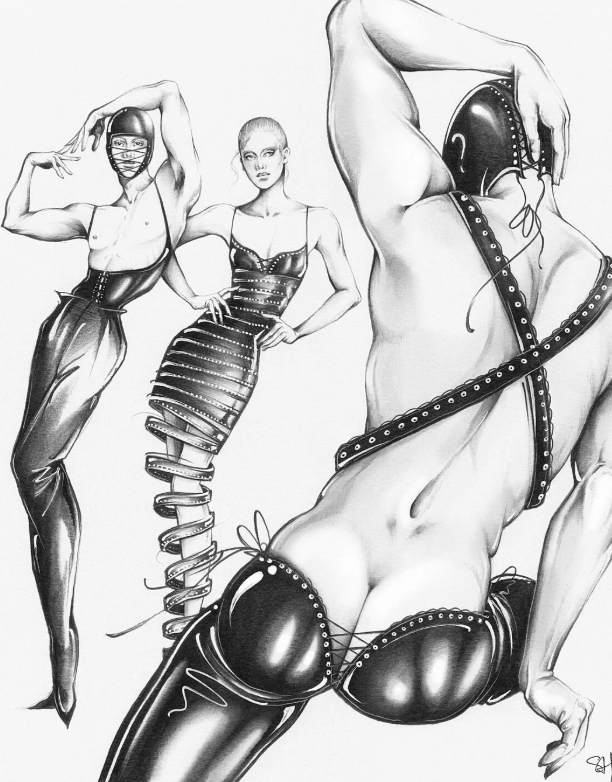
‘Cleavage Pants’ Ludovic de Saint Sernin Print 1 - Samuel Harrison, 2024. Photo courtesy: Samuel Harrison Art
EP: What has this broader exposure shown you about the London/English art world?
SH: I think I’ve been lucky enough to find a community here in London through my work. I’ve met some of my closest friends through working on illustration projects together, or being invited to be a part of the same exhibition. Its something I’m really grateful for because they understand the struggles of being a full time artist in a way that others maybe don’t. We talk art, vent, discuss ideas, help each other with advice about clients and projects, and as much as our friendship is based in art we’re also friends outside of art if that makes sense? It’s a great combo. Being an artist can be a very solitary life, so its nice to feel like when I’m working alone in the studio I can FaceTime my friend in their studio on the other side of the city and we’re like colleagues in the office gossiping by the water fountain.
EP: What is something you would like to change about the London/English art world?
SH: Budget. I think there’s so many amazing opportunities to hire artists and illustrators that could transform a project, especially in today’s world where we are becoming increasingly sick of seeing AI used to replace humans. I’d love to see illustration more widely again.
EP: You mostly draw your pieces. Do you think there is a difference in how art world audiences and critics receive and review drawings versus paintings?
SH: I think in a gallery setting, painting often gets some preferential bias, being sometimes seen as more worthy in that space. I’m not entirely sure why, or if that’s even true. But I do think drawing can be overlooked as not being ‘fine art’ enough.
EP: What are your feelings about erasing/using a rubber when creating one of your pieces?
SH: For me erasing is absolutely nothing to do with mistakes and its completely just another tool in the process. I use both a traditional eraser (for larger areas) and a battery powered eraser by Derwent as a way of creating highlights, adding texture, cleaning shapes. There is no way I would choose to create the contrast in my illustrations without erasing at least some parts of it.
EP: What is another area or method of creation you would like to explore?
SH: I love the idea of creating large ceramics covered in my illustrations. I think this year I would like to explore illustrating on different objects. In my head I’m imagining a large Ancient Greek inspired vase with a black and white composition in my illustration style wrapping around it. The process from start to finish seems like a lot of fun to me, especially if I’m able to create the vase myself.
EP: Who is your current favourite artist?
SH: It alternates between a few, however right now I’m really enjoying some Erté. Particularly his alphabet series, my favourite is the letter X.
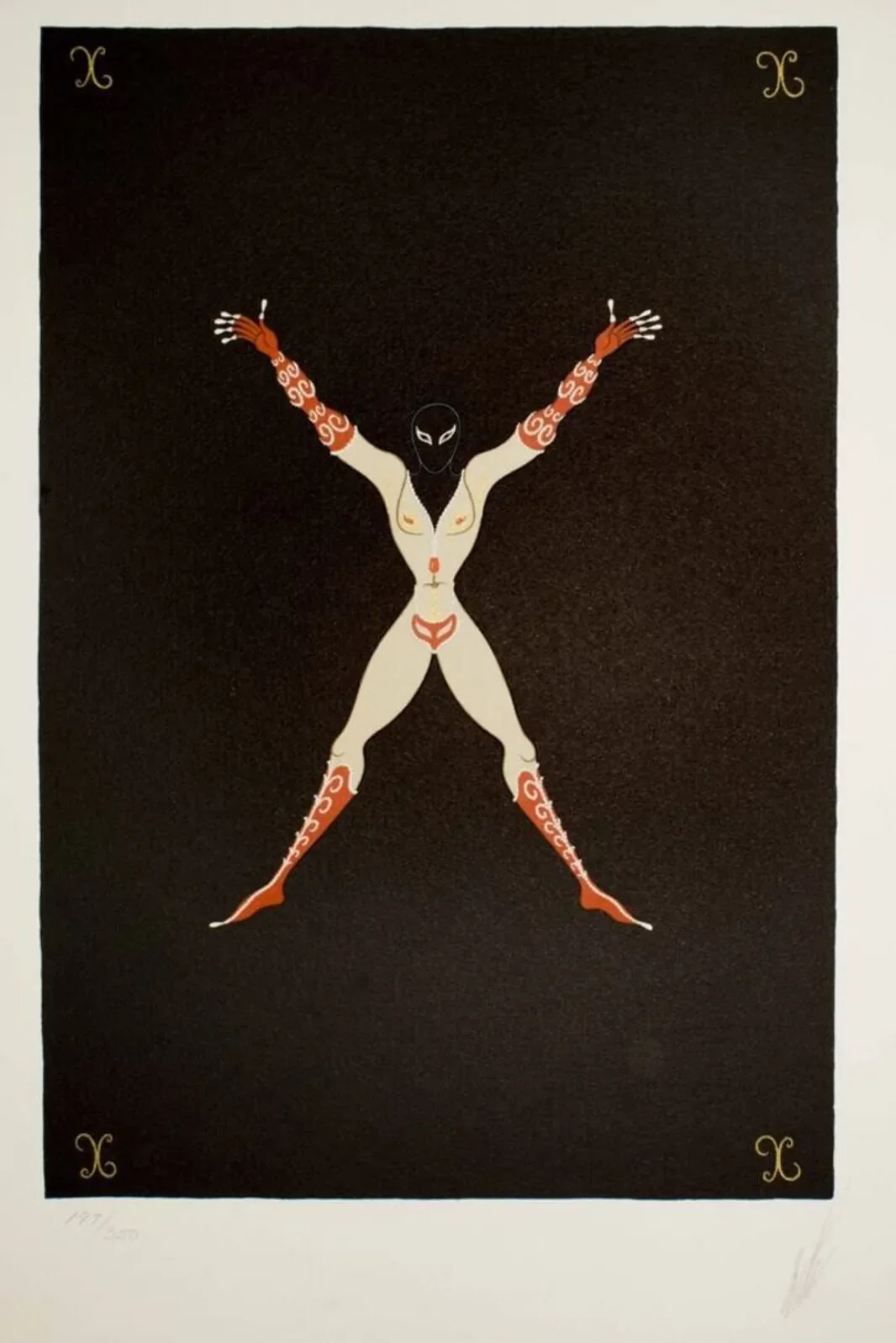
Letter X - Erté, 1976. Photo courtesy: Artsy
EP: You centre a lot of your work around fashion. What is a look you remember drawing that you fell in love with?
SH: One of the largest illustrations I’ve ever created was a 70x100cm graphite pencil drawing of Daphne Guinness in 2023. It was created from a project in which I was on set with Nick Knight, illustrating looks from Daphne’s private couture collection that she was wearing for a music video. I created initial gestural sketches on the day and then went away to work on more detailed larger pieces in my own studio. I love the pose I came up with, the gradient shadow of the fabric bellowing around her, the hands, the side profile, the details of the finger wave hair under this transparent head piece. Its a piece that for me has stood the test of time. Often as time goes on and artists create newer work, its easy to look back and cringe, but I’m still very proud of this one.
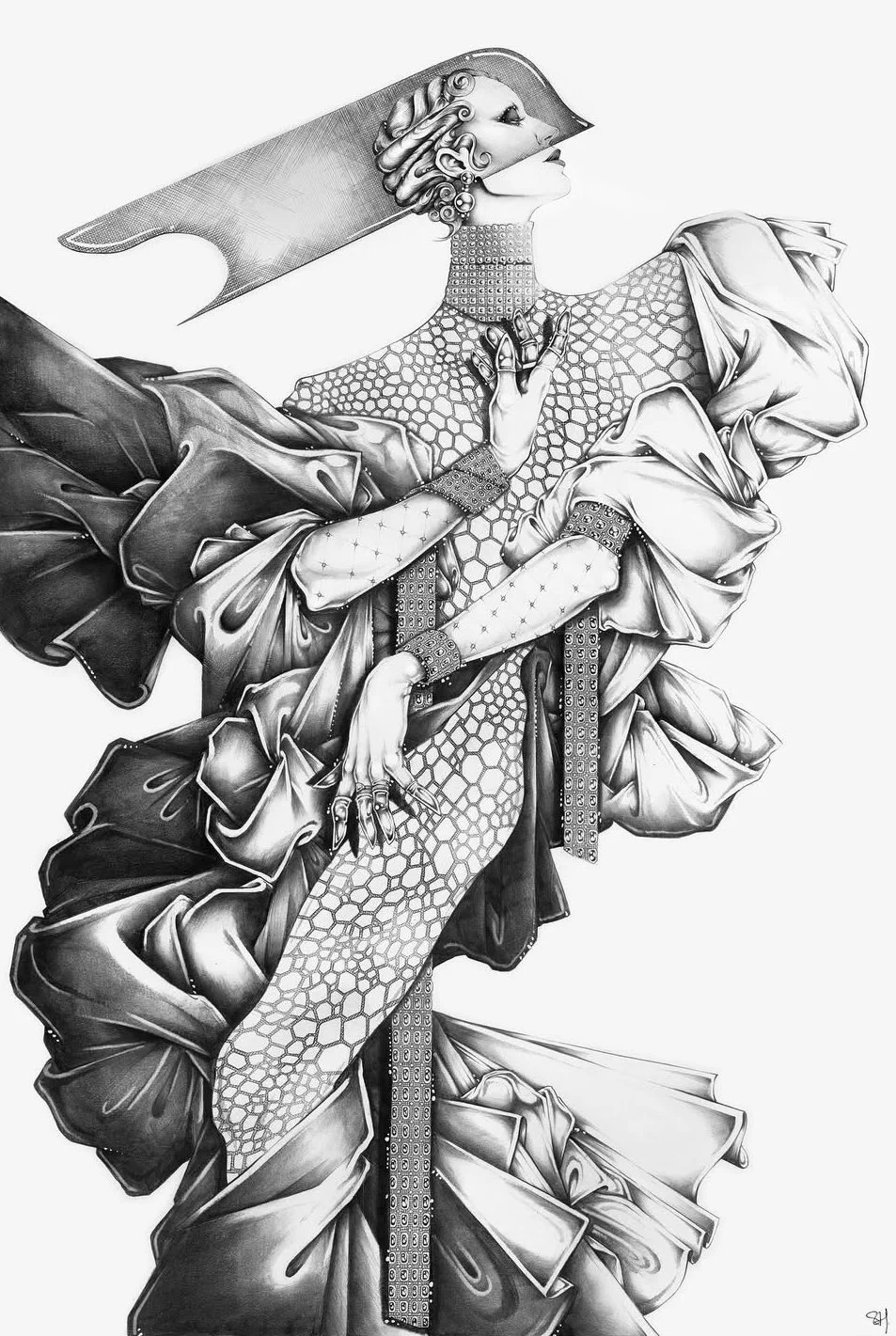
Drawing Daphne - Samuel Harrison, 2023. Photo courtesy: Samuel Harrison.
EP: Who are your current favourite fashion designers?
SH: Matières Fécales are doing some really exciting things on the runway. Daniel Roseberry is extraordinary at Schiaparelli. John Galliano is John Galliano.
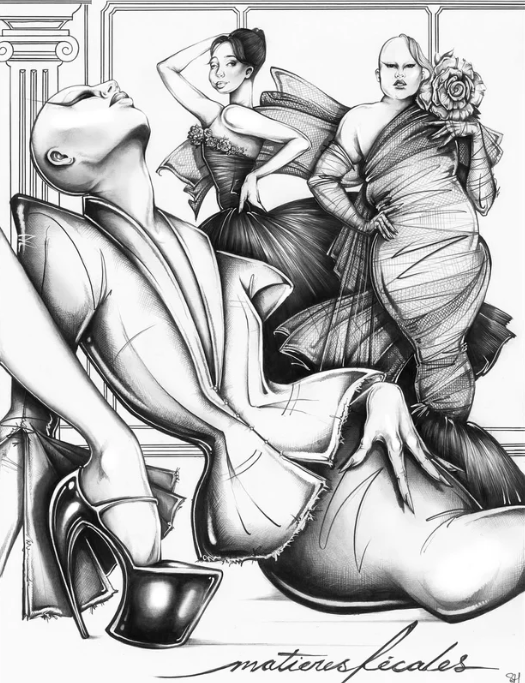
Matières Fécales Illustration - Samuel Harrison, 2025. Photo courtesy: Samuel Harrison Art
EP: What is a goal you are currently working towards?
SH: I’ve recently been illustrating in newer, less established fashion designer’s studios and I’d love to do more of this. Fashion can be a very unattainable world and it can seem hard to access, so its nice to be able to connect with new creatives, see their designs in person and chat to them while they allow me the privilege to draw some of their pieces. I usually gift them some of my original sketches from the day as a ‘Thank You’ and produce some social media content that hopefully showcases their designs to another audience. In the past year I’ve had the opportunity to visit both Brian De Carvalho and Mario Marquina’s studios in London, drawing their garments on mannequins as well as trying them on myself. This has led to the creation of two very special self portraits, which can be a tricky topic for me as the process of drawing myself can seem very alien. Its refreshing to create a portrait with the focus also being the celebration of a designer’s garment and not just about myself, it relieves the pressure.
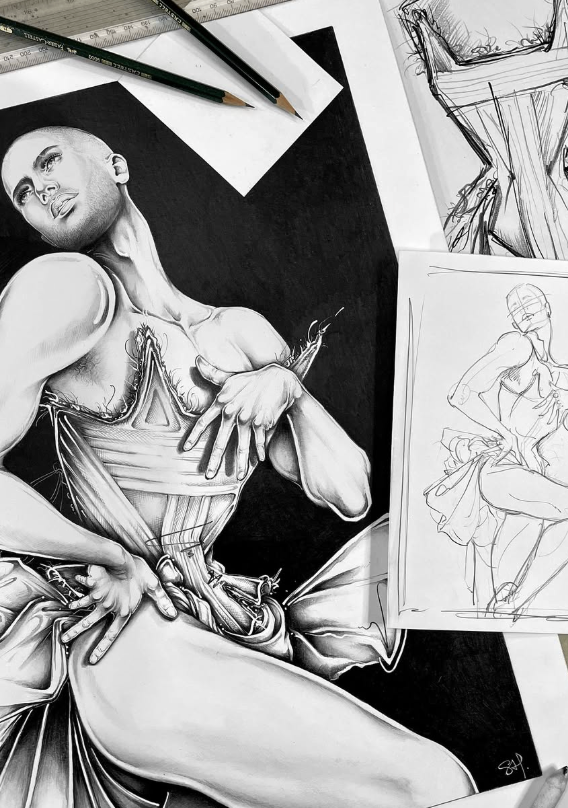
A (kind of) Self Portrait wearing Brian De Carvalho - Samuel Harrison, 2025. Photo courtesy: Samuel Harrison.
EP: What does a perfect day/night in your studio look like?
SH: A Goldilocks temperature…not too hot, not too cold. Music playing while my brain needs to think for the initial sketches and ideas. Then when I begin the longer process of getting the detailed pencil portion down (preferably at night when the world is quiet and I’m less aware of time) I transition into documentaries or lectures about ancient history while I work.
EP: If you could collaborate with one artist, who would it be?
SH: I’d love to collaborate with a team of weavers and turn my work into a large complicated tapestry. Its something I wouldn’t even know where to begin, but I think a large complicated scene of fashion and homoerotic figures would be amazing. Something like The Boar and Bear Hunt from the Devonshire Hunting Tapestries.
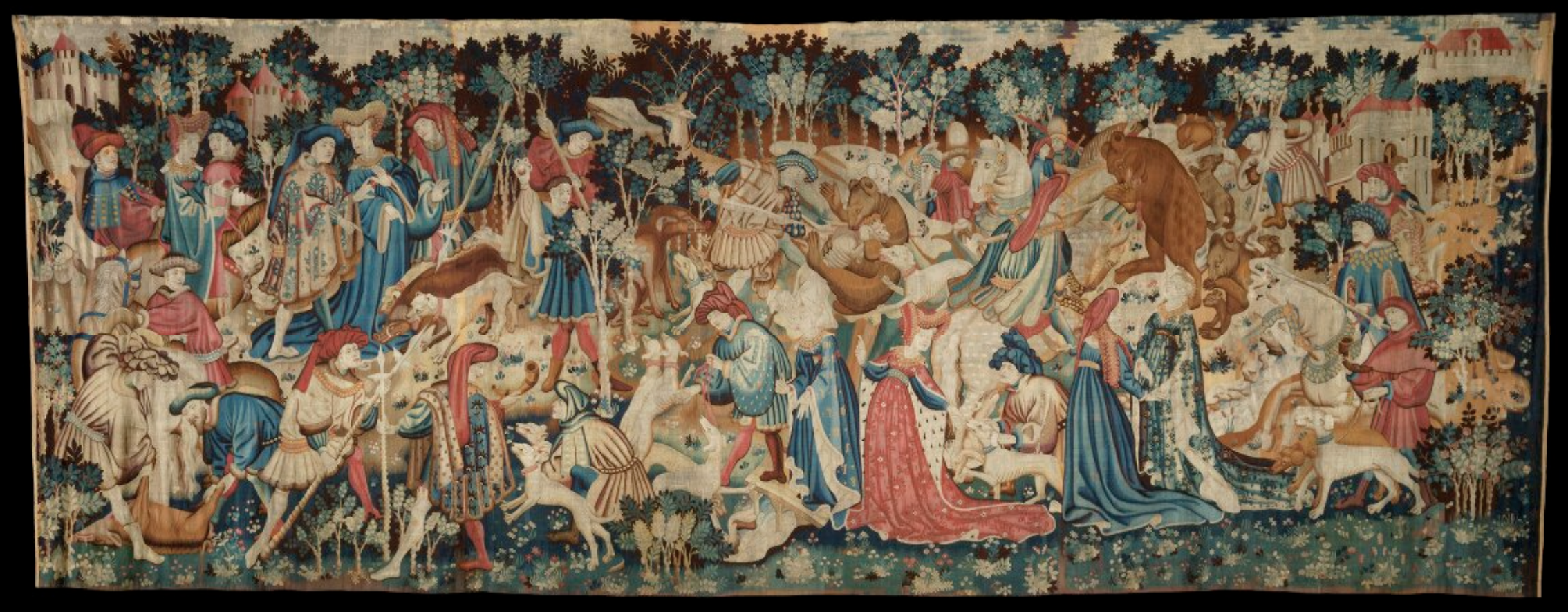
The Devonshire Hunting Tapestry: Boar and Bear Hunt - attributed to Arras, France, c. 1425-1430. Photo courtesy: V & A Museum
EP: If you could only draw for one fashion house for the rest of your career, which would it be?
SH: I’d go back in time and draw John Galliano at Dior from the late 90s to early 2000s.
EP: What is your favourite gallery or museum currently that you recommend people visit?
SH: When it comes to London its always been the V&A, I love the architecture of the building, I could never get bored discovering new things in their permanent collection, and the fashion exhibitions they host are incredible. I’m really looking forward to their Schiaparelli show later this year. Since entering my 30’s I’ve began a tradition of doing a solo trip to a different city each year for my birthday and exploring all the galleries and museums they have to offer. So far I’ve done Paris and Vienna and loved both! I haven’t quite decided where I’ll be this year.
EP: Finally, I’d like to ask—what is your favourite colour?
SH: Black.
Disclaimer: The views, thoughts, and opinions expressed in MADE IN BED are solely those of the individual authors and not those of MADE IN BED magazine or of Sotheby’s Institute of Art.