Alice Huang in Conversation with Artist Thomas Ngan
At a gallery unveiling, attention is often framed as immediacy: a first glance, a first impression, a first photograph. Yet what lingers is rarely the loudest image; it is the after-image—what returns in memory once the room has emptied. Following the 26 February unveiling of Edna (2 m × 6 m)—a monumental new painting created during his London residency with 3812 Gallery—Hong Kong-based artist Thomas Ngan spoke to MADE IN BED about relief, intention, the discipline of saying goodbye to a finished work, and why the ‘brightest part’ of a painting might sit just outside the frame.
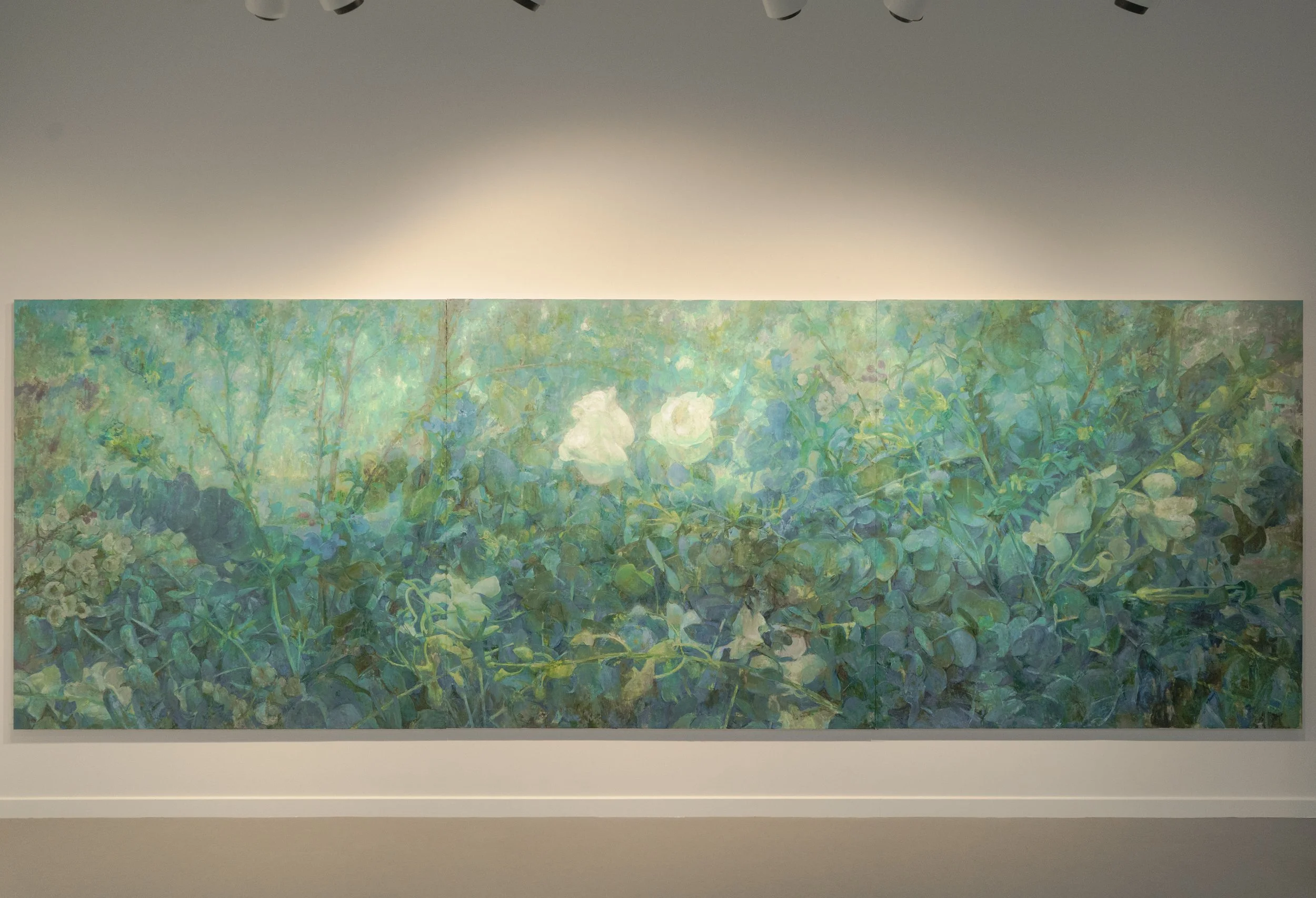
Thomas Ngan, Edna, 2026. Oil on canvas. 2 m × 6 m. Photo courtesy: 3812 Gallery.
Before the Unseen positions paintings as a staged encounter between the visible and the invisible: roses acting as anchors, darkness as a necessary counterweight, and atmosphere as a form of belief. Ngan’s work resists closed narratives; instead, it operates as a directional field—guiding viewers towards something that resists easy naming: ‘the unseen’.
‘Keep your eyes on that light amidst the unknown, knowing that one day when the fog is cleared, you will find yourself in the garden, surrounded by grace.’—Thomas Ngan
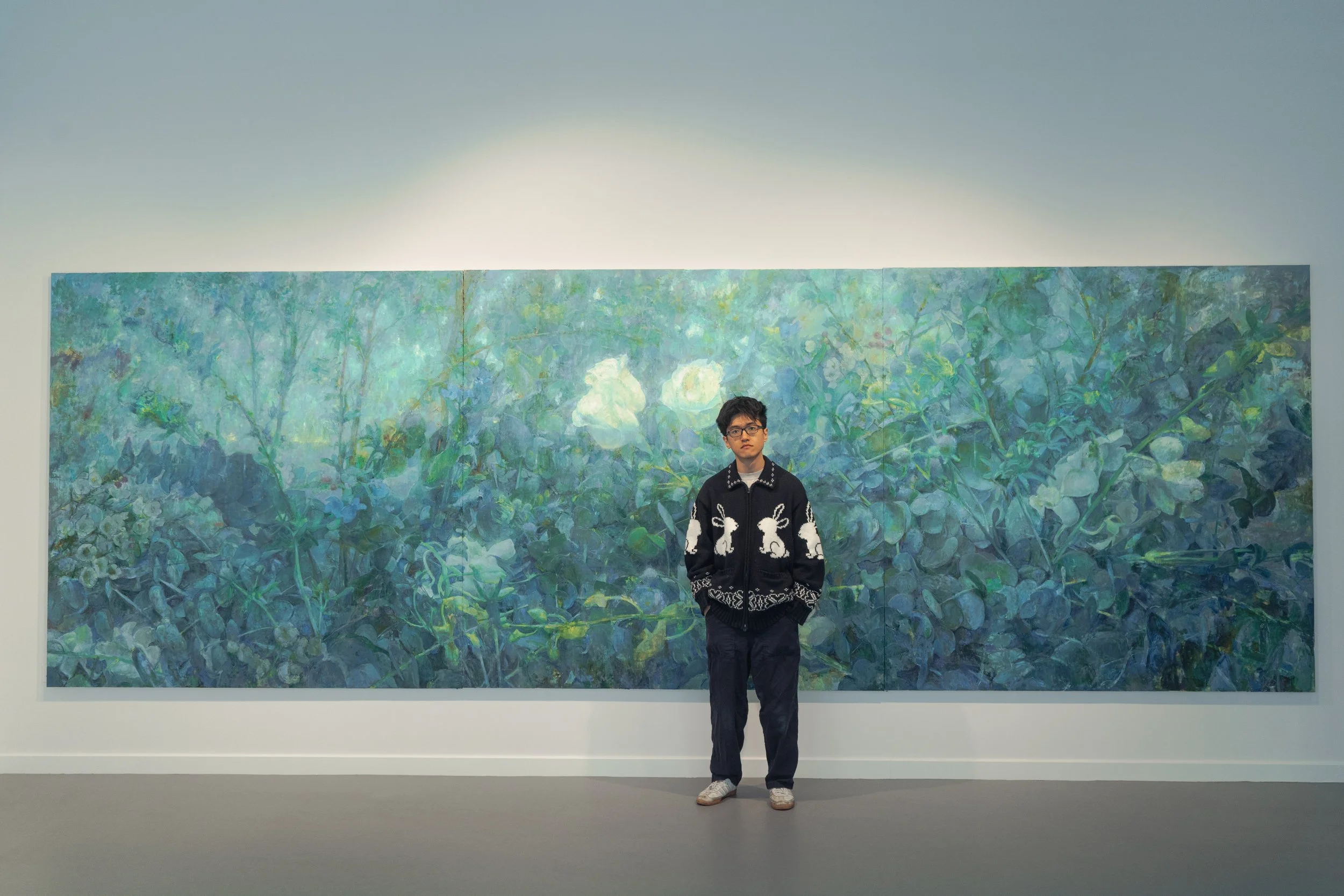
Thomas Ngan, Edna, 2026. Oil on canvas. 2 m × 6 m. Photo courtesy: 3812 Gallery.
Alice Huang (AH): After the unveiling last night, what is one moment or reaction that stayed with you the most?
Thomas Ngan (TN): It's the people. And one of the visitors, Eugene, who has visited twice already, came again to support me yesterday. I just felt really thankful. It's friends like him that make me appreciate more of what I have and keep moving forward. That’s been a huge part of this residency: meeting wonderful people and having thoughtful conversations. People are a huge part of what stays in your memory.
AH: If you had to summarise the unveiling in one sentence, what would it be?
TN: A moment of relief. I was stressed from the moment I landed in London. I came to the gallery and felt like I had to do this and do that, finish the painting, worry about expenses, random obstacles, just one thing after another. I didn’t want to disappoint the gallery as they’ve been really supportive. I didn’t feel relieved until last night, when it was finally over. It felt like: it’s done, mission accomplished. So last night was the first real exhale.
AH: When you look at the monumental work now that it’s finished, what is the first feeling that comes up?
TN: It feels natural—like sitting in a park, drinking a latte, looking at the scene. It doesn’t feel striking to me. It feels peaceful and comfortable. I spent well over three hundred hours on it, so I know every inch. I’m so familiar with the conflicts inside it that they don’t scream at me. They just exist. We coexist in peace.
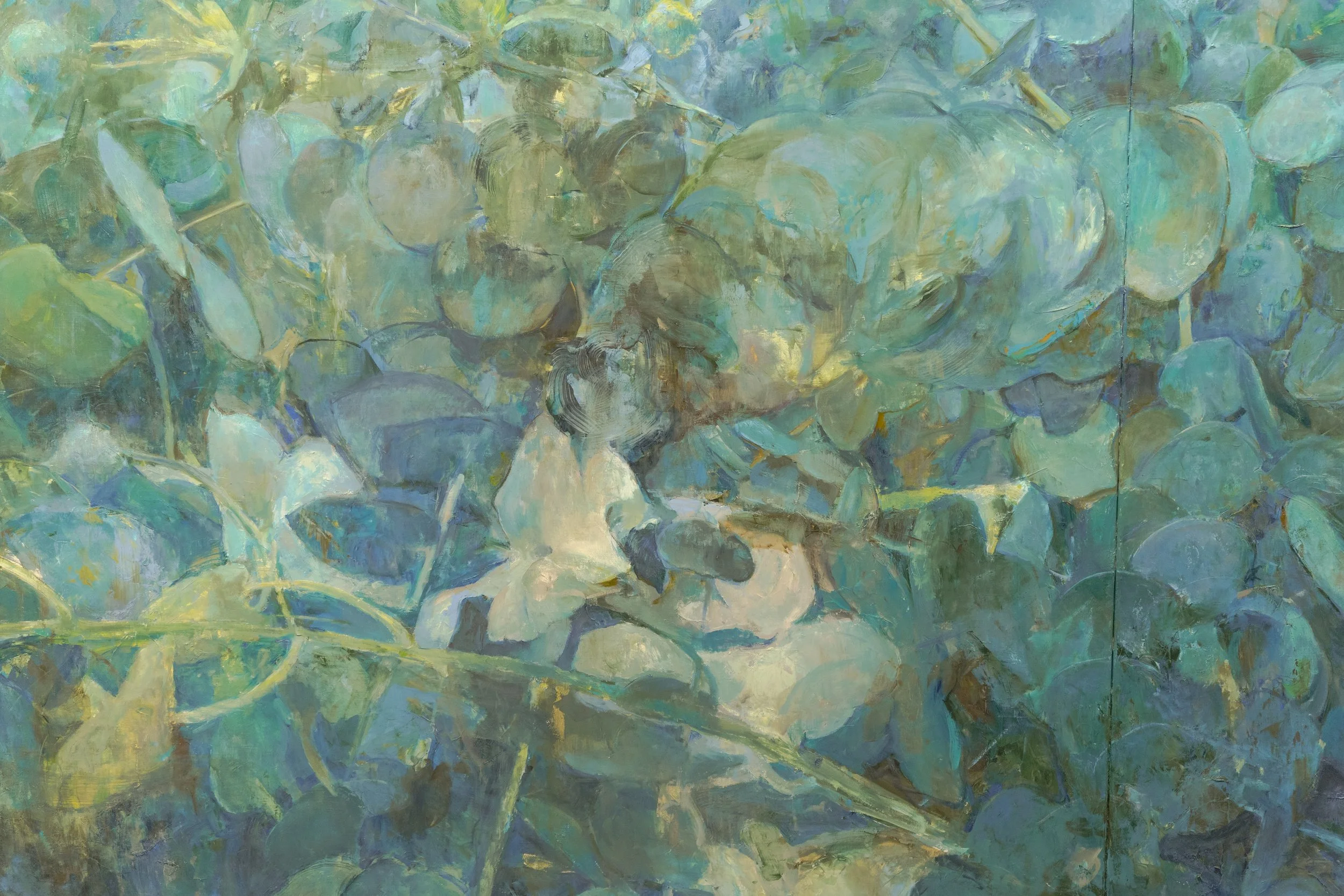
Thomas Ngan, Edna, 2026. Oil on canvas. 2 m × 6 m. Photo courtesy: 3812 Gallery.
AH: What was the hardest decision to make while painting it?
TN: It’s one challenge after another—basically a giant puzzle. The bigger difficulty is accepting that conflict can survive with meaning. It’s not about making everything perfectly peaceful. It’s being at peace with the work not being perfectly peaceful. And honestly, sometimes the hardest part is saying: it’s finished. It’s the moment of saying goodbye. From that point, it becomes the past.
AH: So when do you decide a work is finished?
TN: When the intention and the execution align. Each painting has its own purpose. If it serves its purpose, I’ve done my job and it’s done its job. But the purpose can change along the way—we discover things while we make.
AH: In the language of ‘visible’ and ‘invisible’, where is the ‘unseen’ in this work?
TN: One simple way to describe it is through light. Sometimes the brightest area in a painting is painted in a way that implies we are not truly seeing how bright it is. And then you realise: the brightest thing is outside the painting. If you create the impression that the brightest part is outside the frame, people understand the most meaningful part might also be outside the frame. I don’t have a formula, but I do have the intention.
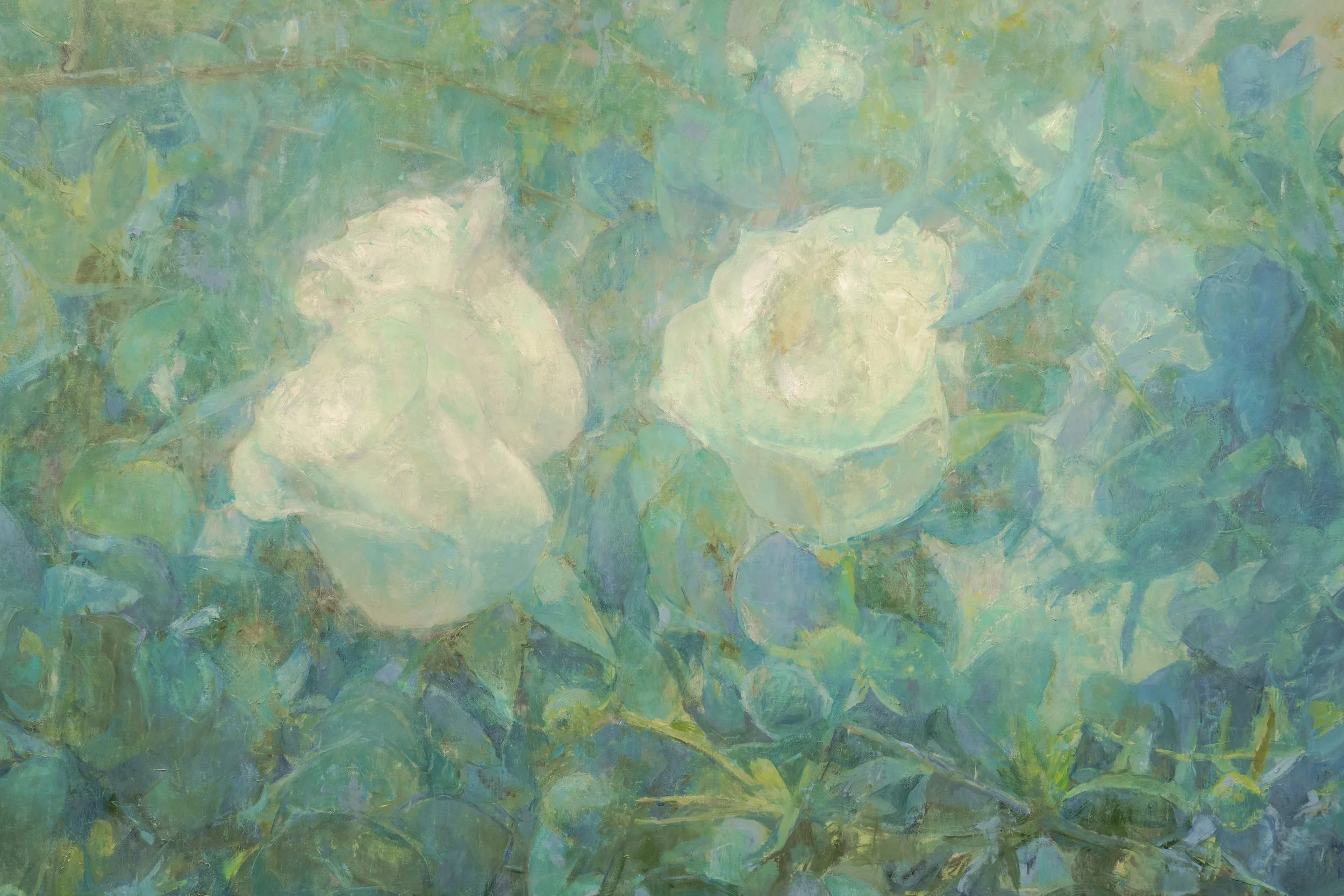
Thomas Ngan, Edna, 2026. Oil on canvas. 2 m × 6 m. Photo courtesy: 3812 Gallery.
AH: Roses recur so consistently across your work. Why roses?
TN: The bright rose is a good anchor. I let the leaves become chaotic and shadowy when they’re not under the light of the rose, and I let the rose act like a light source. For me, hope requires uncertainty. We can’t have everything we want; otherwise we’d be hopeless. The dark is necessary for hope to exist.
AH: You have visited the Natural History Museum more than once. What draws you there?
TN: The minerals and rocks. There’s so much in there it could take weeks to appreciate properly. There’s a certain sequence that is applicable across platforms—sometimes it appears as the golden ratio, sometimes the silver ratio. That sequence shows up in art, literature, music…and it appears in nature.
AH: Finish this sentence: ‘The unseen is…’
TN: The unseen is the hope that guides you to love.
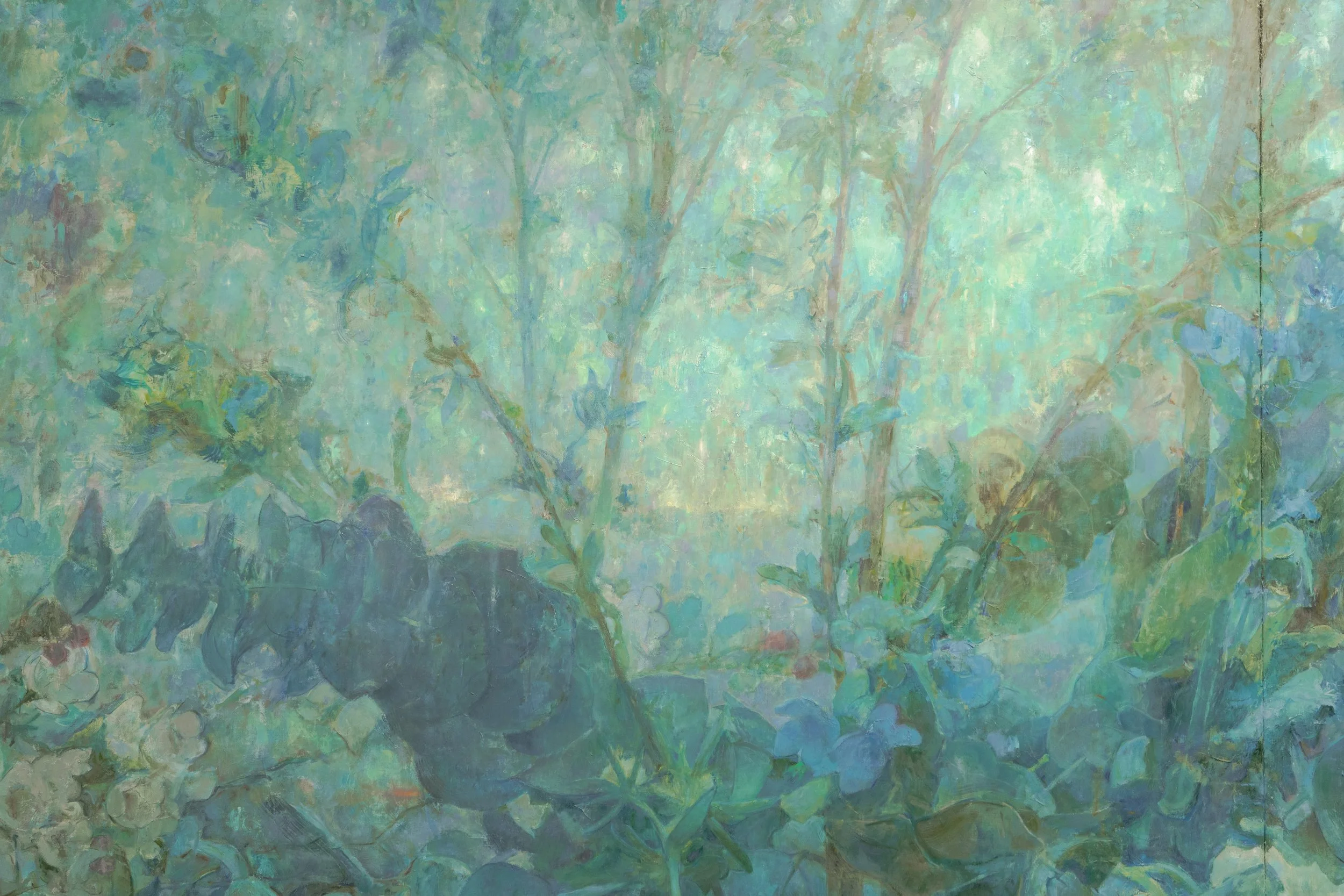
Thomas Ngan, Edna, 2026. Oil on canvas. 2 m × 6 m. Photo courtesy: 3812 Gallery.
Calvin Hui, Co-founder and Chairman of 3812 Gallery who is also the curator of this exhibition, remarks, ‘I am deeply honoured to present Thomas's remarkable works to the UK art market. Before the Unseen not only showcases his courageous journey out of his comfort zone but also marks a significant transitional phase in his artistic career.’
Before the Unseen (16 January – 7 March 2026) coincided with the launch of the inaugural 3812 Artist Residency Programme at The Whiteley, Queensway. Following Ngan’s exhibition, 3812 Gallery will present Illuminated Heart—Hsiao Chin’s first large-scale solo exhibition in London since 1966 (14 March – 23 April 2026).
Many thanks to Thomas Ngan and 3812 Gallery for their time and support in facilitating this conversation on behalf of MADE IN BED. To learn more about Thomas Ngan and 3812 Gallery, visit 3812 Gallery and follow Thomas Ngan on Instagram.
Alice Huang
Guest Writer, MADE IN BED
Disclaimer: The views, thoughts, and opinions expressed in MADE IN BED are solely those of the individual authors and not those of MADE IN BED magazine or of Sotheby’s Institute of Art.